We (the people) won!

WWALS helped by writing a letter to GA PSC, reading it to them, and asking Commissioner Everett to vote for it. He did, and Georgia Power is now required to buy more than twice as much solar power. Details here.
-jsq

We (the people) won!
WWALS helped by writing a letter to GA PSC, reading it to them, and asking Commissioner Everett to vote for it. He did, and Georgia Power is now required to buy more than twice as much solar power. Details here.
-jsq
Folks,
Tomorrow the PSC decides on requiring Georgia Power to add more
 solar power. The swing vote is
H. Doug Everett, Commissioner for
District 1, which includes all of our watersheds.
He went to high school in Sylvester, which is in the Little River
watershed, and he is on the board of the Georgia Agrirama
Development Authority.
You can contact him through the above web page, or call him at his
PSC office: (800) 282-5813.
solar power. The swing vote is
H. Doug Everett, Commissioner for
District 1, which includes all of our watersheds.
He went to high school in Sylvester, which is in the Little River
watershed, and he is on the board of the Georgia Agrirama
Development Authority.
You can contact him through the above web page, or call him at his
PSC office: (800) 282-5813.
You probably remember last month the WWALS board
sent a letter
 to
the Georgia Public Service Commission asking for more solar and wind
and less water-sucking baseload power plants.
Garry Gentry
read the letter to the PSC.
More background
here.
to
the Georgia Public Service Commission asking for more solar and wind
and less water-sucking baseload power plants.
Garry Gentry
read the letter to the PSC.
More background
here.
Here’s your chance to help make more solar happen for Georgia.
-jsq
The Southern Georgia Regional Commission invites you to contact them about agricultural runoff. WWALS is concerned with how industrial farming and clear cutting affects both water quality and quantity in our watershed.
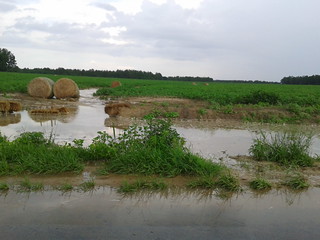 The pictured example of runoff from a cotton field was in Berrien County
yesterday.
While rain was pouring down, it ran half way across the road, and
two cars wrecked.
Once it gets across the road, either over it or through the culvert,
it runs into the Withlacoochee River.
As Pesticide Action Network reminds us,
“Conventionally grown cotton uses more insecticides than any other single crop.”
The pictured example of runoff from a cotton field was in Berrien County
yesterday.
While rain was pouring down, it ran half way across the road, and
two cars wrecked.
Once it gets across the road, either over it or through the culvert,
it runs into the Withlacoochee River.
As Pesticide Action Network reminds us,
“Conventionally grown cotton uses more insecticides than any other single crop.”
Abbie Fentress Swanson wrote for GPB 6 July 2013, What Is Farm Runoff Doing To The Water? Scientists Wade In,
Agriculture is the nation’s leading cause of impaired water quality, according to the U.S. Environmental Protection Agency.
Continue reading
Kind of high (movie):

Picture and video by John S. Quarterman for WWALS Watershed Coalition (WWALS),
Berrien County, Georgia, 8 July 2013.
-jsq
Dear WWALS Watershed Friend,
The WWALS Watershed Coalition has had an excellent first year. We have had many people join to become dues-paying members, many excellent speakers and many excellent outings on our local rivers.
It is my pleasure to let you know that we will have our first annual meeting along with the election of three board members at our July 10th meeting.
If you are a member, you should have received a letter already informing you of the upcoming meeting.
If you aren’t a member yet, you are welcome to attend the annual meeting and become a member.
Our annual meeting will be Continue reading
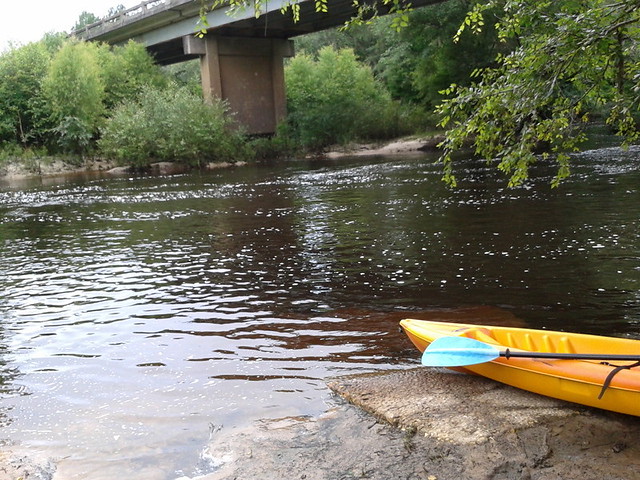
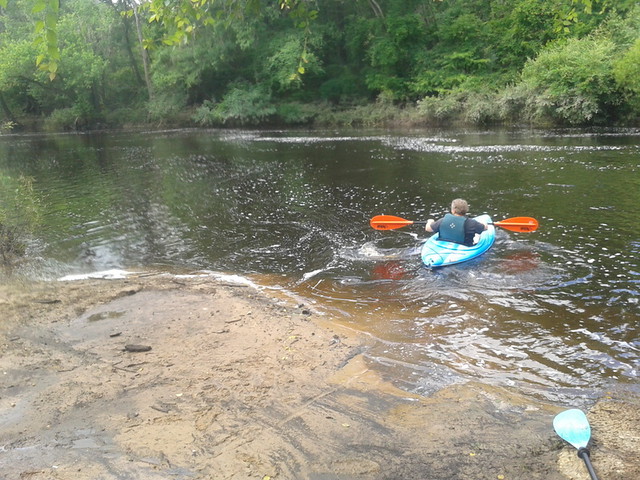
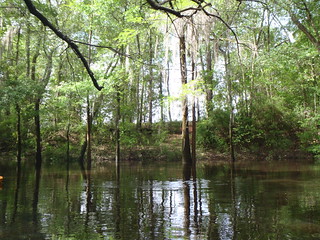
A few pictures from today’s WWALS Outing on the Withlacoochee River from Clyattville-Nankin Road to GA 31, with 12 people in 8 boats (4 kayaks, 4 canoes).
Gage height, US 84 Quitman: 3.25 feet (86.75 feet NAVD 1988).
Withlacoochee River at Clyattville-Nankin Landing:
Heather sets out:
The June WWALS outing is from Clyattville-Nankin Road to Horn Bridge on
 Madison Highway (GA 31) on the Withlacoochee River.
Meet at the Clyattville-Nankin Road putin at 9AM, put in at 10AM, Saturday, 22 June 2013.
Join the
facebook event if you like.
See you there!
Madison Highway (GA 31) on the Withlacoochee River.
Meet at the Clyattville-Nankin Road putin at 9AM, put in at 10AM, Saturday, 22 June 2013.
Join the
facebook event if you like.
See you there!
Update 20 June 2013: How are we getting back to our vehicles with this trip? We’ll deposit all the boats at the put-in (Clyattville-Nankin Road), take most of the vehicles down to the take-out (Horn Bridge on Madison Highway aka GA 31), carpool in a few vehicles back to the put-in, and float down the river.
Tom Baird described this nine-mile two-hour trip as:
The section includes where Clyatt Mill Creek enters, a truly fun set of rapids (two drops) at the Ga – Fla border, a very nice Second Magnitude Spring (that I have yet to find the correct name), the remains of the enormous abandoned trestle over the river of the Georgia & Florida Railroad,or Ole God Forsaken as it was nicknamed, the ghost town of Olympia on the Georgia side, and several Indian quarry sites. It is along this section that the river cuts deeply enough that the banks switch from sand banks to limerock cliffs. Paddle distance is about 9 miles, so a little over two hours paddling time. There are plenty of places to stop and look around.
There are shoals right at the state line, so beware, esp. if you’re in a canoe. The book Canoeing and Kayaking Georgia, by Susanne Welander, Bob Sehlinger, and Don Otey (2004) says: Continue reading
Approved 12 June 2013 by unanimous vote of the WWALS board, Dave has mailed a signed copy to the Georgia Public Service Commission, and I will go read it to the PSC Tuesday morning at 10 AM 18 June 2013, at their hearing about
Docket 36498, Georgia Power Company’s 2013 Integrated Resource Plan and Application for Decertification of Various Unitsand
Docket 36499, Application for the Certification of Amended Demand Side Management Plan
Y’all come! -jsq
From: WWALS Watershed Coalition, Inc.
3338 Country Club Road #L336
Valdosta, GA 31605
12 June 2013To: Georgia
Public Service Commission
244 Washington Street, SW
Atlanta GA, 30334-9052
Dear Public Service Commissioners and Staff,
The recent rains have swollen our blackwater rivers, Withlacoochee, Willacoochee, Alapaha, and Little, under our longleaf pines and Spanish-moss-covered oaks, and filled up the tea-colored tannin waters in our frog-singing pocosin cypress swamps here in central South Georgia. But that was only a dent in our protracted drought that ranges from mild to extreme, with projections not much better.

We do not need more traditional big baseload power plants gulping down our river or aquifer water when solar and wind power use far less, and those renewables are now at grid parity with coal, natural gas, and nuclear.
Power plants are thirsty, as the Union of Concerned Scientists pointed out in a 2011 report, “Freshwater Use by U.S. Power Plants: Electricity’s Thirst for a Precious Resource”.
Much of the water used to cool power plants evaporates, and is Continue reading
WWALS Watershed CoalitionPDF of Dissolved Oxygen Dynamics in the Upper Suwannee River Basin by Prof. George Vellidis, Crop & Soil Sciences Dept., University of Georgia, Tifton, GA. He used these slides when he discussed the dynamics of dissolved oxygen concentrations in WWALS waterways at the 8 May 2013 WWALS board meeting.

More later.
-jsq