Category Archives: VWW

FL Sen. Nelson to EPA about Valdosta sewage and response

Here is a letter from Florida Senator Bill Nelson to the EPA about the Valdosta wastewater situation, and the EPA’s response, which was underwhelming.

A suggestion: say what it is you’d like the EPA, GA-EPD, FDEP, etc. to actually do. And what I’d suggest is get them all to fund and implement regular, frequent, closely spaced, water quality monitoring along all the rivers in the Suwannee River Basin. That way we’d know where pollution is coming from, we’d be able to calibrate what cities including Valdosta say from their own monitoring, and we’d have baselines to compare to.

Sen. Bill Nelson to EPA

Continue reading

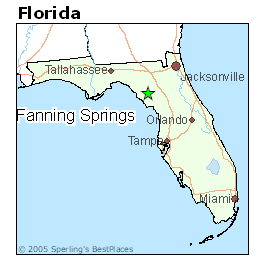
Protection of the Suwannee River against Valdosta Sewage –City of Fanning Springs, FL 2017-04-11

Not just for all seven downstream Florida counties anymore: the City of Fanning Springs has also passed a resolution asking the Florida governor to help stop Valdosta wastewater spills. Maybe Valdosta will pay attention this time.

The Valdosta City Council and Mayor didn’t seem to understand when I used the Suwannee County resolution to draw attention to the part about:

“which again resulted in the Florida Department of Health issuing public health advisories warning the public of wastewater contamination in the Withlacoochee River and portions of the Historic Suwannee River, which resulted in warnings being posted at all public access areas along the rivers stating that the rivers were not safe for recreational use and every precaution should be taken to avoid any contact with the river;”

Maybe I should have tried this pithier part at the end: Continue reading

Requesting protection of Suwannee River from Valdosta wastewater –Levy BOCC 2017-03-07

Levy BOCC passed a resolution Tuesday much like the Suwannee BOCC resolution, but adding instructions to transmit it to a wide range of Florida and U.S. elected officials and agencies.

If you’re in Valdosta today, the City Council meets at 5:30 PM; you can join us in talking to them about this, or send them email.

Thanks to Jessica Berryhill, Administrative Assistant I, Board Administration, Levy Board of County Commissioners, for the PDF.

RESOLUTION 2017-008

A RESOLUTION BY THE BOARD OF COUNTY COMMISSIONERS OF LEVY COUNTY, FLORIDA REQUESTING THE PROTECTION OF THE HISTORIC SUWANNEE RIVER IN NORTH FLORIDA.

WHEREAS, Levy County is located in North Central Florida and is bordered by the Historic Suwannee River on its western side; and

WHEREAS. the Historic Suwannee River is one of the most widely known and recognized river system in the world; and Continue reading

Water issues at Valdosta City Council 2017-03-09

A rare agenda with nothing about water on it does have this, “6. Citizens to be Heard”, which people from anywhere can use to talk about water issues such as sewage and its effects on the Withlacoochee, Alapaha, and Suwannee Rivers all the way to the Gulf, coal ash from TVA and Florida, PCBs, and Superfund wastewater in the landfill in Lowndes County, which is a quarter mile upstream from the Withlacoochee River and in a recharge zone for the Floridan Aquifer.

When: 5:30 PM, Thursday, March 9, 2017

Where: Council Chambers, City Hall, 216 E Central Avenue, Valdosta, GA 31601, 30.832961, -83.277471
Too far? Call them up or send them email.

Event: facebook


Photo: Michael Rivera Creative Commons Attribution-Share Alike 3.0 Unported License.

What: Continue reading

Ensure that Valdosta, Georgia eliminates the dumping of raw sewage into our rivers –Madison BOCC 2017-02-08

Apparently Madison County was the first in Florida to call for state help to resolve the Valdosta sewage situation, back on February 8, 2017.

Followed by Hamilton and Suwannee Counties, both on February 21, 2017, and the other three four downstream Florida counties seem to have it on their agendas. After all, people downstream have been complaining about this since at least 2013, and the 2009 old Withlacoochee Wastewater Treatment Plant (WWTP) overflow was one of the reasons for the founding of WWALS in 2012.

In the BOCC packet for the Wednesday March 8, 2017 Regular Meeting of the Madison County, Florida Board of County Commissioners, and see also PDF of just those two pages.

RESOLUTION 2017-02-08

A RESOLUTION BY THE BOARD OF COUNTY COMMISSIONERS OF MADISON COUNTY, FLORIDA ASKING FOR THE PROTECTION OF THE HISTORIC SUWANNEE RIVER AND THE WITHLACOOCHEE RIVER IN NORTH FLORIDA.

WHEREAS, Madison County is located in North Central Florida and is bordered by the State of Georgia to the North and the Withlacoochee River and Historic Suwannee River to the East; and

WHEREAS, the Withlacoochee River starts its journey in Valdosta, Continue reading

Ask Florida governor to intervene about Valdosta wastewater –Suwannee BOCC 2017-02-21

The Suwannee County BOCC resolution is even more explicit than the Hamilton County one.

Thanks to Eric Musgrove, Clerk, Suwannee BOCC, for the PDF.

RESOLUTION 2017-26

A RESOLUTION BY THE BOARD OF COUNTY COMMISSIONERS OF SUWANNEE COUNTY, FLORIDA REQUESTING THE PROTECTION OF THE HISTORIC SUWANNEE RIVER IN NORTH FLORIDA.

REQUESTING THE PROTECTION OF THE HISTORIC SUWANNEE RIVER IN NORTH FLORIDA WHEREAS, Suwannee County is located in North Central Florida and is bordered for 100 miles by the Historic Suwannee River on its north, west and south sides; and

WHEREAS. the Historic Suwannee River is one of the most widely known and recognized river system in the world; and

WHEREAS, the Withlacoochee River (North) begins at its headwaters in South Georgia, and flows into the Historic Suwannee River at Suwannee County’s northwestern border area; and

WHEREAS, Suwannee County and each Continue reading

Hamilton County Florida Valdosta wastewater resolution asks Georgia and Florida governors to step in 2017-02-21

Hamilton County, Florida is not pleased with Valdosta’s sewage, and has asked the states of Georgia and Florida to step in.

Thanks to Kristy Morgan, Chief Deputy Clerk/Administrative Assistant, Hamilton County Clerk’s Office, for the PDF.

RESOLUTION 2017-01

A RESOLUTION BY THE BOARD OF COUNTY COMMISSIONERS OF HAMILTON COUNTY, FLORIDA DEMANDING PROTECTION OF THE WITHLACOOCHEE RIVER, THE ALAPAHOOCHEE RIVER, THE ALAPAHA RIVER AND THE SUWANNEE RIVER FROM THE ILLEGAL DISCHARGE OF RAW SEWAGE BY THE CITY OF VALDOSTA, GEORGIA

WHEREAS, WHEREAS, the Withlacoochee River forms the Western boundary of Hamilton County, Florida from the Florida/Georgia state line until its juncture with the Suwannee River; and

WHEREAS, the Withlacoochee River provides recreational and economic benefits to the citizens of Hamilton County and others; and

WHEREAS, citizens of Hamilton County depend on clean water from the Withlacoochee River watershed for activities of daily life as well as for agricultural, business, and recreational purposes; and

WHEREAS, the health and welfare of many Hamilton County citizens is directly harmed by any degradation of the quality of water in the Withlacoochee River and its watershed; and

WHEREAS, the City of Valdosta, Georgia over the past several years has Continue reading

Only Valdosta and Tifton spilled sewage in Georgia in Suwannee River Basin in January 2017

GA-EPD’s Atlanta office sent their entire sewage spill database for January 2017 in response to an open records request from WWALS. For the Suwannee River Basin, I see only the known ones by Valdosta, plus a spill from Moultrie’s Carlton Woods Lift Station into the Ocholockonee River, with 36000 gallons, which matches the amount we got directly from Moultrie. That Ochlockonee spill is still not in the Suwannee River Basin.

The Georgia Environmental Protection Division (GA-EPD) Southwest office in Albany handles the other sewage treatment operations in the Suwannee River Basin in Georgia, and that Albany office already told us by telephone that they had no reported spills other than the Tifton spill into the New River which I had gotten directly from Tifton. So I think we can conclude there were no other sewage spills into the Suwannee River Basin in Georgia in January 2017 other than the ones from Valdosta and Tifton.

Interestingly, Valdosta with its 2.2 million gallon Withlacoochee Wastewater Treatment Plant (WWTP) leak (and three manhole spills) was not the winner. Continue reading

Bad bill HB 316 SB 116 would take away stormwater permit revenue

If you want the Valdosta wastewater situation to be worse, let HB 316 SB 116 pass, taking away revenue for Valdosta or anybody upstream or down to control stormwater.

It turns out HB 316 was apparently from 2009.

The stormwater bill before the Georgia legislature this year (2017) is SB 116.

Here are the current GAWP talking points about SB 116, which you may notice also mention HB 316, which leads me to believe SB 116 is just HB 316 back again under another name.

Please Oppose Senate Bill 116
Georgia Association of Water Professionals

Senate Bill 116 would exempt “water-neutral sites”, defined as those properties designed to control runoff form a 25 year, 24-hour storm event in a manner consistent with the Georgia Stormwater Management Manual (GSMM), from paying stormwater user fees charged by local governments or authorities that have established stormwater utilities. Water-neutral sites, as defined in this bill, still discharge stormwater to the local drainage system, which the local government or authority is legally responsible for operating and maintaining.

Implications of HB 316: We ask you to consider the following far-reaching implications of the bill.

  1. Local Control. The State of Georgia should not interfere in how a local government operates a utility or charges its customers. This would be equivalent to the State saying how a local utility could charge (or not charge) for water or sewer services. If the General Assembly exempts “water-neutral properties” from paying fees for stormwater services, could they next exempt a defined class of customers from paying local water and sewer fees in the future?
  2. Economic Impact on Local Governments. This bill could have a devastating impact on local governments who are required to operate and maintain stormwater drainage systems for the public good and to protect the health, safety and welfare of their communities. “Water Neutral” properties are not actually water neutral because they still discharge stormwater runoff to the local drainage system thereby causing an impact. A local government still must bear the cost of maintaining the stormwater drainage system even if every property builds a detention pond to the 25 year, 24 hour storm event standard. The City of Griffin reports that the potential loss of revenue to their stormwater utility, should this bill pass, would be approximately 40% of their annual user fee revenue, thus crippling their stormwater utility and its ability to provide essential services.
  3. Public Safety. Stormwater utility revenues allow local governments to reduce flooding and replace failing infrastructure, including collapsing culverts under public roads. There is an unacceptable risk to public safety if local governments no longer have the ability to collect revenues to perform important and essential storm water management services.
  4. Existing Credits. Eligible properties with detention ponds are already offered user fee credits ranging from 30 — 50% from most stormwater utilities. This credit is offered in recognition of the reduced impact these properties have on the drainage system. However, the credit is not 100% because controlling the 25 year, 24-hour storm does not eliminate a property’s impact on the local drainage system; the customer still receives stormwater services.
  5. Customer Equity. Local governments are alone in their responsibility to manage stormwater drainage systems and operate stormwater management programs to protect life and property from flooding, and to protect local waterways from stormwater impacts so that the State’s waters remain fishable and swimmable for Georgians to enjoy. There is virtually no funding available from the State or Federal governments to assist local governments in carrying out this important charge. Thus, local governments have been forced to develop local financing mechanisms to provide sufficient revenue sources to carry out this responsibility. Allowing a contributor to the problem to be exempted from participating in paying a fair user fee for this service would be grossly unfair to the remainder of the paying customers and to the local government as well.

Here are all the Georgia state senators in WWALS watersheds.

 -jsq, John S. Quarterman, Suwannee RIVERKEEPER®

You can join this fun and work by becoming a WWALS member today!

In addition to ACCG and GAWP, this bill is also opposed by the Georgia Water Coalition (GWC), including WWALS. Below are talking points from the ACCG website. Please contact your Georgia state legislators.

Please Oppose House Bill 316
Association County Commissioners of Georgia
Georgia Association of Water Professionals

House Bill 316 would exempt state government entities from paying local government stormwater utility charges. While specifically using the word “charges”, the proposed exemption appears to presume that the stormwater utility fee is a tax and not a fee for services. In presenting and promoting the bill, proponents may refer to these fees as a “rain tax”. However, in 2004, the Georgia Supreme Court specifically ruled in McLeod v. Columbia County that stormwater utility charges are, in fact, a fee for services, and not a tax. The State is exempt from taxes, but there is no legal or logical basis for the State to exempt itself from paying valid fees for actual services rendered.

Implications of HB 316: Continue reading

FL House Rep. Elizabeth Porter asks EPA to Valdosta wastewater

There’s been an outcry for the EPA to intervene, from people downstream of Valdosta on the Withlacoochee and Suwannee Rivers. Representing Hamilton, Suwannee, Columbia, and Baker Counties in the Florida statehouse, FL Rep. Elizabeth Porter [R-10] has taken up that cry.

In the current political climate of the EPA being downsized after it already was underfunded, Continue reading