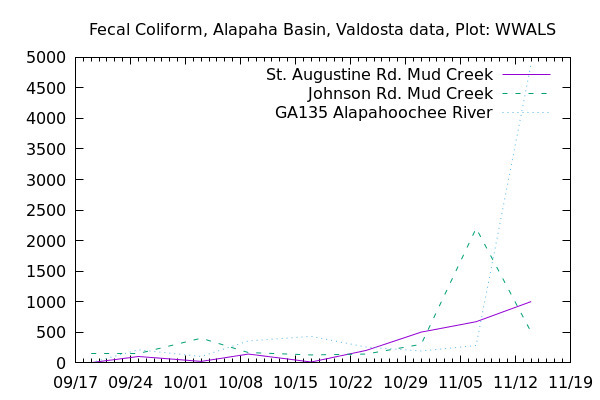
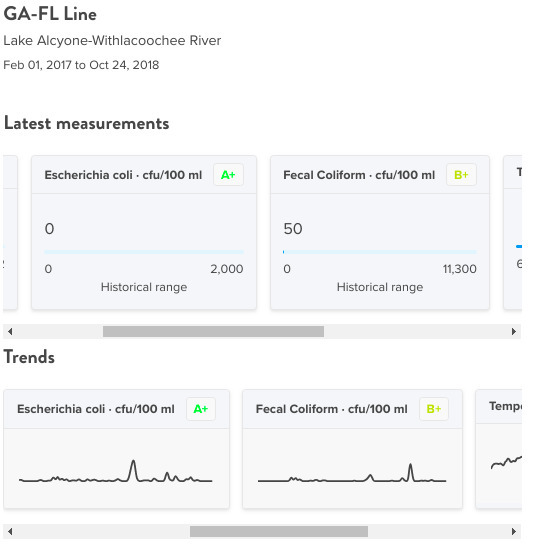
Twenty five times the state limit for Fecal coliform could be a problem. What got into the Alapahoochee River last week?
GA 135, Alapahoochee River, Alapaha Basin
If you want to help find out what’s getting into our rivers, you can Continue reading
Twenty five times the state limit for Fecal coliform could be a problem. What got into the Alapahoochee River last week?
If you want to help find out what’s getting into our rivers, you can Continue reading
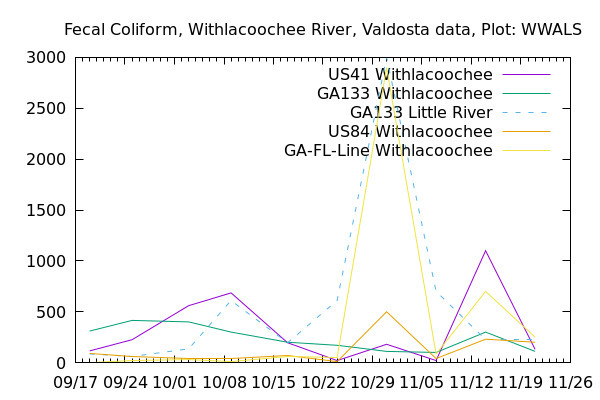
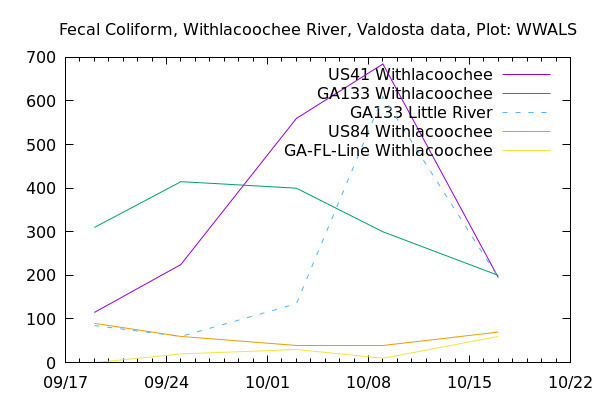
Was there rain Wednesday? That might explain the sudden spikes at US 41 on the Withlacoochee River, at GA 133 on the Little River, and at State Line on the Withlacoochee River. We can guess that the rains Thursday and Friday (today) have washed away whatever that very odd spike was at the state line.
Thanks to Valdosta Utilities and Valdosta City Clerk Teresa Bolden for sending this Wednesday’s Valdosta water quality testing data before the end of Friday. For more contact, see https://wwals.net/issues/vww/.
It’s a very odd spike, because Continue reading
Valdosta’s bacterial counts are always low at State Line Ramp (Mozell Spells), where we moved the WWALS Boomerang paddle race from Georgia to Florida and back.
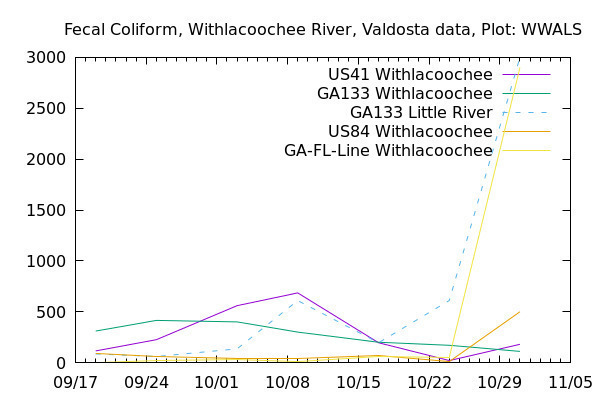
Things were generally better last week in the Withlacoochee Basin, except for the Little River at GA 133, just above Troupville Boat Ramp. Continue reading
Fecal coliform went down last week to 195 at US 41 and 200 at GA 133 on the Withlacoochee River, right at the Georgia limit of 200 cfu/100 ml, while rising slightly at US 41 and at the GA-FL line at the Madison Highway Horn Ferry Bridge, according to Valdosta’s testing.
Wednesday of this week, we still don’t know, because Continue reading
Water quality is worse upstream of Valdosta’s Withlacoochee WTP and far downstream of its Mud Creek WTP, according to Valdosta’s most recent data, received last week in response to a Georgia Open Records Act (GORA) request from WWALS. This is the recent data I mentioned in the tour of Valdosta WTPs.
Does this data mean Valdosta is perfect and will never spill again? Nope. But it does mean there’s more than one source of fecal coliform and E. coli. We need to find those other sources, which is one reason WWALS is starting a water quality testing program.
Valdosta’s smaller WTP is in the Alapaha River Basin.
The WTP is the image left of top center, St. Augustine Road is the green diamond top left, Johnson Road is the grey diamond below and left of top center, and GA 135 Alapahoochee is the grey diamond bottom right.
100 and 10 are good readings for Fecal Coliform and E. coli, upstream of the Mud Creek WTP. Continue reading
Thanks to Valdosta Utilities Director Darryl Muse and staff for the Tour of Valdosta wastewater treatment plants Wednesday. Afterwards, I got them to sit down in a conference room and say again the most important points. They said what they had done to prevent future spills like the big ones this year.
Counterclockwise from front: Utilities Director Darryl Muse, Public Information Officer Ashlyn Becton, Environmental Manager Scott Fowler, Mud Creek WTP Superintendent Mud Creek
Stanley K. Martin.
We also elicited Valdosta Utilities’ view on the letter establishing the Middle and Lower Suwannee River and Withlacoochee River Task Force, which was mainly Continue reading
WCTV came to Hagan Bridge Landing at GA 122 on the Withlacoochee River to interview Suwannee Riverkeeper John S. Quarterman about what Madison County and 10 more Florida counties are doing about Valdosta sewage spills into local rivers. Don’t forget the Tour of Valdosta wastewater treatment plants 9:30 AM this morning, Wednesday, October 3, 2018.
Emma Wheeler, WCTV, 2 October 2018, North Florida communities look to solve sewage spills in Valdosta, Continue reading
Here is most of a year’s river water quality testing data from the city of Valdosta, on a Water Reporter map:
Click on any of the colored diamonds for graphs. Scroll right to see more graphs. Click on any graph to see every datapoint. Clearly fecal coliform (FCOLI) and E. coli (ECOLI) have significant spikes way beyond the Georgia state limit of 200 cfu/100 ml.
However, as we already saw on the spill followup data map, often, even usually, FCOLI and ECOLI are just as bad or worse upstream Continue reading
WWALS will tour Valdosta’s Wastewater Treatment Plants (WTPs). Thanks to Scott Fowler and Director Darryl Muse for the longstanding invitation. WWALS invites you to come, from both Georgia and Florida, especially people downstream on the Withlacoochee, Alapaha, or Suwannee Rivers.
When: 9AM, Wednesday, 3 October 2018
Where:
Valdosta Utilties, 1016 Myrtle Street, Valdosta, Georgia 31601
The Myrtle Street off of E. Force Street between Troup and Forrest (not the one in Remerton).
Where: We will go to the Withlacoochee WTP next to the Withlacoochee River, and the Mud Creek WTP on Knights Creek, upstream from Mud Creek, the Alapahoochee River, and the Alapaha River. We may go to other points such as force mains or lift stations. If we have time we will also tour Valdosta’s drinking water treatment plant.
Duration: Probably several hours, but should be done by noon.
Free: There is no charge. This tour is primarily for WWALS members, but we won’t turn away anybody else and I doubt Valdosta will, either. We do recommend you join WWALS today.
Why: For why so many people are interested in Valdosta’s WTPs and what Valdosta has done to date, see Valdosta (and other) Wastewater.
This is not a regular WWALS outing or event, but for more WWALS outings and events as they are posted, see the WWALS calendar or the WWALS outings and events web page. WWALS members also get an upcoming list in the Tannin Times newsletter.
-jsq, John S. Quarterman, Suwannee RIVERKEEPER®
You can join this fun and work by becoming a WWALS member today!
Here is (at least some of) the water quality testing data Valdosta was required to collect after its major spills of June in the Withlacoochee River basin and August in the Alapaha River basin. Maybe Valdosta is right that neither of these spills got into waterways, but something sure did, according to this data. Curiously, in both cases the worst fecal coliform readings were upstream from the spill location.
Downstream at Johnson Road on Mud Creek from
the Mud Creek WTP after the August spill