April Ingle opening Weekend for Rivers 2013:
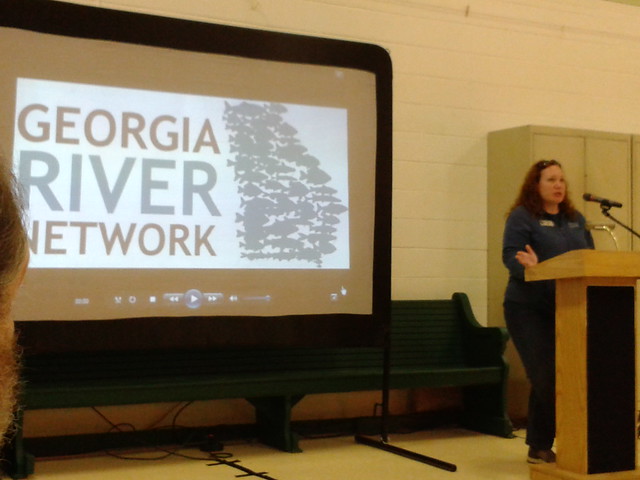
April Ingle at Chattahoochee Nature Center, talking about the agenda
Continue reading
April Ingle opening Weekend for Rivers 2013:
April Ingle at Chattahoochee Nature Center, talking about the agenda
Continue readingGoogling for Diane Shearer’s “A-lap-a-WHAT?” at Weekend for Rivers by Georgia River Network 31 March 2012, I ran across “Ala…alapa…what?” by Christy Ramsey, 22 Sep 2011.
-jsq
 The
U.S. Army Corps of Engineers (USACE) didn’t know there was
a large water problem hereabouts, but now they do, and they want
to take a watershed-wide approach, from the headwaters to the Gulf of
Mexico, including both surface water and aquifer issues,
perhaps starting with redrawing FEMA’s flood maps,
and maybe even including once again funding the state water council.
The
U.S. Army Corps of Engineers (USACE) didn’t know there was
a large water problem hereabouts, but now they do, and they want
to take a watershed-wide approach, from the headwaters to the Gulf of
Mexico, including both surface water and aquifer issues,
perhaps starting with redrawing FEMA’s flood maps,
and maybe even including once again funding the state water council.
 Thursday 11 April 2013 there was a rather large governmental meeting
organized by USACE in response to
the City of Valdosta’s request of 11 March 2103.
Yesterday,
Valdosta City Council District 5 Tim Carroll sent the appended
list of attendees, augmented by a conversation with him on the phone just now.
We know little else, because no media or private citizens were invited.
Thursday 11 April 2013 there was a rather large governmental meeting
organized by USACE in response to
the City of Valdosta’s request of 11 March 2103.
Yesterday,
Valdosta City Council District 5 Tim Carroll sent the appended
list of attendees, augmented by a conversation with him on the phone just now.
We know little else, because no media or private citizens were invited.
Those state and national agencies were brought by:
Continue reading
 Confused about how to test your water for arsenic?
I was, too.
Here’s how to do it.
Confused about how to test your water for arsenic?
I was, too.
Here’s how to do it.
Recently, there was a statement made by the Department of Health, recommending that well owners have their wells tested for arsenic.
I had heard about this previously from Janet McMahan and definitely wanted to do what she recommended (test hot water also).
 I volunteer regularly at the County Extension Office and figured it
would be easy to get what I needed for the testing.
I volunteer regularly at the County Extension Office and figured it
would be easy to get what I needed for the testing.
I got a sheet of paper labelled “Water Submission Form” and it seemed like a standard information sheet, name, address type of well, tests requested. I figured that this is filled in at the extension once I would bring in my sample.
I got a summary sheet of paper labelled “Sampling Protocol for Testing Drinking Water” and knew that I wanted to test for Arsenic and Uranium so I followed those directions for both hot (as directed by Janet) and cold water. There is a more complete document about water quality attached.
Then, I took my samples to the extension office along with the list of tests that Janet had recommended getting. “Oh,” said the office manager, “you didn’t bring enough water for all those tests.”
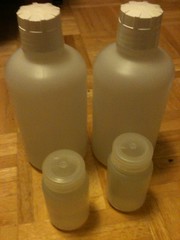
She opened the book about tests and showed me that some tests I want need 4 ounces each (and one of them needs 16 oz) so the two 4 oz bottles I brought in are not near enough.
When she explained to me that tests W1 and W3 cost the same as W2 and W2 tests for more stuff, I figured I should get W2 instead of W1 and W3. But I didn’t even know what those things were, nor that the collection mechanisms are really different when I started.
It’s sort of like learning a foreign language, you can say the words, but until you actually know what they mean you don’t have a clue.
Understanding what each of the different water tests are, how to properly collect the water and how they are priced (another important factor) made it clear to me that I needed to go home (with some new bottles) and collect water on another day.
-gretchen
Water Quality and Common Treatments for Private Drinking Water Systems, Revised by Uttam Saha, Leticia Sonon, Mark Risse1 and David Kissel, Originally written by Anthony Tyson and Kerry Harrison, Extension Engineers.
Here is the agenda for tonight’s board meeting. The public is invited. -jsq
Continue readingWWALS Watershed Coalition
Regular Meeting
Board of Directors
7:30 PM 10 April 2013, IHOP, Adel, GA
 Wanted to make sure all of you have a Water Filter to remove
Arsenic III [arsenic trioxide] and
Lead!! Jane Perry, Chemical Hazards Project Director, Ga Dept
of Health, has not been allowed to tell Doctors about Arsenic in our
drinking water causing Cancer, especially Lung Cancer… Until she is
“allowed to”, please share this email and tell others to get proper
water filter! Thank You!!
Wanted to make sure all of you have a Water Filter to remove
Arsenic III [arsenic trioxide] and
Lead!! Jane Perry, Chemical Hazards Project Director, Ga Dept
of Health, has not been allowed to tell Doctors about Arsenic in our
drinking water causing Cancer, especially Lung Cancer… Until she is
“allowed to”, please share this email and tell others to get proper
water filter! Thank You!!
-Janet McMahan
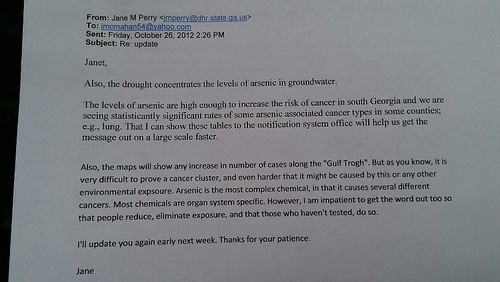
Continue readingFrom: Jane M Perry <jmperry@dhr.state.ga.us>
To: jmcmahan54@yahoo.com
Sent: Friday, October 26, 2012 2:26 PM
Subject: Re: update
Janet,
Also, the drought concentrates the levels of arsenic in groundwater.
The levels of arsenic are high enough to increase the risk of cancer in
 On Saturday, March 30 WWALS held their first joint fundraiser with
the Friends of Reed Bingham State Park: the first annual Big LITTLE
RIVER Paddle Race. We had 18 boats and 27 paddlers participate. The
start was at Rountree Bridge at the north end of Reed Bingham State
Park.
On Saturday, March 30 WWALS held their first joint fundraiser with
the Friends of Reed Bingham State Park: the first annual Big LITTLE
RIVER Paddle Race. We had 18 boats and 27 paddlers participate. The
start was at Rountree Bridge at the north end of Reed Bingham State
Park.
-Bret Wagenhorst
Start:
Continue reading
 Here are the slides I used yesterday at
Georgia River Network‘s
Weekend for Rivers 2013
in Roswell, Georgia:
Why WWALS?
Here are the slides I used yesterday at
Georgia River Network‘s
Weekend for Rivers 2013
in Roswell, Georgia:
Why WWALS?
-jsq
EPA found phosphorus and nitrogen from fertilizers, bacteria and other pollutants from urban runoff, plus mercury, in most U.S. rivers and streams. And they didn’t even mention low dissolved oxygen.
Ian Simpson wrote for Reuters, carried by NBC, EPA: More than half of U.S. rivers unsuitable for aquatic life,
Continue readingFifty-five percent of U.S. river and stream lengths were in poor condition for aquatic life, largely under threat from runoff contaminated by fertilizers, the U.S. Environmental Protection Agency said on Tuesday.
High levels of phosphorus and nitrogen, runoff from urban areas, shrinking ground cover and pollution from mercury and bacteria were putting the 1.2 million miles of streams and rivers surveyed under stress, the EPA said.
“This new science shows that America’s streams and rivers are under significant pressure,” Nancy Stone, acting administrator of the EPA’s Office of Water, said in a statement.
Twenty-one percent of the United States’ river and stream length was