The Southern Georgia Regional Commission invites you to
contact them
about agricultural
runoff. WWALS is concerned with how industrial
farming and clear cutting affects both water quality and quantity in
our watershed.
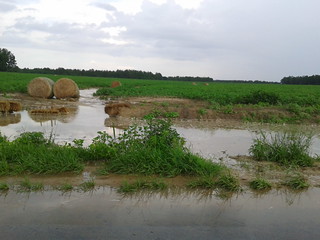
The pictured example of runoff from a cotton field was in Berrien County
yesterday.
While rain was pouring down, it ran half way across the road, and
two cars wrecked.
Once it gets across the road, either over it or through the culvert,
it runs into the Withlacoochee River.
As Pesticide Action Network reminds us,
“Conventionally grown cotton uses more insecticides than any other single crop.”
The WWALS Watershed Coalition has had an excellent
first year. We have had many people join to become
dues-paying members, many excellent speakers and many
excellent outings on our local rivers.
It is my pleasure to let you know that we will have
our first annual meeting along with the election of
three board members at our July 10th meeting.
If you are a member, you should have received a letter
already informing you of the upcoming meeting.
If you aren’t a member yet, you are welcome to attend
the annual meeting and
become a member.
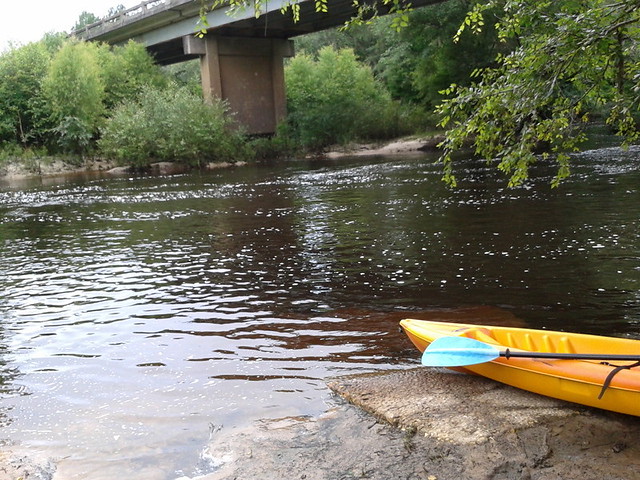
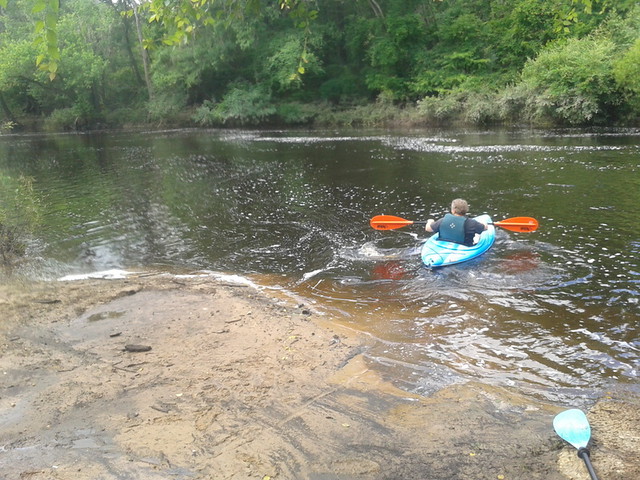
The June WWALS outing is from Clyattville-Nankin Road to Horn Bridge on
Madison Highway (GA 31) on the Withlacoochee River.
Meet at the Clyattville-Nankin Road putin at 9AM, put in at 10AM, Saturday, 22 June 2013.
Join the
facebook event if you like.
See you there!
Update 20 June 2013:
How are we getting back to our vehicles with this trip?
We’ll deposit all the boats at
the put-in (Clyattville-Nankin Road), take most of the vehicles
down to the take-out (Horn Bridge on Madison Highway aka GA 31),
carpool in a few vehicles back to the put-in, and float down the river.
Tom Baird described this nine-mile two-hour trip as:
The section
includes where Clyatt Mill Creek enters, a truly fun set of rapids (two
drops) at the Ga – Fla border, a very nice Second Magnitude Spring (that I
have yet to find the correct name), the remains of the enormous abandoned
trestle over the river of the Georgia & Florida Railroad,
or Ole God
Forsaken as it was nicknamed, the ghost town of Olympia on the Georgia side,
and several Indian quarry sites. It is along this section that the river
cuts deeply enough that the banks switch from sand banks to limerock cliffs.
Paddle distance is about 9 miles, so a little over two hours paddling time.
There are plenty of places to stop and look around.
There are shoals right at the state line, so beware, esp. if you’re in a canoe.
The book Canoeing and Kayaking Georgia, by Susanne Welander, Bob Sehlinger, and Don Otey (2004) says: Continue reading →
Approved 12 June 2013 by unanimous vote of the WWALS board,
Dave has mailed a signed copy to the Georgia Public Service Commission,
and I will go read it to the PSC Tuesday morning at 10 AM 18 June 2013,
at
their hearing about
Docket 36498, Georgia Power Company’s 2013 Integrated Resource Plan and Application for Decertification of Various Units
and
Docket 36499, Application for the Certification of Amended Demand Side Management Plan
The recent rains have swollen our blackwater rivers, Withlacoochee,
Willacoochee, Alapaha, and Little, under our longleaf pines and
Spanish-moss-covered oaks, and filled up the tea-colored tannin waters
in our frog-singing pocosin cypress swamps here in central South Georgia.
But that was
only a dent in our protracted drought that ranges from mild
to extreme, with projections not much better.
We do not need more traditional big baseload power plants gulping down our
river or aquifer water when solar and wind power use far less, and those
renewables are now
at grid parity with coal, natural gas, and nuclear.
PDF
of
Dissolved Oxygen Dynamics in the Upper Suwannee River Basin
by
Prof. George Vellidis,
Crop & Soil Sciences Dept., University of Georgia, Tifton, GA.
He used these slides when he discussed the
dynamics of dissolved oxygen concentrations in WWALS waterways at the
8 May 2013 WWALS board meeting.
Water issues strongly affect economic development, so I talked about
the new WWALS Watershed Coalition at the
16 April 2013 Board Meeting
of the Valdosta-Lowndes County Industrial Authority.
The VDT declined to speak, so I did.
After apologizing for no okra today,
I commended the Authority for talking about the missing agenda items
and for mentioning due diligence and flood control.
WWALS board meetings are every second Wednesday of the month,
usually at the IHOP in Adel because it’s centrally located.
WWALS is communicating with Valdosta and
various organizations about
flooding and other watershed-wide issues, which in my opinion
have to do with things like too much clearcutting without
consideration for where the water goes, too much development
without consideration for what the impervious surface would do,
(to my surprise, the Executive Director and several board
members nodded along with that)
so it was good to hear them mention flood containment.
Arsenic, Outings, and Flooding: WWALS Watershed Coalition
Regular Meeting, Valdosta-Lowndes County Industrial Authority (VLCIA),
Norman Bennett, Tom Call, Roy Copeland, Chairman, Mary Gooding, Jerry Jennett,
Andrea Schruijer, Executive Director, J. Stephen Gupton, Attorney, Tom Davis, CPA, Allan Ricketts, Project Manager,S. Meghan Duke, Public Relations & Marketing Manager, Lu Williams, Operations Manager,
Video by John S. Quarterman for Lowndes Area Knowledge Exchange (LAKE), Valdosta, Lowndes County, Georgia, 16 April 2013.
At Risk: Water supply for communities, farms, recreation, and wildlife
Threat: Outdated water management
The Flint River provides water for over one million people, 10,000
farms, unique wildlife, and 300 miles of exceptional fishing and
paddling. Despite being in a historically wet area of the country,
in recent years many Flint River tributaries are drying up
completely and the river’s low flows have dropped dramatically.
American Rivers and Flint Riverkeeper are working in collaboration
with diverse partners to restore the flows and health of the Flint.
The State of Georgia also has a role to play and must act to protect
the Flint in droughts and at all times to safeguard the river’s
health for today and future generations.
The Threat
The Flint is a river running dry. The reasons are many, and include
Tifton, GA, April 17, 2013, WWALS Watershed Coalition brings Janisse Ray, a South Georgia naturalist and conservation writer to Tifton for fundraising, food and fun on Saturday May 11th at Blackshank Pavilion, 457 N. Carpenter Road.
A native to South Georgia, Ray writes about the places that are
familiar to us. She is an American writer, naturalist, and environmental
activist. Ray will read to us from some of her works which include:
Ecology of a Cracker Childhood,
Wild Card Quilt: Taking a Chance on Home,
Between Two Rivers: Stories from the Red Hills to the Gulf,
Pinhook: Finding Wholeness in a Fragmented Land,
A House of Branches,
Drifting into Darien: a Personal and Natural History of the Altamaha River
and
The Seed Underground: A Growing Revolution to Save Food.
Ray lives and works on a family farm in southern Georgia.

 The pictured example of runoff from a cotton field was in Berrien County
yesterday.
While rain was pouring down, it ran half way across the road, and
two cars wrecked.
Once it gets across the road, either over it or through the culvert,
it runs into the Withlacoochee River.
As Pesticide Action Network reminds us,
“Conventionally grown cotton uses more insecticides than any other single crop.”
The pictured example of runoff from a cotton field was in Berrien County
yesterday.
While rain was pouring down, it ran half way across the road, and
two cars wrecked.
Once it gets across the road, either over it or through the culvert,
it runs into the Withlacoochee River.
As Pesticide Action Network reminds us,
“Conventionally grown cotton uses more insecticides than any other single crop.”