
The South Georgia Regional Commission (SGRC)
produced this interesting map of the Alapahoochee River Watershed
 I saw on the counter while visiting the USDA FSA office in Valdosta about something unrelated.
Curiously, it doesn’t show the actual river nor its tributaries
Mud Creek and Grand Bay Creek.
But it does show that this watershed includes much of Valdosta,
half of Dasher, and all of Lake Park. Continue reading
I saw on the counter while visiting the USDA FSA office in Valdosta about something unrelated.
Curiously, it doesn’t show the actual river nor its tributaries
Mud Creek and Grand Bay Creek.
But it does show that this watershed includes much of Valdosta,
half of Dasher, and all of Lake Park. Continue reading
Tag Archives: conservation
WWALS Annual Meeting Wednesday July 9th
 Once a year all WWALS members are invited to an annual meeting
to hear what WWALS has done for the last year and to elect some
of the board.
The board then holds a meeting to elect its officers and
to conduct its usual business.
This year it’s at the IHOP in Adel, Georgia, 7:30 PM Wednesday 9 July 2014.
Once a year all WWALS members are invited to an annual meeting
to hear what WWALS has done for the last year and to elect some
of the board.
The board then holds a meeting to elect its officers and
to conduct its usual business.
This year it’s at the IHOP in Adel, Georgia, 7:30 PM Wednesday 9 July 2014.
Agenda for the Annual Meeting.
Agenda for the Board Meeting.
See you there!
-jsq
GWC Meeting Report 2014-06-05
 Clean natural water systems for drinking, agriculture, and recreation, now and in the future:
Georgia Water Coalition spelled those things out in six recommendations at its
recent partner meeting.
Dave Hetzel represented WWALS at that meeting.
Clean natural water systems for drinking, agriculture, and recreation, now and in the future:
Georgia Water Coalition spelled those things out in six recommendations at its
recent partner meeting.
Dave Hetzel represented WWALS at that meeting.
Beginning of the Georgia Water Coalition Partners Meeting June 5, 2014 Report Prepared by Hans Neuhauser, Facilitator, Georgia Land Conservation Center: Continue reading
Proposed EPA Water rule
 The U.S. Environmental Protection Agency proposes some new rules to
clarify Clean Water Act protection.
Some people and organizations have concerns about that,
and the EPA has now responded to those concerns.
Comment periods are still open for you to provide input directly to EPA
about the proposed rule.
The U.S. Environmental Protection Agency proposes some new rules to
clarify Clean Water Act protection.
Some people and organizations have concerns about that,
and the EPA has now responded to those concerns.
Comment periods are still open for you to provide input directly to EPA
about the proposed rule.
Here’s the EPA’s Waters of the United States Proposed Rule. EPA says clarification of the Clean Water Act was requested by a broad range of state, tribal, and local government agencies and elected officials and NGOs, ranging from AASHTO to the National Association of State Foresters. One of the two examples EPA cites of state enforcement problems is on the Flint River in Georgia:
Recreation in Lake Blackshear, Georgia
Continue reading
Blueway Trails in South Georgia?
In the Lanier County Advocate today:
Blue Trails are marked routes that take visitors along rivers, lakes, canals and coastlines. Water trails not only require suitable access points and take-outs for exits but also provide place ashore to camp and picnic and points of interest for canoeists, paddle boarders, boaters, kayakers and rafts. Some trails maybe suitable for float tubing. Blueways are typically developed by the state, county or local municipalities to encourage recreation, ecological education and preservation of wildlife resources.
As a Naylor resident I urge the surrounding county residents to contact their local commissioner and demand all public access to the Alapaha river to be tie into the #Regional_ Water_ Trails_System.
Here are some of the benefits Continue reading
Suwannee Bioregion Coalition?
 Related to
population centers in the Suwannee River watershed,
someone asked,
“Do we need an interstate Suwannee Bioregion Coalition to guard the waters that feed into the Suwannee River?”
We’ve got pieces of it already cooperating to some extent in opposing
the Sabal Trail pipeline.
There are many other even larger issues that everyone in the Suwannee River
basin faces.
Related to
population centers in the Suwannee River watershed,
someone asked,
“Do we need an interstate Suwannee Bioregion Coalition to guard the waters that feed into the Suwannee River?”
We’ve got pieces of it already cooperating to some extent in opposing
the Sabal Trail pipeline.
There are many other even larger issues that everyone in the Suwannee River
basin faces.
In south Georgia and north Florida we have Continue reading
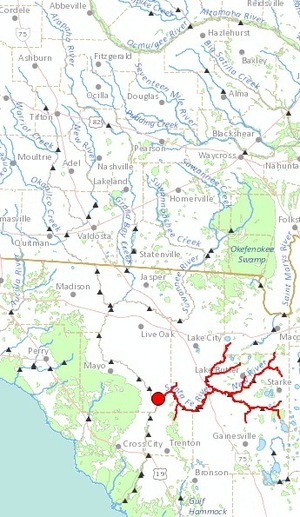
Our Santa Fe River and Ichetucknee Alliance for water conservation
 Much conservation activism lately on
the third main tributary of the Suwannee River, the Santa Fe River,
with its tributary the Ichetucknee River, both completely in Florida,
unlike WWALS’ Withlacoochee and Alapaha Rivers, which cross from Georgia
into Florida.
They each have their own watershed groups, somewhat like WWALS.
Much conservation activism lately on
the third main tributary of the Suwannee River, the Santa Fe River,
with its tributary the Ichetucknee River, both completely in Florida,
unlike WWALS’ Withlacoochee and Alapaha Rivers, which cross from Georgia
into Florida.
They each have their own watershed groups, somewhat like WWALS.
Christopher Curry wrote for the Gainesville Sun 21 June 2014, Grassroots environmentalists fight to protect Ichetucknee, Santa Fe,
At the head spring, a woman stands in knee-deep water on the stairs leading into the swimming hole. About 20 feet in front of her, splashing, swimming family members shout out some encouragement to try to coax her into the cold blue water.
It’s an idyllic scene of summer fun. At a nearby picnic table in the shade, the atmosphere is more serious.
There, some folks from two small but active environmental groups in the Suwannee River Water Management District — Our Santa Fe River and the Ichetucknee Alliance — are gathered, sharing Continue reading
Seven Out Superfund Assessment Public Meeting 2014-07-17
6-8PM Thursday 17 July 2014
Memorial Stadium, 715 Dewey St., Waycross, GA 31501
 The Environmental Protection Agency, GA Environmental Protection
Division, and Georgia Department of Public Health will be present to
discuss sample collection and results from the Seven Out Tank site
in downtown Waycross.
The Environmental Protection Agency, GA Environmental Protection
Division, and Georgia Department of Public Health will be present to
discuss sample collection and results from the Seven Out Tank site
in downtown Waycross.
EPD will also be available to address issues and answer questions regarding CSX.
From Satilla Riverkeeper’s facebook event. Here’s a map: Continue reading
The Politics of Water: Epic Battles and Endeavors to Protect Georgia’s Water –GWC
 The very effective Georgia Water Coalition (GWC)
invites you to see how it’s done and to come help.
This is not a WWALS event, but WWALS is one of the
216 GWC Partners.
Details via WWALS Ambassador Dave Hetzel:
The Politics of Water: Epic Battles and Endeavors to Protect Georgia’s Water,
The very effective Georgia Water Coalition (GWC)
invites you to see how it’s done and to come help.
This is not a WWALS event, but WWALS is one of the
216 GWC Partners.
Details via WWALS Ambassador Dave Hetzel:
The Politics of Water: Epic Battles and Endeavors to Protect Georgia’s Water,
Tuesday, June 24 at 7:00 PM
Riverview Landing, Mableton, GeorgiaOn the banks of the Chattahoochee River in conjunction with Paddle Georgia 2014 Continue reading
Biggest city in Suwannee River watershed?
 Apparently everybody knew this but me.
The biggest city in the entire
11,020 square mile Suwannee river basin,
half in south Georgia and half in Florida (that half being the largest river basin in Florida),
is…. Continue reading
Apparently everybody knew this but me.
The biggest city in the entire
11,020 square mile Suwannee river basin,
half in south Georgia and half in Florida (that half being the largest river basin in Florida),
is…. Continue reading