Tag Archives: Hailey Hall

Plant a Seed with Of the Trees at Hulaween 2026-10-23

Update 2026-10-15: New time of 3-4 PM.

Friday evening at Hulaween, with 30,000 of our closest friends, WWALS will assist Of the Trees in Plant A Seed, 3-4 PM, October 23, 2026, at Spirit of the Suwannee Music Park.

Heather Brasell of the Gaskins Forest Education Center will talk about fire-resistant longleaf pine and show people how to plant them.

She will be introduced by some of the WWALS attendees: Events Committee member Hailey Hall, Board members Sara Squires Jones and Scotti Jay, and Verlyn Jipson and Madelyn Gardner.

You have to have a Hulaween ticket to get in.

https://hulaween.com

So if you’re coming to the festival, come plant a tree!

You’ll also get to hear Of the Trees at the Amphitheatre later Friday, 10:15 PM to 11:45 PM.

As well as many other musical acts, such as the String Cheese Incident, the band that started Hulaween. The Cheese are actually playing the same time as Plant a Seed, but they’re playing many other times as well, so come help Plant a Seed! Continue reading →

WWALS at Our Water Our Future Our Voice, Alachua, FL 2026-10-10

Join WWALS at a North Central Florida Water Summit, presented by Suwannee-St. Johns Group, Sierra Club, Florida, and Alachua County League of Women Voters at the Alachua Lions Club.

That’s at 2 PM, Saturday, October 10, 2026.

Location: Alachua Lions Club 15125 NW 142 Terrace, Alachua, FL 32615, USA

“What’s really in the water coming from our taps and wells? How much stress is the Floridan Aquifer under? And who makes the decisions that determine how much water is pumped, where development occurs, and how our springs, rivers, and wetlands are protected?”

It’s free and open to the public.

https://bit.ly/OurWaterOurFutureOurVoice

[WWALS Booth at Our Water Our Future Our Voice, by SSJGSC, in Alachua, FL 2026-10-10]
WWALS Booth at Our Water Our Future Our Voice, by SSJGSC

Representing WWALS will be Events Committee member Hailey Hall. She will also be representing AquiferWatch. Continue reading →

The river we inherited: the Suwannee River –American Academy of Arts & Sciences 2026-09-17

Pullquote:

If one thing is agreed upon in north Florida, it is that Suwannee Basin water is in trouble. American Rivers recently named the Suwannee the 10th most endangered river in America, and Quarterman says the fight for its future will require people who do not agree on much else to work together. “I’ve never found anybody who likes to drink dirty water,” he said. “Doesn’t matter your political, religious, or other persuasion.” Protecting rural Florida’s water, he said, “is going to take everybody.”

You’ll recognize many of the names in this story: Dennis Price, Hailey Hall, Robby Robertson, Corey Simon, Chuck Brannan, Hugh Thomas, Larry Thompson, Moses Klepper, Stephen C. Foster, Andrew Jackson, and the notorious Water First North Florida (WFNF).

Other names you may see for the first time. It’s well worth reading.

Stephenie Livingston, American Academy of Arts & Sciences, September 17, 2026, The river we inherited,

In rural Florida, the Suwannee River is both real and imagined. It rises in Georgia’s Okefenokee Swamp, dark with tannin, then winds south through limestone and cypress swamps to the Gulf of Mexico, one of the last largely free-flowing rivers in the Southeast. Beneath it lies a vast aquifer that feeds more than 300 springs, five rivers, and the wetlands of the Suwannee Basin. The same water supplies much of Florida and southern Georgia, some 11 million people.

Many Americans know the river first as a song—one written by a man who never saw it, who nonetheless turned the river into a national myth.

In White Springs, the myth and the river meet. The riverside town of less than 800 was once home to a famous sulfur spring, where tourists came to bathe in water advertised as healing quite literally any ailment. Today, the old four-story spring house that once served those seekers stands around a limestone pool that is often nearly dry. This year, as the country celebrated its 250th anniversary, the Suwannee Basin was in its worst drought in 25 years. The Declaration of Independence began as a complaint against distant authority. Along the Suwannee, people are asking an old American question, albeit in the language of rivers and wells: What does self-government mean when the very water you rely on is governed from somewhere else?

This year, that question revolved around a proposal to move treated wastewater from Jacksonville into the aquifer system that feeds the Basin’s springs and rivers. Its backers call it restoration. Many in the Basin see a familiar imbalance: a rural region asked to absorb a problem created by a larger, wealthier city.

[The river we inherited: the Suwannee River 2026-09-17 --American Academy of Arts & Sciences, Drought and WFNF]
The river we inherited: the Suwannee River 2026-09-17 –American Academy of Arts & Sciences, Drought and WFNF

There is much more in the story. It ends:

A river is never only water. When it is diminished, it signals an impaired system, and the loss falls hardest on the people who depend on it most: those who know the river’s name because if it flows, so do the crops; if it’s clean, so are the wells; and when it dries up, so does the tourism a song helped create.

To describe the loss, [Pedro Zepeda, a citizen of the Seminole Tribe of Florida,] reached for an Indigenous saying that roughly goes: only when the last tree is cut, the last river poisoned, the last fish caught will we realize—

The full version escaped him, but the ending did not.

“You can’t eat money,” he said.

Continue reading →

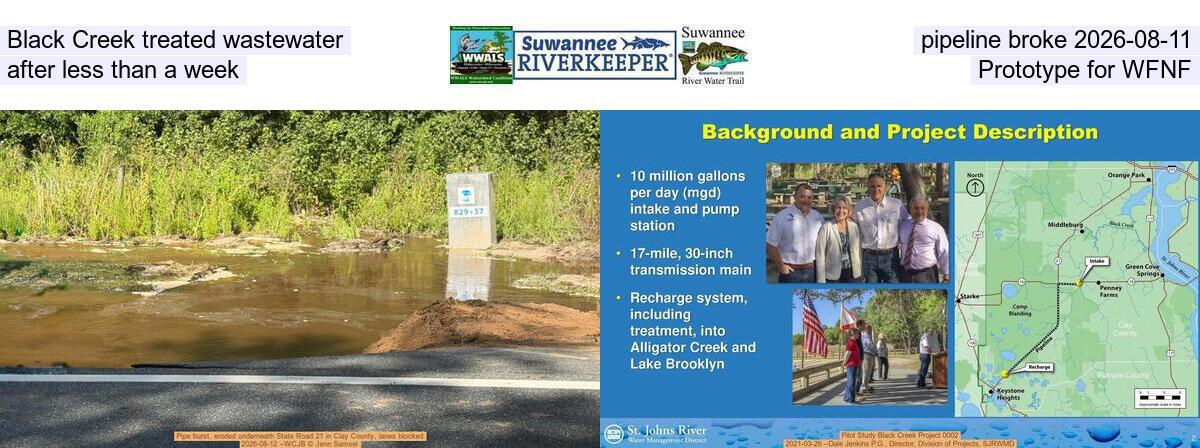
Black Creek treated waste creek water pipeline broke after less than a week 2026-08-11

Update 2026-08-15: It’s treated creek water, not human wastewater.

It broke four days after SJRWMD bragged about it working: the Black Creek treated waste creek water pipeline into Alligator Creek.

This is the prototype for the 60+-mile Water First North Florida (WFNF) pipeline from Jacksonville into the Suwannee River Basin.

We should trust SJRWMD and JEA to build a pipeline?

There’s an election going on. No candidate seems to want to support WFNF.

WWALS sent a clean water questionnaire to all Florida candidates for office. It also got answers on many other water topics. Some of those answers may help you choose who to vote for.

Here are the answers from Statehouse District 9:

https://wwals.net/?p=70813

And the answers from Statehouse District 10:

https://wwals.net/?p=70829

[Black Creek treated creek water pipeline broke 2026-08-11, after less than a week, Prototype for WFNF]
Black Creek treated creek water pipeline broke 2026-08-11, after less than a week, Prototype for WFNF

WCJB Staff, WCJB, August 11, 2026, Pipe burst, eroded underneath State Road 21 in Clay County, lanes blocked,

KEYSTONE HEIGHTS, Fla. (WCJB) – The Black Creek pipeline burst and eroded underneath State Road 21 between State Road 16 and Sharron Road in Clay County Tuesday morning.

Clay County Fire Rescue officials say the pumps that supply the water are secured. State Road 21 is currently down to one lane.

Fire rescue officials are at the scene and FDOT officials are mobilizing to repair the damage. Officials say there are no injuries or accidents at this time.

Continue reading →

Farms, Forests, Flows & Fish: Exploring Possible Futures for the Suwannee River Watershed and Estuary, WWALS Webinar 2026-12-10

Update 2026-10-19: Rescheduled to December 10, 2026.

Dr. David Kaplan and Dr. Wendy Graham, both of the University of Florida, will present an online WWALS Webinar:

Noon to 1 PM, Thursday, December 10, 2026

Register here to attend by zoom:

https://us02web.zoom.us/meeting/register/KPoObaVMRammKk6dKYyI0Q

You can mark going on this facebook event to encourage others to attend:

https://www.facebook.com/events/2165192244412437/

WWALS Events Committee Member Hailey Hall will introduce the speakers, who will speak for about 45 minutes, followed by questions and answers.

The Suwannee River watershed supports one of the world’s largest spring systems, productive estuarine ecosystems, working agricultural and forest landscapes, and communities whose livelihoods depend on healthy water resources. Understanding how future changes in climate and land use will affect these interconnected systems is critical for informed management and conservation.

[Farms, Forests, Flows & Fish: Exploring Possible Futures for the Suwannee River Watershed & Estuary, a WWALS Webinar 2026-08-19]
Farms, Forests, Flows & Fish: Exploring Possible Futures for the Suwannee River Watershed & Estuary, a WWALS Webinar 2026-08-19

This presentation will highlight results from a large interdisciplinary research project that coupled hydrologic, estuarine ecological, and economic models to evaluate a range of plausible future scenarios for the Suwannee River watershed and estuary. Using a landscape-scale groundwater-surface water model, we examined how alternative land-use futures—including agricultural expansion, forest restoration, conservation planning, and urban growth—interact with projected climate change to influence groundwater recharge, river flows, nitrate transport, estuarine water quality, fisheries, and regional economic outcomes.

Rather than attempting to predict a single future, this scenario-based approach explores Continue reading →

Florida Homestead Property Tax Exemption: for-pay parks and boat ramps? @ Gilchrist County Workshop 2026-04-20

Update 2026-10-09: County and City revenue gaps due to property tax change –Vote No on 3, 2026-10-09.

A Florida bill could force Florida county parks and boat ramps to be pay for use, and could eliminate 4-H, agricultural extension services, libraries, and even county veteran services.

If passed, HJR 203 would eliminate all property taxes on homestead property except school taxes.

It failed in the Florida Senate, but it will be heard again in a July 2026, legislative special session.

If it passes the legislature, the people will get to vote on this constitutional amendment on the November ballot.

[Florida Homestead Property Tax Exemption: for-pay parks and boat ramps? @ Gilchrist County Workshop, Monday, April 20, 2026]
Florida Homestead Property Tax Exemption: for-pay parks and boat ramps? @ Gilchrist County Workshop, Monday, April 20, 2026

Gilchrist County held a workshop about this on April 20, 2026. Other counties would do well to do the same.

The origin of the word republic is the latin phrase Res publica, which means public thing. It is often translated as commonwealth. I understand people don’t like paying taxes, especially property taxes. But something is needed to fund public services. Florida already does not have income tax.

That leaves a gas tax, increasing millage on everybody else, or, as slide 28 suggests, “100% Fee based parks.” Which wouldn’t help libraries or 4-H.

I don’t know about you, but I prefer people, especially young people, being able to go to the library or to the river without paying, such as to Hart Springs, Otter Springs, or the FL 47 Ramp, aka Santa Fe River Gilchrist County Park Ramp. Otherwise, they will find other, perhaps more troublesome, ways to spend their time.

Oh, and your taxes would still be paying to pipe treated wastewater from Jacksonville into the Suwannee Basin; see:

https://wwals.net/issues/wfnf Continue reading →

Leaf Area Index and Forest Water Yield, Matt Cohen, WWALS Webinar 2026-05-28

Dr. Matthew J. Cohen will present research about forest management to lower Leaf Area Index (LAI) and increase water yield.

WWALS Events Committee member Hailey Hall will give a brief introduction.

Dr. Cohen will speak for about 45 minutes.

Questions and answers will be at the end.

When: 12-1 PM, Thursday, May 28, 2026

Register to join with Zoom: https://us02web.zoom.us/meeting/register/Vd2_7sR3RyWtl4fuKQ3w9g

[Leaf Area Index and Forest Water Yield, Dr. Matthew J. Cohen, WWALS Webinar 2026-05-28]
Leaf Area Index and Forest Water Yield, Dr. Matthew J. Cohen, WWALS Webinar 2026-05-28

Continue reading →

Two moratoriums: detention centers and WFNF –Hailey Hall to Alachua BOCC 2026-05-05

The Alachua County BOCC meets this morning, May 5, 2026, at 10 AM, County Administration Building – Grace Knight Conference Room 12 SE 1 Street, 2nd Floor, Gainesville, FL 32601.

There is nothing on their agenda about either of the moratoria that Hailey Hall requested on April 28, 2026, after their last meeting:

[Two moratoriums: detention centers and WFNF --Hailey Hall to Alachua BOCC, 2026-04-28]
Two moratoriums: detention centers and WFNF –Hailey Hall to Alachua BOCC, 2026-04-28

Hello Commissioners,

Thank you for your efforts and for allowing everyone to speak today at the meeting.

I am requesting that you enact two separate moratoriums.

  1. A moratorium prohibiting construction of new, non-municipal detention centers as Kansas City has done.
  2. A moratorium against further development and construction of the Water First North Florida pipeline project.

Please see the attached ordinance from Kansas City and resolution from Town of Branford.

Thank you and take care,

Hailey Hall

You’ve already seen the Branford resolution.

https://wwals.net/?p=69710

Here is the Kansas City ordinance: Continue reading →

Residents raise concerns over WFNF and Suwannee River –WCTV 2026-03-18

TV reported on the WWALS Workshop on Crafting Public Comments, yesterday at the Live Oak Public Library.

Don Hale came to speak about the resolution against WFNF that the dozen-county Task Force had passed earlier that same day, and the letter the Suwannee County BOCC had passed the previous evening.

For much more about WFNF, see:

https://wwals.net/issues/wfnf

[Residents raise concerns over WFNF and Suwannee River --WCTV 2026-03-18]
Residents raise concerns over WFNF and Suwannee River –WCTV 2026-03-18

Julia Miller, WCTV, March 18, 2026, Residents raise concerns over Water First North Florida project impacting Suwannee River:
Residents held a discussion ahead of the Water First North Florida Project open house on Thursday

SUWANNEE COUNTY, Fla. (WCTV)—Residents are weighing in on a North Florida water project that could impact the Suwannee River.

The “Water First North Florida Project” will be discussed at a public open house on Thursday, with officials saying it could help meet water demand and restore the river and aquifer.

Community members gathered Continue reading →

WFNF Update, an interactive WWALS Webinar 2026-03-25

A more interactive than usual WWALS Webinar update about what happened in the previous week’s meetings on Water First North Florida (WFNF), the plan to pipe treated wastewater from Jacksonville into the Suwannee River Basin.

https://wwals.net/issues/wfnf

Hailey Hall will give a brief rundown.

Suwannee Riverkeeper John S. Quarterman will expand, especially on modern desalination examples.

Then we will keep it casual and conversational. We will field and pose questions, and “popcorn share”. We will call on various people if they are present, and others can chime in.

When: 6 PM, Wednesday, March 25, 2026

Put In: https://us02web.zoom.us/meeting/register/zDdB5oQARxeUvH8U7ypW4A

[WFNF Update, an interactive WWALS Webinar, Online by zoom, 6 PM, Wednesday, March 25, 2026]
WFNF Update, an interactive WWALS Webinar, Online by zoom, 6 PM, Wednesday, March 25, 2026

Continue reading →