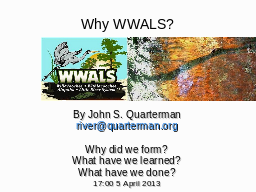
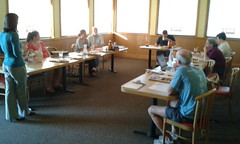
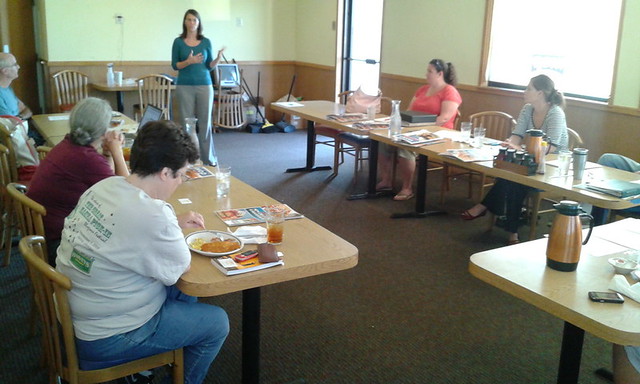
Here are the slides I used yesterday at
Georgia River Network‘s
Weekend for Rivers 2013
in Roswell, Georgia:
Why WWALS?
-jsq
Here are the slides I used yesterday at
Georgia River Network‘s
Weekend for Rivers 2013
in Roswell, Georgia:
Why WWALS?
-jsq
EPA found phosphorus and nitrogen from fertilizers, bacteria and other pollutants from urban runoff, plus mercury, in most U.S. rivers and streams. And they didn’t even mention low dissolved oxygen.
Ian Simpson wrote for Reuters, carried by NBC, EPA: More than half of U.S. rivers unsuitable for aquatic life,
Continue readingFifty-five percent of U.S. river and stream lengths were in poor condition for aquatic life, largely under threat from runoff contaminated by fertilizers, the U.S. Environmental Protection Agency said on Tuesday.
High levels of phosphorus and nitrogen, runoff from urban areas, shrinking ground cover and pollution from mercury and bacteria were putting the 1.2 million miles of streams and rivers surveyed under stress, the EPA said.
“This new science shows that America’s streams and rivers are under significant pressure,” Nancy Stone, acting administrator of the EPA’s Office of Water, said in a statement.
Twenty-one percent of the United States’ river and stream length was
Valdosta City Council Tim Carroll spoke about the need for watershed-wide
planning to reduce flooding and provide water for agriculture with
distributed flood containment reservoirs.
He
referred to
the
materials he sent in advance
as well as to some additional data about water quality measurements
upstream and downstream of selected points.
And he sent an update the next day.
Tim Carroll noted that one thing that was clear from the
Valdosta City Manager Larry Hanson’s 2010 presentation to the
Suwannee-Satilla Water Council about the 2009 flood was that the
drainage basin study proposed by that Council (which completed
its report and disbanded) still needs to be completed.
For that purpose, Hanson had just sent
a letter to the Army Corps of Engineers requesting assistance.
Apparently they have
partial answer,
and they’re also talking the state.
Carroll said that with the renewed attention to flooding problems Continue reading
More than three years after Janet McMahan
found toxic levels of arsenic in her well water in Ben Hill County,
more than half a year after
she told us about it
at a
WWALS water quality testing training,
and four months after
Erin Brokovich agreed it was a problem,
the Georgia Departnment of Health finally has sounded the alarm.
They still left out part of the story, though.
The Valdosta Daily Times carried the story in its paper Saturday edition, but apparenlty never put it online. WTXL’s story Friday by Jade Bulecza, UPDATE: South Georgians urged to test private wells due to arsenic risk, quoted Dr. Grow, head of our local eleven-county South Health District:
Continue reading
Valdosta City Council member Tim Carroll will speak tonight
at the monthly WWALS Watershed Coalition board meeting
at 7:30 PM at the IHOP in Adel (exit 39 from I-75, 1200 W 4th St, Adel, GA, 229-896-2662); the public is invited.
In advance he sent the appended letter from the City of Valdosta
to the Army Corps of Engineers requesting assistance related to
flooding and droughts.
March 11, 2013Continue reading
William Bailey
Chief of Planning Division
US Army Corps of Engineers – Savannah District Office
100 W. Oglethorpe Avenue
Savannah, Georgia 31401Dear Mr. Bailey,
Over the last several years, the City of Valdosta and neighboring communities have been severely impacted by the increase of flood events that have occurred throughout our region and particularly the drainage basin we are located in. The city recognizes the various levels of responsibility throughout government agencies for flood management and flood control and is interested in furthering the discussions to understand the changes that are occurring and to ensure the protection of our communities from future flood events.
In February 2009, the city began updating its 1996 Master Stormwater Management Plan. In April, just two months later, our county along with 46 counties in south Georgia, experienced historic flooding and were declared disaster areas. The Federal Emergency Management Agency (FEMA) reported
CNN iReports lets citizens send in videos.
One jkluke has posted four videos of flooding on the Withlacoochee River.
Here’s that last video embedded:
-jsq
PS: Owed to John C. Griffin.
The first speaker at a WWALS board meeting after incorporation was Emily Davenport, the Storm Water Utilities Director for the City of Valdosta.
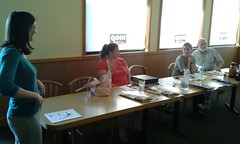
Emily Davenport, Brittney Hull (Treasurer), Angela Bray of SGRC, Dave Hetzel (President), Nathan Wilkins (Secretary), visitor, Gretchen Quarterman, Bret Wagenhorst, John S. Quarterman (VP, photographing)
-jsq
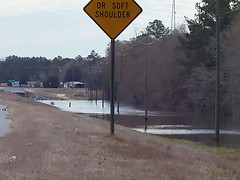
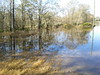
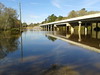
The Withlacoochee River in flood stage after 10 inches of rain, at the GA 122 bridge in Lowndes County, Georgia.
Here’s a video playlist:
Continue reading
Movies on 18 February 2013 after the first rains of
the Alapaha River on GA 122 at Lakeland in Lanier County
and
the Withlacoochee River at GA 122 and Hambrick Road in Lowndes County
and some points in between.
Here’s a video playlist.
Continue reading
Uranium? Yes, really: it comes out of granite rocks up deep water wells
in the Georgia Piedmont.
The other metals arsenic come from human energy,
industrial, and agricultural activities,
ranging from fenceposts to Plant Scherer,
dirtiest coal plant in the country, emitting mercury, some of which ends
up in the Alapaha River.
Here’s
video of Janet McMahan speaking about this:
Janet McMahan spoke to the group after the
Adopt-A-Stream water quality testing training
taught by Angela Bray and Richard Batten.
Video by Gretchen Quarterman for WWALS Watershed Coalition (WWALS),
Valdosta, Lowndes County, Georgia, 5 August 2012
Janet McMahan adds:
Continue reading