Tag Archives: NFRWSP

SRWMD kept money from Florida for “routinely anticipated budget shortfalls”

Where does the buck stop for these “routinely anticipated budget shortfalls”? Who let a budget include those? Isn’t the point of a budget to, well, budget for what’s needed? Or, given the history of deliberate downsizing of environmental agencies in Florida, maybe shortfalls were the point.

Noah Valenstein
Noah Valenstein got the job as secretary of the Department of Environmental Protection on Tuesday May 23rd, on a unanimous vote by Gov. Rick Scott and the Cabinet. His previous job? Executive director of the Suwannee River Water Management District, which was flagged by state auditors for $22.5 million in “questionable costs”. The audit covered the time Valenstein led the district. He oversees the district in his new job. [Special to the Times]

Mary Ellen Klas, Miami Herald-Times Tallahassee Bureau, 14 July 2017, Auditors find millions in ‘questionable costs’ at water district,

Weak budgetary controls led to $22.5 million in “questionable costs,” auditors found. Officials had transferred $13.3 million of it into the district’s operating account without proper authority. They may have overspent some areas of the budget and directed money to other areas to make up for shortfalls. They set aside $3.8 million “in the event of an economic crisis” without authorization, and they steered $1.7 million “to cover routinely anticipated budget shortfalls” without explanation.

Contingency funds, sure, but “routinely anticipated”? And in an economic crisis, wouldn’t it be the legislature that should be authorizing funds?

Auditors concluded that accounts were “misclassified because district personnel misunderstood” standard accounting requirements and budget staff members were “somewhat new to the process” so they couldn’t explain how and why it happened.

That is what happens when a state massively defunds its environmental agencies and makes political tests and servicing economic development more important than competence. The article goes into that, rightly pointing a finger repeatedly at Governor Rick Scott, who said “ensuring that Florida’s precious water resources are protected and managed in the most fiscally responsible way possible” while:

The five districts, whose boards are appointed by the governor and operate under the oversight of the Department of Environmental Protection, were purged of hundreds of veteran professionals, and budgets were cut in half. They continued cutting their budgets through 2016. Suwannee, because of its small size, had proportionally fewer cuts.

The article discusses and quotes SRWMD staff, with some pretty amusing tidbits, including this one from “Roary E. Snider, the district’s chief of staff”, who

also disputed the auditor’s claim they don’t have documentation. “While we absolutely will provide these records, these documents were largely in hard copy,” Snider said. “Staff couldn’t assemble these additional records in time.”

SRWMD staff don’t know how to use a scanner? Or they didn’t know where they put those paper documents? Or maybe the dog ate them.

The article even quotes Eric Draper of Audubon Florida about “problems we’ve seen at the Suwannee River district with the change of leadership over the years,”. If Audubon Florida “works closely with the water management districts”, what did Audubon Florida know, when did they know it, and why are they only speaking up now?

The actual audit report lists on page 2:

Executive Director
Noah Valenstein from October 13, 2015
Carlos Herd, Interim, from May 14, 2015, to October 12, 2015
Dr. Ann B. Shortelle to May 13, 2015

The article mentions that:

The district is overseen by the Florida Department of Environmental Protection, which is now headed by Noah Valenstein. His last job was executive director of the Suwannee River WMD during the time the audit was underway.

Guess which fox the foxhouse is turning to for assistance:

The district said it would turn to the Department of Environmental Protection for advice on how to resolve the dispute over whether money is owed to the state.

“DEP has communicated with staff at the Suwannee River Water Management District, and they have informed us that they are reviewing accounting and land acquisition records for additional information,” said Lauren Engel, spokesperson for Valenstein.

“If it is determined that these funds should be returned to DEP, they would go to the trust fund from which the funding was issued, however, DEP would require spending authority from the legislature to use it.”

This is the same Noah Valenstein who told me shortly after he was appointed to SRWMD that he believes that Florida law requires him and SRWMD to provide water resources for economic development. Maybe he should have paid more attention to making sure the economic resources of the District were properly organized.

The Miami Times-Herald story as carried by tbo.com (Tampa Bay Times) has a bit more pointed headline and picture caption (see top of this blog post), Auditors find millions in ‘questionable costs’ at water district, but will it matter? Continue reading

St Johns Riverkeeper, Suwannee Riverkeeper

In Alachua, 2017 01 17: Lisa Rinaman, St Johns Riverkeeper, and John S. Quarterman, Suwannee Riverkeeper.

This was after SRWMD and SJRWMD passed the NFRWSP. Videos here of what we and many others said before the vote in that joint board meeting.

 -jsq, John S. Quarterman, Suwannee RIVERKEEPER®

You can join this fun and work by becoming a WWALS member today!

FL House Rep. Elizabeth Porter asks EPA to Valdosta wastewater

There’s been an outcry for the EPA to intervene, from people downstream of Valdosta on the Withlacoochee and Suwannee Rivers. Representing Hamilton, Suwannee, Columbia, and Baker Counties in the Florida statehouse, FL Rep. Elizabeth Porter [R-10] has taken up that cry.

In the current political climate of the EPA being downsized after it already was underfunded, Continue reading

Videos: NFRWSP Plan passed at joint SRWMD-SJRWMD Board Meeting 2017-01-17

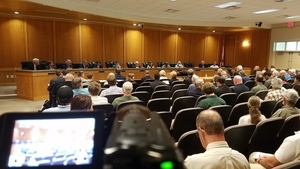
Pretty full The playwright could have added a bit more suspense. After listening to almost two dozen public comments, many recommending tabling the North Florida Regional Water Supply Plan (NFRWSP) or a moratorium on new water withdrawal permits, the boards of the Suwannee River Water Management District and the St Johns River Water Management District each voted unanimously to approve.

Here are WWALS videos of each of the speakers, with a few notes, followed by video playlist of the whole thing. Continue reading

SRWMD responds about NFRWSP; come to Alachua Tuesday 2017-01-17

SRWMD did post responses to comments from WWALS and others on the North Florida Regional Water Supply Plan (NFRWSP). A week before the planned NFRWSP adoption, same as for the agenda for the joint SRWMD-SJRWMD meeting next Tuesday in Alachua. After OSFR and WWALS posted critical blog posts, SRWMD Executive Director Noah Valenstein sent us and others an offer to meet this Friday in Live Oak to discuss. While many (including me), thanked him for his collegial offer, nobody took him up on it. See you in Alachua Tuesday (facebook event).

Below are Noah Valenstein’s letter and my response. Continue reading

North Florida Regional Water Supply Plan on agenda for joint SRWMD-SJRWMD meeting 2017-01-17

Update 2017-01-19: Videos: NFRWSP Plan passed at joint SRWMD-SJRWMD Board Meeting 2017-01-17.

Update 2017-01-12: SRWMD did post responses to comments on the NFRWSP: they posted them a week in advance of planned adoption. Come on down to Alachua Tuesday!

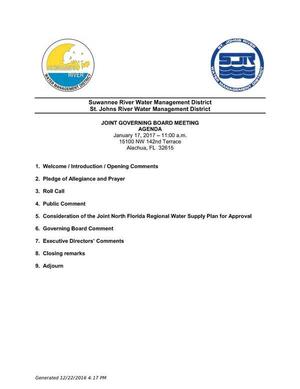
Next week in Alachua without further public meetings or response to those who wrote in, SRWMD and SJRWMD plan to approve the North Florida Regional Water Supply Plan (NFRWSP), as the only item on the agenda.

Agenda

When: 11AM Tuesday 17 January 2017

Where: 15100 NW 142nd Terrace, Alachua, FL 32615

Event: facebook

WWALS never got a response to our letter about the NFRWSP, not about less water withdrawal, nor about better modeling and data, nor about more water retention, nor specifically about ditching the Rube Goldberg Falling Creek Aquifer Recharge Project for Dennis Price P.G.’s more cost-effective solution, nor with any mention of participation from farther afield in Florida nor in Georgia, for that matter.

The language of the memorandum accompanying the agenda is rather Orwellian:

The NFRWSP has identified sufficient sources of water to meet the needs of the environment and the projected demands through 2035.

That sounds like the environment is making projected demands. Actually, the maps in the NFRWSP are pretty clear that Jacksonville is making the most demands for water, along with other cities and corporate agriculture, and the plan would take from the environment, mostly from the Suwannee River Basin, to get that water.

Our Santa Fe River sums it up pretty well: Continue reading

Less withdrawals, more water retention for North Florida Regional Water Supply Plan: WWALS PR 2016-12-06

FOR IMMEDIATE RELEASE

Jasper, Florida, November 6th 2016 — Better modeling and measurement of more water reuse and retention with fewer water withdrawals in both north Florida and south Georgia, WWALS Watershed Coalition (WWALS) recommended yesterday in comments (PDF) on the North Florida Regional Water Supply Plan (NFRWSP). WWALS also opposed the Falling Creek Aquifer Storage project and suggested a replacement, and recommended including threats to the FLoridan Aquifer and the Suwannee, Withlacoochee, and Alapaha Rivers such as pipelines and fracking.

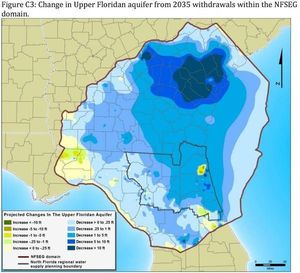
Figure C3: Aquifer surface change due to withdrawals in north Florida and south Georgia WWALS applauded water supply projects involving reuse or stormwater, especially those in Jacksonvile and Gainesville, two of the sources of the general problem of falling water levels in the Floridan Aquifer. WWALS also applauded the plan to set minimum flow levels on the upper Suwannee River and WWALS expects to be involved with that.

WWALS recommended expanding the original study area, which stopped at the Suwannee River on the west and the Georgia-Florida state line on the north. WWALS president John S. Quarterman explained,

“Our rivers don’t stop because there’s a state line on a map, and there are three second-magnitude springs on the Withlacoochee River in Georgia south of Valdosta, one of them with a more than 4,000-foot cave system, that aren’t taken into account in this draft plan.”

Quarterman elaborated on a much larger concern: Continue reading