Tag Archives: quality

Aquifers, sinkholes, and ground scans –Don Thieme @ WWALS

Moved to VSU, University Center, Dogwood Room!
Prof. Don Thieme of VSU will speak about underground water issues at the October WWALS board meeting in Wednesday October 9th at 7:30 PM in Adel at the IHOP, 1200 W 4th Street. Valdosta.

Here’s the letter Prof. Thieme and two other VSU professors wrote to the Air Force about sinkholes and subsidence on the proposed Moody Family Housing in Lowndes County, which also turns out to be in an aquifer recharge zone.

It’s an open board meeting anyone can attend for the business part, as well. Here’s the agenda:

Agenda WWALS Board Meeting
7:30 pm October 9, 2013
IHOP, Adel GA
  1. Call to Order, Welcome and Introductions
  2. Speaker: Don Thieme, VSU geologist. Topic: Aquifers, sinkholes, and ground scans.
  3. Agenda Review: Additions and Changes
  4. Review and Approval of Minutes of September Board Meeting
  5. Future Meetings and Events
    1. Monthly outing (fourth Saturday): October 26, 2013 at Banks Lake near Lakeland.
    2. Monthly board meeting (second Wednesday): November 13 Continue reading

WWALS Watershed Conference, Tifton, GA, 24 August 2013

How we manage water affects our water’s quality and quantity. WWALS logo WWALS Watershed Coalition is pleased to announce a Water Conference where Gordon Rogers, Flint Riverkeeper will share information on hydrology of the South Georgia region and Neill Herring, Environmental Lobbyist, will discuss upcoming legislation that can affect our watersheds and aquifer. The conference will take place in Tifton on Saturday, August 24, 2013 from 9:00 am until noon at the NESPAL, University of Georgia, Tifton Campus at 2360 Rainwater Road.

Continue reading

Agricultural runoff

The Southern Georgia Regional Commission invites you to contact them about agricultural runoff. WWALS is concerned with how industrial farming and clear cutting affects both water quality and quantity in our watershed.

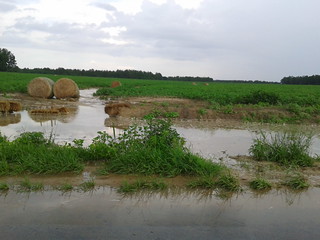
Runoff on Old Valdosta Road in Berrien County 2013-07-08 The pictured example of runoff from a cotton field was in Berrien County yesterday. While rain was pouring down, it ran half way across the road, and two cars wrecked. Once it gets across the road, either over it or through the culvert, it runs into the Withlacoochee River. As Pesticide Action Network reminds us, “Conventionally grown cotton uses more insecticides than any other single crop.”

Abbie Fentress Swanson wrote for GPB 6 July 2013, What Is Farm Runoff Doing To The Water? Scientists Wade In,

Agriculture is the nation’s leading cause of impaired water quality, according to the U.S. Environmental Protection Agency.

Continue reading

Getting water tested for arsenic (and other stuff)

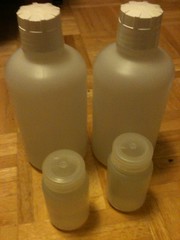
Water quality testing bottles Confused about how to test your water for arsenic? I was, too. Here’s how to do it.

Recently, there was a statement made by the Department of Health, recommending that well owners have their wells tested for arsenic.

I had heard about this previously from Janet McMahan and definitely wanted to do what she recommended (test hot water also).

I volunteer regularly at the County Extension Office and figured it would be easy to get what I needed for the testing.

I got a sheet of paper labelled “Water Submission Form” and it seemed like a standard information sheet, name, address type of well, tests requested. I figured that this is filled in at the extension once I would bring in my sample.

I got a summary sheet of paper labelled “Sampling Protocol for Testing Drinking Water” and knew that I wanted to test for Arsenic and Uranium so I followed those directions for both hot (as directed by Janet) and cold water. There is a more complete document about water quality attached.

Then, I took my samples to the extension office along with the list of tests that Janet had recommended getting. “Oh,” said the office manager, “you didn’t bring enough water for all those tests.”

She opened the book about tests and showed me that some tests I want need 4 ounces each (and one of them needs 16 oz) so the two 4 oz bottles I brought in are not near enough.

When she explained to me that tests W1 and W3 cost the same as W2 and W2 tests for more stuff, I figured I should get W2 instead of W1 and W3. But I didn’t even know what those things were, nor that the collection mechanisms are really different when I started.

It’s sort of like learning a foreign language, you can say the words, but until you actually know what they mean you don’t have a clue.

Understanding what each of the different water tests are, how to properly collect the water and how they are priced (another important factor) made it clear to me that I needed to go home (with some new bottles) and collect water on another day.

-gretchen

Water Quality and Common Treatments for Private Drinking Water Systems, Revised by Uttam Saha, Leticia Sonon, Mark Risse1 and David Kissel, Originally written by Anthony Tyson and Kerry Harrison, Extension Engineers.

Water filter to remove arsenic and lead

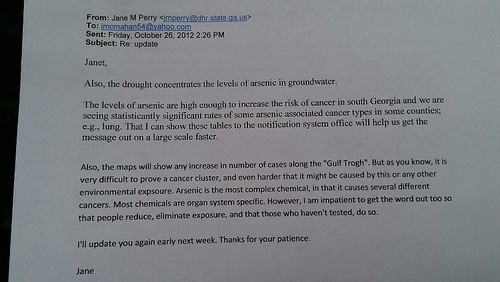
Arsenic --OSHA Wanted to make sure all of you have a Water Filter to remove Arsenic III [arsenic trioxide] and Lead!! Jane Perry, Chemical Hazards Project Director, Ga Dept of Health, has not been allowed to tell Doctors about Arsenic in our drinking water causing Cancer, especially Lung Cancer… Until she is “allowed to”, please share this email and tell others to get proper water filter! Thank You!!

-Janet McMahan

Letter from Jane M. Perry to Janet McMahan

Jane M. Perry From: Jane M Perry <jmperry@dhr.state.ga.us>
To: jmcmahan54@yahoo.com
Sent: Friday, October 26, 2012 2:26 PM
Subject: Re: update

Janet,

Also, the drought concentrates the levels of arsenic in groundwater.

The levels of arsenic are high enough to increase the risk of cancer in
Continue reading

Adopt-A-Stream water quality testing training with WWALS 2012-08-25

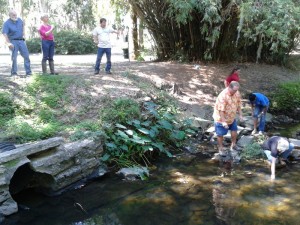
Students getting water from creek for Adopt-A-Stream water quality testing training.

Students getting water from creek for Adopt-A-Stream water quality testing training.

Angela Bray of the Southern Georgia Regional Commission (SGRC), assisted by Richard Battenn of SGRC and Al Browning, taught an Adopt-A-Stream water quality testing workshop Saturday 25 August 2012 in Valdosta.

Here’s a video playlist.

A few highlights:

Continue reading