Tag Archives: water use permit

Packet: with Public Hearing on Modified Phase II Water Shortage Order @ SRWMD 2026-04-14

Update 2026-04-14: The promoters bear the burden of proof about WFNF –WWALS to SRWMD 2026-04-13.

Update 2026-04-13: 10 AM that same day, three hours drive away in Palatka: Packet: Governing Board –SJRWMD 2026-04-14.

SRWMD is avoiding going to a Phase III Water Shortage Order by modifying their Phase II Order of last month.

[Packet: with Public Hearing on Modified Phase II Water Shortage Ordinance @ SRWMD 2026-04-14]
Packet: with Public Hearing on Modified Phase II Water Shortage Ordinance @ SRWMD 2026-04-14

The new Order does add some mandatory requirements, on agricultural uses, golf course irrigation, and utilities.

There is nothing on the agenda directly about Water First North Florida (WFNF), the SRWMD and SJRWMD plan to pipe treated wastewater from Jacksonville into the Suwannee Basin to rehydrate wetlands and raise levels and flows in rivers and springs, and also so Jacksonville’s water utility JEA can meet the letter of 2021 SB 64 that says it can’t keep outflowing treated wastewater into the St. Johns River starting in 2032. But this Modified Phase II Order is related.

For much more about WFNF, including the letters and resolutions against it by towns, counties, and regional entities, as well as who you can contact and a petition, see:

https://wwals.net/issues/wfnf

Be on time by 9 AM, Tuesday, April 14, 2026, at SRWMD HQ, 9225 County Road 49 Live Oak, FL, United States, Florida 32060, to comment at this meeting of the Suwannee River Water Management District (SRWMD).

While the agenda says there will be a Public Hearing about this Order, nothing in the agenda says that will call on members of the public to speak on that agenda item.

WATER RESOURCES
Amy Brown, Deputy Executive Director

  1. Water Resources Division Updates
  2. Public Hearing for Approval of Order Number 26-003, Modified Phase II Water Shortage

So best to follow the letter of the SRWMD policy in the agenda (see below) and fill in a comment card saying you want to speak on item number 10.

If you can’t go, you can watch the meeting live or later on the District’s YouTube channel:

https://www.youtube.com/@SRWMD

Somebody may also want to examine the agenda of the Audit Committee Meeting, which will happen “Following Board Meeting”. Maybe you can glean some clues as to what the District has spent on WFNF thus far.

https://www.mysuwanneeriver.com/ArchiveCenter/ViewFile/Item/1744

Also, given the Exceptional Drought that covers almost all of the Suwannee River Basin, Continue reading

Nutrien water withdrawals approved –SRWMD 2025-09-09

After SRWMD Chair Virginia Johns took the oath of office due to being reappointed, the Board at its September 9, 2025, meeting approved the agenda unchanged and then approved the Consent Agenda with the Nutrien White Springs phosphate mine water use permit still in there, for withdrawal of up to 64.1621 million gallons per day (MGD) of groundwater.

Plus, “The executive director may authorize the use of groundwater for back-up mining/dewatering use in excess of 11.0000 mgd in emergency circumstances.”

For comparison, the City of Gainesville is permitted 30.0 mgd by SJRWMD.

This strip mine water use permit was approved despite the fish kill WWALS notified SRWMD of and despite frequent violations of the Clean Water Act and the Resource Conservation and Recovery Act (RCRA).

[Nutrien water withdrawals approved, Consent Agenda unchanged, Letters from WWALS and OSFR ignored --SRWMD 2025-09-09]
Nutrien water withdrawals approved, Consent Agenda unchanged, Letters from WWALS and OSFR ignored –SRWMD 2025-09-09

I wonder if the Suwannee River Water Management District (SRWMD) Board or Staff looked at EPA ECHO, which shows Clean Water Act (CWA) Violations Identified in 5 of 12 quarters and 1 Significant Noncompliance, as well as Significant Noncompliance in all 12 quarters of the Resource Conservation and Recovery Act (RCRA). It’s true that these EPA ECHO quarters do not seem to include 2025, but such previous results are troubling. This is for PCS PHOSPHATE WHITE SPRINGS, 15843 SE 78TH PL, WHITE SPRINGS, FL 32096, which is the permit holder for NPDES permit FL0000655, which is cited in the SRWMD Board packet on page BCS 66: Continue reading

The NFRWSP’s job is to figure out how to increase water levels in the aquifer. –Dennis J. Price 2016-12-12

This is a letter Practicing Geologist Dennis J. Price wrote for publication.

December 12, 2016

RE: North Florida Regional Water Supply Partnership

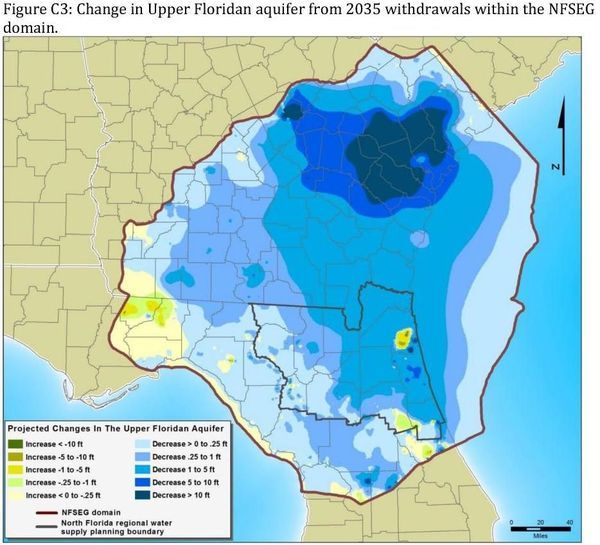
About 5 years ago, a report prepared for the Suwannee River Water Management District (SRWMD) indicated that under North Columbia County, East Hamilton County and Baker County, ground water levels in the Floridan aquifer (the aquifer the majority of us citizens get our water from) had dropped about 20 feet, more or less. The effects of the loss of that 20 feet was first felt and is very obvious in White Springs, 13 miles north of Lake City. The spring quit flowing for all intents and purposes. Tourism and the Towns economy plummeted.

[2019-04-03 White Sulfur Spring Flowing]
2019-04-03 White Sulfur Spring Flowing, so unusual an event it was reported for SRWMD by their Senior Hydrologist Fay Baird.

The report placed the greatest blame for the drawdown on water use by the coastal communities of South Georgia and North Florida. Scientists from the St. John’s River Water Management District (SJRWMD) at first concurred with this assessment. After objections from the Jacksonville Electric Authority (JEA) and the removal of several key employees at the SJRWMD, the SJRWMD said they weren’t sure anymore and a study needed to be done.

So, you guessed it, a committee was formed, The North Florida Regional Water Supply Partnership (NFRWSP). Don’t get me wrong regarding this committee, it is probably the single most important committee ever formed in our area. Their plans will affect the continued growth of North Florida communities along with the economy and recreational opportunities in our lakes and rivers.

Figure C3: Aquifer surface change due to withdrawals in north Florida and south Georgia

The NFRWSP’s job Continue reading