Category Archives: FDEP

Southern Cross Dairy (Suwannee Farms) liquidation and permit renewal 2019-11-25

Today I got an automated notice from FDEP about a wastewater permit for Suwannee Farms, and a WWALS member sent a picture of this auction sign saying “HUGE PRODUCE & ROW CROP FARM COMPLETE LIQUIDATION” next to a bigger sign saying Suwannee Farms. This is in Suwannee County near the Suwannee River.

[HUGE PRODUCE & ROW CROP FARM COMPLETE LIQUIDATION]

I called DeMottAuction.com and asked if the land was also for sale. They said they weren’t selling the land, only equipment. Which of course doesn’t mean that the land is not for sale; only that Continue reading

Turbidity, Coral Reef, Cyanotoxin, and Numeric Nutrient Criteria –Waterkeepers Florida to Florida Triennial Review 2019-11-22

Florida provides Get Out of Jail Free cards for fertilizer, sewage, and manure (FSM), wrote Waterkeepers Florida in this letter sent Friday to the Florida Department of Environmental Protection (FDEP) in its Triennial Review of Water Quality Standards:

If actual substantial harm is eventually found, the only result is a planning processes that lead to Basin Management Action Plans (BMAPs). BMAPs are largely collaborations of the operators of FSM pollution sources, and the only consequence of the failure of the plan to actually curb FSM pollution is a requirement to report the failure. Where BMAPs were hoped to be practical mechanisms to reduce FSM pollution, they have in fact functioned as a “Get Out of Jail Free” card for agriculture industries and other sources of as FSM pollution, while our waters continue to be degraded. The FSM rules have been implemented over the past seven years, during which time, widespread massive algae outbreaks have taken place on the St. Johns River, and in other rivers and lakes throughout Florida.

[Turbidity Criteria]

Much of this letter from most of the members of Waterkeepers Florida, including Suwannee Riverkeeper, is about cyanotoxins, which fortunately we do not yet have in the Suwannee River Basin, and coral reefs, which are a southern Florida regional matter. Yet every regional matter affects the whole state of Florida, the southeast, the nation, and the world. For example, about II. Routes of Ingestion:

This calculation only takes ingestion while swimming into account. Exposure to cyanotoxins can also occur dermally and through inhalation of aerosolized particles. These routes are not taken into consideration, as EPA states, because adequate effects data are not available. The relative source contribution that was a part of the 2016 recommendations has been removed, to focus on the ingestion.

Plus people all over Florida and beyond eat fish caught in the red tide areas: how much exposure to ingested cyanotoxins do we all have?

WKFL Letter

Continue reading

Nutrients and Cyanotoxins, FDEP Triennial Review Workshop, Tallahassee 2019-11-04

Water quality testing for nutrients and cyanotoxins were big topics at yesterday’s Public Workshop in Tallahassee. Apalachicola Riverkeeper Georgia Ackerman was there, but had to leave at noon. So John S. Quarterman ended up speaking as Suwannee Riverkeeper and on behalf of Waterkeepers Florida, in Florida’s Triennial Review of Water Quality Standards.

[Apalachicola Riverkeeper Georgia Ackerman]
Apalachicola Riverkeeper Georgia Ackerman

The FDEP presenters made it pretty clear they preferred putting up warning signs based on clorophyl a measurements and whenever cyanobacteria blooms are sighted, as they ask DOH to do now, to waiting for lab tests to come back to confirm, as EPA Continue reading

Tallahassee Triennial Review Public Workshop 2019-11-04

Update 2019-11-05: Workshop report.

FDEP is holding a Triennial Review workshop in Tallahassee Monday (tomorrow) morning.

When: 9AM, Monday, November 4, 2019

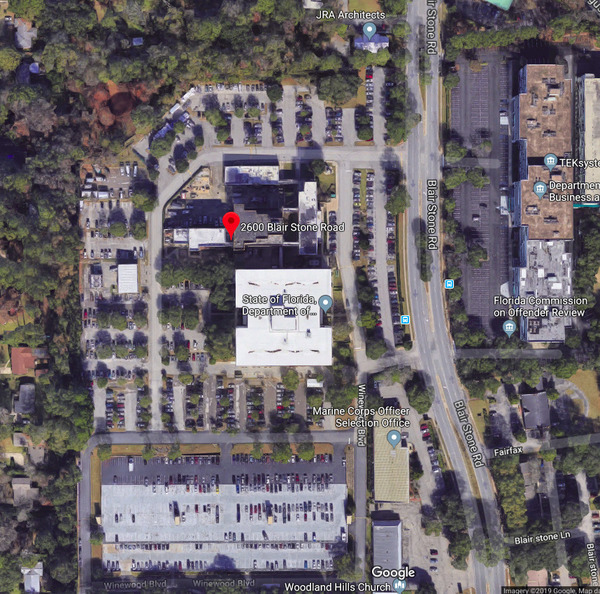
Where: Florida Department of Environmental Protection, Bob Martinez Center, Room 609, 2600 Blair Stone Road, Tallahassee, Florida

Announcement: on the FDEP website, along with the agenda.

Teleconference Call-in: 1-888-585-9008,

Conference Room Number: 125-938-245#

Teleconference participants will be in “listen only” mode (muted) throughout most of the meeting, but will be given an opportunity to provide verbal comments during the public comment period (after in-person attendees).

2600 Blair Stone Road, Tallahassee, FL, Map

If you can’t go to this one, three more are scheduled, but they will not have teleconference participation. They are: Continue reading

Waterkeepers Florida passes resolution against titanium mine application near Okefenokee Swamp

Waterkeepers Florida asks the Army Corps to require Twin Pines Minerals to supply all the information missing from its application for a titanium mine near the Okefenokee Swamp, to prepare a full Environmental Impact Statement (EIS), to hold Public Hearings, including in Florida, and “to answer how the Corps has or will determine that the Applicant’s proposed mine would not adversely affect the Okefenokee Swamp, the St. Marys River, the Suwannee River, the Floridan Aquifer, or the State of Florida.”

You can also still comment to the Army Corps.

[TPM Equipment closeup, Wayne Morgan]
TPM Equipment closeup Photo: Wayne Morgan for Suwannee Riverkeeper on Southwings flight, pilot Allen Nodorft, 2019-10-05.

Continue reading

Raise no limits, sample more water, publish timely –WWALS to FDEP Triennial Review 2019-05-31

Dear FDEP, please raise no pollutant limits, do more water quality monitoring, and publish all testing results in days, not months.

[More water quality monitoring]
More water quality monitoring

Continue reading

Florida Algal Bloom Maps 2019-06-01

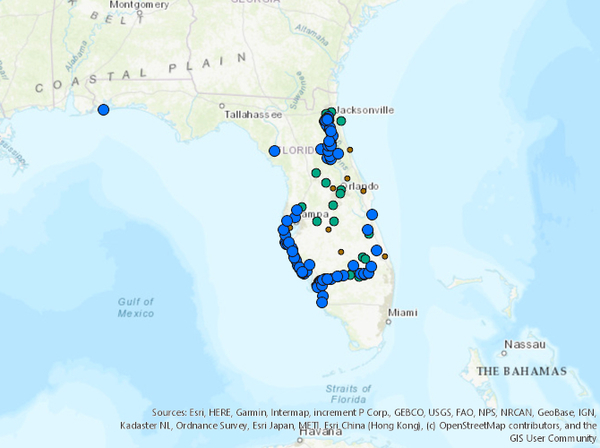
What’s this about cyanobacteria blooms in Florida?

Florida, Maps

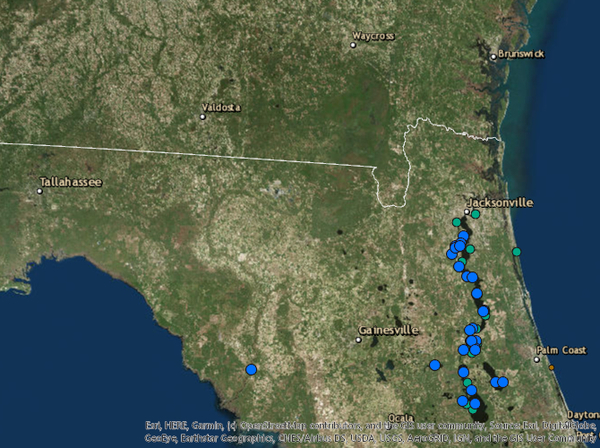
It’s a big problem, although no so much in the Suwannee River Basin. However, there is a yellow-green (not cyanobacteria) bloom at Manatee Spring Run on the lower Suwannee River.

Suwannee River Basin, Maps

FDEP provides Weekly Updates and Subscription to Algal Bloom Monitoring, including maps in Algal Bloom Sampling Status, from which these maps come.

Here’s the detail on the one algal bloom in the Suwannee River Basin. Continue reading

Cyanobacteria in Florida Triennial Review of Water Quality Standards –Waterkeepers Florida 2019-05-31

Waterkeepers Florida yesterday voted to send a letter to FDEP about cyanobacteria as comment in the Triennial Review of Florida Water Quality Standards.

[The cyanobacteria problem in Florida]
The cyanobacteria problem in Florida

You may recall Continue reading

SRWMD Water Quality Monitoring 2019-04-25

Confirmed today by telephone: FDEP is analyzing DNA and human tracers such as sucralose monthly at at least three stations: on the Withlacoochee and Alapahoochee Rivers at the Georgia-Florida line, and at the Withlacoochee River Confluence with the Suwannee River at Ellaville. Those are the top center left blue stars on this map.

[Surface water Trend Stations]
Surface water Trend Stations

Confirmed by: Darlene Velez, Water Resources Chief, Suwannee River Water Management District (SRWMD).

This is what Waterkeepers Florida (WKFL) heard in Orlando on April 15th from Continue reading

Waterkeepers Florida met FDEP in Orlando about Triennial Review of Water Quality Standards 2019-04-15

FDEP is analyzing DNA and human tracers such as sucralose monthly at at least three stations: on the Withlacoochee and Alapahoochee Rivers at the Georgia-Florida line, and at the Withlacoochee River Confluence with the Suwannee River at Ellaville. This is what Waterkeepers Florida (WKFL) heard in Orlando on April 15th from FDEP’s Tom Frick. I think he may have also said at the Alapaha Confluence with the Suwannee River.

Tom Frick (DEAR), Ken Weaver (Standards), Dave Whiting (Laboratory), Darryl Joyner (WQSP), FDEP
FDEP, left to right: Tom Frick (DEAR), Ken Weaver (Standards), Dave Whiting (Laboratory), Darryl Joyner (WQSP).

I asked Tom Frick about that at the meeting FDEP requested with Waterkeepers Florida (WKFL) about the Florida Triennial Review of Water Quality Standards,

Unlike in Georgia, Continue reading