Tag Archives: agriculture

Sabal Trail slips its in-service request to June; FERC classifies WWALS shutdown request as motion 2017-05-26

They finally admit to FERC the Sabal Trail boondoggle is a month late! And FERC reclassifies the WWALS filing as a motion for all three SMPP pipelines.

Susan Salisbury, Palm Beach Post, 26 May 2017, Sabal Trail seeks new pipeline start date; group wants shutdown,

Sabal Trail Transmission on Friday asked federal regulators for an early June in-service date for its portion of the Alabama-to-Florida natural gas pipeline, a later date than it had requested earlier this month.

With segmented KMI FGT JEP to Jacksonville to Eagle LNG export:

On May 17 Houston-based Sabal Trail had asked the Federal Energy Regulatory Commission for permission to start sending gas through the pipeline by today — May 26.

Also Friday, the Georgia-based WWALS Watershed Coalition asked FERC to deny all requests to place the pipeline into service, and said FERC should revoke the permit and shut it down.

The Sierra Club recently asked FERC to delay the pipeline’s operation until after pending litigation is resolved.

FERC has yet to act on either of Sabal Trail’s start-up date requests or on The Sierra Club’s request.

Maybe FERC staff have noticed Continue reading

WWALS asks FERC to deny Sabal Trail’s in-service request and to revoke its permit

Update: 2017-06-05: WWALS files with FERC against Sabal Trail again, about sea change from fossil fuels to sun and wind power.

Update 2017-05-27: Sabal Trail slips its in-service request to June; FERC classifies WWALS shutdown request as motion 2017-05-26.

FOR IMMEDIATE RELEASE

Hahira, GA, May 26, 2017 — WWALS Watershed Coalition today asked the Federal Energy Regulatory Commission (FERC) to “stay, stop, or deny all requests to place any project facilities into service” for the Southeast Markets Pipeline Project (SMPP) including Sabal Trail. Further “WWALS as an intervenor formally requests FERC to revoke its Certificate of Convenience and Necessity for SMPP.”

In its thirteen-page filing (available online and in PDF), WWALS listed six reasons, each with its own attachment of details:

  1. The alleged need for this pipeline project, which has been refuted by its funding organization in FPL’s 2016 Ten Year Plan and by other evidence; and
  2. FERC has taken jurisdiction of at least one LNG export chain from Sabal Trail, despite FERC’s own assertion in its February 2016 Certificate; and
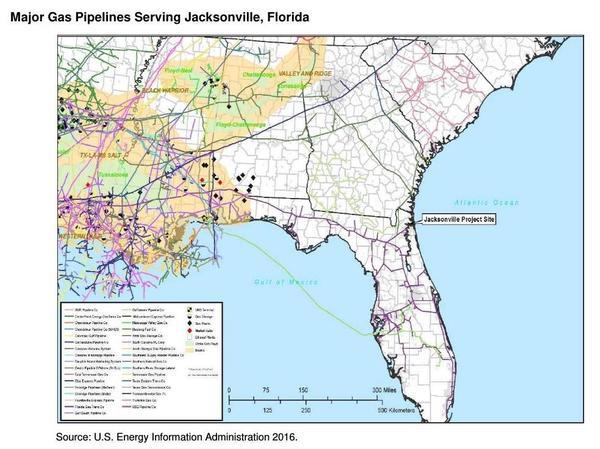
  3. Major Gas Pipelines Serving Jacksonville, Florida
    See Sabal Trail to export through Jacksonville, FL.

  4. Failure to assess risks to Floridan Aquifer, the primary water supply for the region; and
  5. Numerous permit violations during construction; and
  6. Failure to address especially egregious violations such as the destruction of Randy Dowdy’s world-record soybean fields; and
  7. The legal challenges recited in the Sierra Club letter of May 18, 2017, FERC Accession Number 20170519-5018, are all completely litigated.

WWALS president and Suwannee Riverkeeper John S. Quarterman said, “It’s not too late for FERC to do its job and actually evaluate all the new evidence that has come to light. Even more, FERC should look at how the world has changed Continue reading

Sabal Trail asks FERC to authorize turning on gas 2017-05-17

Sabal Trail has discovered the southeast has drought! That’s its excuse for not greening up its gouge across what it calls its “greenfield” route. Sabal Trail “will continue to be available” to address landowner concerns, as if they have addressed destroying Randy Dowdy’s world-record soybean fields. They claim they’ve resolved 271 of 279 landowner issues: as near as I can tell mostly by suing the landowners, like they did the Bell Brothers.

Revegetation and drought

Pipeline company chutzpah! Solar power would do this faster, cheaper, and cleaner: “Granting Sabal Trail’s request by May 26 will allow Sabal Trail to commence service promptly to FPL and will significantly increase the available supply of natural gas to the Southeastern United States during the heart of the peak summer cooling season.” More likely Sabal Trail wants to be in-service by the end of May to avoid forfeiting that $200 million bond required by FPL’s RFP.

Sabal Trail’s list of karst features doesn’t match its own Continue reading

Video: Randy Dowdy in VDT 2017-05-05

“We’ve got loss of production for the future that will take not my lifetime, not my kids’ lifetime, but my kids’ kids’ lifetime to recover from,” Randy Dowdy

Daniel DeMersseman, Valdosta Daily Times, 5 May 2017, Farmer: Sabal Trail devastated farm,

QUITMAN — A Brooks County farmer said Wednesday the controversial Sabal Trail natural gas pipeline has ruined his farmland.


“We’ve got loss of production for the future that will take not my lifetime, not my kids’ lifetime, but my kids’ kids’ lifetime to recover from,” Randy Dowdy, interviewed by Daniel DeMersseman, Valdosta Daily Times.

Randy Dowdy is a major corn and soybean producer. In fact, he holds a world’s record for soybean production and a U.S. record for corn production but now he says his award-winning farm is in jeopardy.

Daniel Demersseman (VDT), Randy Dowdy (farmer)
Daniel Demersseman (VDT), Randy Dowdy (farmer), photo by John S. Quarterman for WWALS Watershed Coalition

Environmentalists held a press conference this week alongside Dowdy to say their worst fears about the pipeline have been realized.

“Sabal Trail gouged its pipeline through Continue reading

Record-holding farmer, land destroyed by Sabal Trail, in Valdosta at pipeline safety meeting

FOR IMMEDIATE RELEASE

Valdosta, May 3, 2017 — U.S. corn production record holder and world soybean record holder Randy Dowdy, whose record-producing fields were severely eroded in rains after Sabal Trail’s pipeline construction destroyed his terraces and caused massive erosion of his cropland, will be at the Rainwater Conference Center in Valdosta 11:30 AM this morning at a pipeline safety exercise to talk about the implications of Sabal Trail’s destruction for pipeline safety and his livelihood.

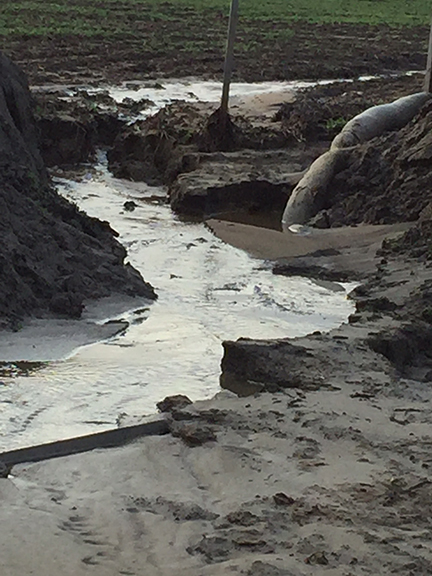
Randy Dowdy is the 2014 50-year record holder for U.S. corn production and the world record holder for soybean production. Sabal Trail gouged its pipeline through his terraces on the land he used for those soybeans in Brooks County. Despite his warnings, they left that damage unfixed until rains in January caused massive erosion, washing his topsoil into a nearby creek. Beyond immediate damage, this destruction affects Dowdy’s ability to grow such record yields, and the basic productivity of his fields. What further economic damage has Sabal Trail done to other farmers and landowners? Where else will Sabal Trail’s pipeline cause erosion, perhaps in some places exposing the pipe and risking corrosion and breaks?

The event 11:30 AM this morning at Rainwater Conference Center in Continue reading

Suwannee Riverkeeper at Sparkleberry Florida Native Plant Society in Branford 2017-05-09

Water, Agriculture, Forestry, and WWALS, by WWALS Executive Director Gretchen Quarterman, and recent advocacy (BMAPs, Bill Gates, Pilgrim’s Pride, phosphate mines, Wanee, Sabal Trail, and solar power) by Suwannee Riverkeeper John S. Quarterman, at the Florida Native Plant Society Sparkleberry Chapter in Branford, Suwannee County, Florida, on the Suwannee River.

When: 6:30 PM 9 May 2017: 30-45 minutes plus Q & A

Where: Hatch Park, 403 SE Craven St., Branford, FL 32008

Host: Sparkleberry Chapter, Florida Native Plant Society
“Serving Suwannee, Dixie, Gilchrist, Lafayette and Taylor Counties.”

Event: facebook

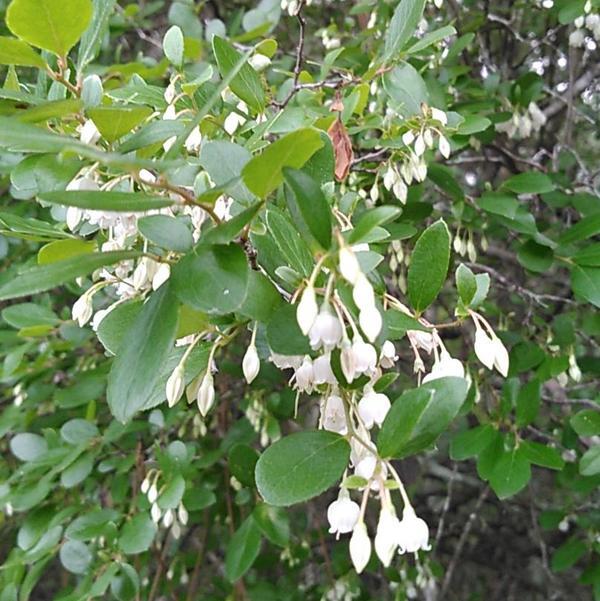
Vaccinium arboreum
Vaccineum Arboreum, tree huckleberry, sparkleberry

Hatch Park is easy walking distance from Continue reading

BMAPs: Agriculture and water at the Suwannee River Basin crossroads 2017-04-13

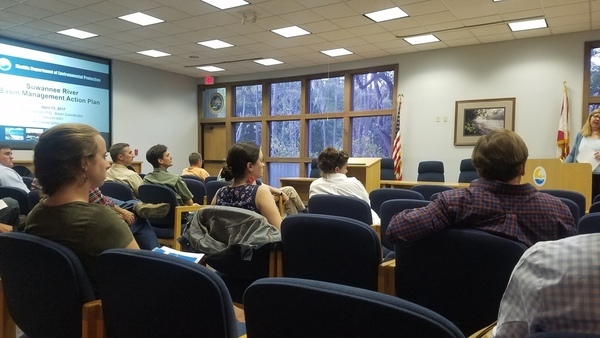
The conclusion from FDEP in their BMAP presented to an almost-full SRWMD boardroom on April 13, 2017 was: nitrogen runoff into springs and rivers from all sources (the biggest being agriculture, dairies, and poultry) must decrease 83 to 93 percent. For once nobody seemed to argue with research by state agencies. Rather everyone, from representatives of the biggest of farmers to Pilgrim’s Pride to a wide variety of environmental groups seemed aghast at the severity of the situation.

Title slide

This Basin Management Action Plan (BMAP) for the Lower and Middle Suwannee River Basin turns out to include the Withlacoochee River almost to the Georgia line, because Continue reading

River spraying erosion, Withlacoochee River

Received yesterday:

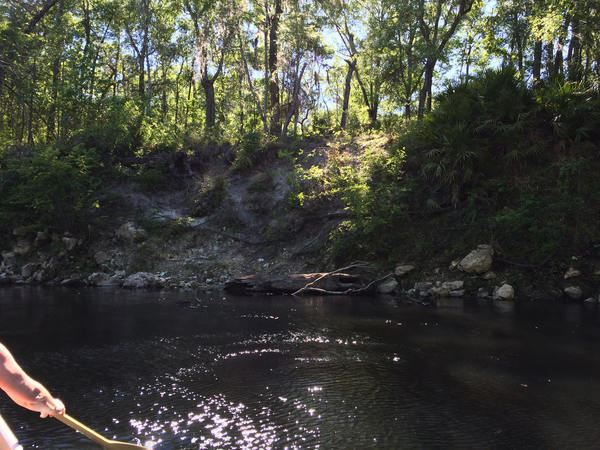
The property owner sprayed this section of bank along the Withlacoochee with roundup several years ago. This picture clearly shows why we need to protect and leave intact the vegetation along the river banks. The erosion has only occurred at the section that was denuded of vegetation.

Chris Mericle

Denuded bluff,
Madison County side, 30.4162370, -83.2077630.

 -jsq, John S. Quarterman, Suwannee RIVERKEEPER®

You can join this fun and work by becoming a WWALS member today!

Videos: Water, Agriculture, and Forestry; WWALS @ VSU 2017-03-28

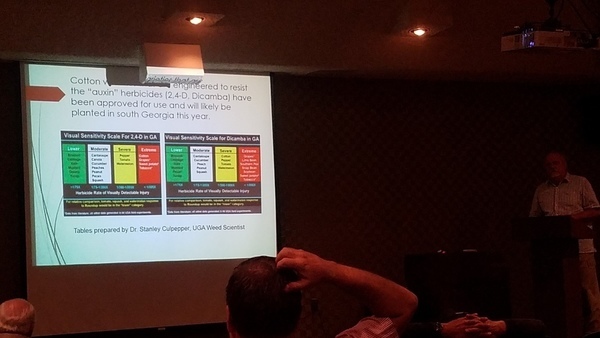
You can’t use traditional models for the karst Floridan Aquifer; new and harsher pesticides are expected this summer; but you can help raise native species; and later this month you can go see many of them in Berrien County, plus WWALS monthly outings, the Withlacoochee and Little River Water Trail, and the Alapaha River Water Trail and some WWALS history.

Yeah, 2,4-D and Dicamba are head-scratchers --Tom Potter
Yeah, coming this summer, and they’re head-scratchers.

All this was at the quarterly WWALS public meeting, this one on Water, Agriculture, and Forestry at Valdosta State University, March 28, 2017.

Here are links to each WWALS video of each talk, with a few notes and a few extra pictures, followed by a WWALS video playlist. Continue reading

Crop nitrogen losses into Suwannee Basin

Here is a very interesting paper about increasing nitrogen from crops into the Suwannee River Basin and its springs (promoting algae growth), with actual data on how well best management practices (BMPs) are containing the runoff: Environmental Nitrogen Losses from Commercial Crop Production Systems in the Suwannee River Basin of Florida, by Rishi Prasad, George J. Hochmuth, PLOSOne, Published: December 1, 2016, http://dx.doi.org/10.1371/journal.pone.0167558


Fig 3. Comparison of A) environmental nitrogen losses (Nenvloss) from three crops (potato, sweet corn and silage corn) during four growing seasons (2010 to2013) and B) relationship between seasonal total N rates and environmental nitrogen losses at the study farm in the Middle Suwannee River Basin, Florida. Silage corn was not studied during 2013. Mean values of Nenvloss (represented by individual bars and their standard errors for the three crops) followed by different letters indicate significant difference at α = 0.05 level

Abstract Continue reading