 First a $250 check, then a letter of support, from the Hamilton County, Florida
Tourist Development Council (TDC).
WWALS thanks TDC!
First a $250 check, then a letter of support, from the Hamilton County, Florida
Tourist Development Council (TDC).
WWALS thanks TDC!
In this picture taken at the 26 October 2014 Dead River Sink Outing Continue reading

First a $250 check, then a letter of support, from the Hamilton County, Florida
Tourist Development Council (TDC).
WWALS thanks TDC!
In this picture taken at the 26 October 2014 Dead River Sink Outing Continue reading
 “There is no reason anyone
in WWALS’ watersheds should accept any risk for the
profit of Williams Company, Spectra Energy, and FPL, when
any need for the Sabal Trail pipeline is unproven, and in
any case the pipeline does not serve anyone in
Georgia.”
“There is no reason anyone
in WWALS’ watersheds should accept any risk for the
profit of Williams Company, Spectra Energy, and FPL, when
any need for the Sabal Trail pipeline is unproven, and in
any case the pipeline does not serve anyone in
Georgia.”
Filed with FERC 15 November 2014, and appeared in FERC’s ecomment system 17 November 2014 (PDF).

WWALS Watershed Coalition, Inc.
3338 Country Club Road #L336
Valdosta, GA 31605
15 November 2014VIA ELECTRONIC FILING
Ms. Kimberly Bose
Federal Energy Regulatory Commission
888 First Street NE
Washington, DC 20426Re: Southeast Market Pipelines Project,
Sabal Trail Transmission, LLC Docket No PFl4-1-000
Williams Transco Hillabee Expansion Project, LLC Docket No PFl4-6-000Dear Ms. Bose,
I applaud FERC for getting Sabal Trail to move off of the Withlacoochee River in Hamilton County, Florida. However, the same karst limestone geology underlies the same Withlacoochee River and the Floridan Aquifer in Brooks and Lowndes Counties, Georgia, and WWALS Watershed Coalition continues Continue reading
The Alapaha River goes underground because the underlying karst limestone rises in what’s called the Cody Scarp, which runs across north Florida. Other rivers that go underground there include the Little Alapaha River and the Santa Fe River. The Withlacoochee River does not go underground, but it does sprout Madison Blue Spring.

Source: Bulletin of the Geological Society of America, vol. 123, no. 3-4, p. 457.
Here’s a cutaway diagram of how all that works underground: Continue reading
Update 2025-09-21: Graphs from water.noaa.gov.
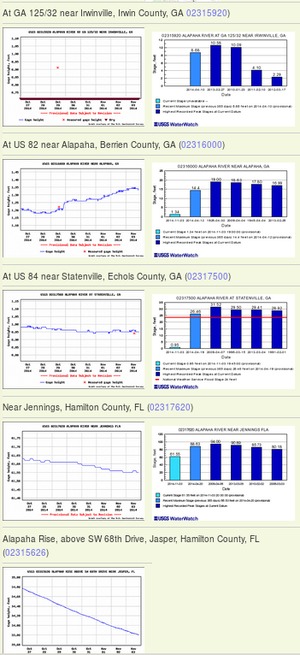 Update 2016-12-23: graphs from water.weather.gov.
Update 2016-05-31: See sea level gage reports.
Update 2015-04-28: Added flood stages and tentative highest safe and lowest boatable water levels, both above the charts for each gauge and in a summary table. If you have data, please let us know.
Here are water level gauges for the Alapaha River in Georgia and Florida, north to south. The graphs should show the current levels at this time, in feet, plus for most of the gauges a bar graph of selected historic levels.
This is a draft of a concept for use with the Alapaha River Water Trail. See also Alapaha River Rainy Season.
It is also a companion to the similar set of graphs for the Withlacoochee and Little Rivers.
See below for the current Alapaha River water level graphs. Continue reading
 Received yesterday. -jsq
These pictures are of a dust storm that occurred earlier this year. The dust is from Bill Gates’ farms. Look closely, there is a power transmission tower in the picture. Continue reading
 Two dozen agricultural parcels owned by a shell of a shell of a shell company
investing for Bill Gates in Hamilton County, Florida.
Two parcels are in the Withlacoochee River
watershed and within the blast radius of the original
path of the Sabal Trail fracked methane pipeline.
Two dozen agricultural parcels owned by a shell of a shell of a shell company
investing for Bill Gates in Hamilton County, Florida.
Two parcels are in the Withlacoochee River
watershed and within the blast radius of the original
path of the Sabal Trail fracked methane pipeline.
The Hamilton County, Florida, Property Appraiser shows these results for a search for Lakeland Sands: Continue reading
This Sunday afternoon, Oct 26th at 2PM:
where the Dead River meets the Alapaha River and goes underground
at the Dead River Sink, aka the Alapaha Sink.
 Park on SRWMD’s Jennings Bluff Tract and walk in with WWALS
to see what Samuel Taylor Coleridge dreamed as
“Where Alph, the sacred river, ran
Through caverns measureless to man
Down to a sunless sea.”
No boat required: this is a walking outing.
Park on SRWMD’s Jennings Bluff Tract and walk in with WWALS
to see what Samuel Taylor Coleridge dreamed as
“Where Alph, the sacred river, ran
Through caverns measureless to man
Down to a sunless sea.”
No boat required: this is a walking outing.
It’s an adventure, as Deanna Mericle reported recently:
…the hike to the sink does have some steep parts, especially if you go the scenic route, which I recommend. The area around the sink itself is kind of steep with slick mud/clay. So wear good shoes for hiking. There were only a few Mosquitos. The area is beautiful and worth the effort.
This event is FREE! All we ask is Continue reading
Drilling through fragile sinkhole-prone
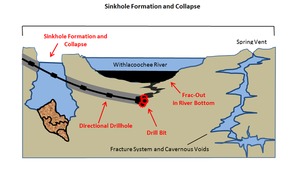 karst limestone under the Withlacoochee River (or the Suwannee River,
or the Santa Fe River): what could possibly go wrong?
Sabal Trail now proposes to move off of the Withlacoochee River in
Florida, but still plans to cross the Withlacoochee in Georgia,
and to cross the Suwannee and Santa Fe Rivers, all of which have
the same hydrogeology.
You can talk directly to Sabal Trail and FERC at the
Open House in Jasper, Florida, 5-7PM Tuesday 21 October 2014,
and you can join WWALS where the Alapaha River
disappears entirely into a sinkhole,
at the
Alapaha Sink, 2PM Sunday 26 October 2014.
karst limestone under the Withlacoochee River (or the Suwannee River,
or the Santa Fe River): what could possibly go wrong?
Sabal Trail now proposes to move off of the Withlacoochee River in
Florida, but still plans to cross the Withlacoochee in Georgia,
and to cross the Suwannee and Santa Fe Rivers, all of which have
the same hydrogeology.
You can talk directly to Sabal Trail and FERC at the
Open House in Jasper, Florida, 5-7PM Tuesday 21 October 2014,
and you can join WWALS where the Alapaha River
disappears entirely into a sinkhole,
at the
Alapaha Sink, 2PM Sunday 26 October 2014.
Here are before and after diagrams by Continue reading
Due to fine work by WWALS members Chris and Deanna Mericle in Hamilton
County, Florida,
 Sabal Trail proposes to move its fracked methane
pipeline off of the Withlacoochee River in Florida, and invites the public
to an Open House in Jasper, FL Tuesday October 21st about that and
other matters. We can ask them to move it off the Withlacoochee River
in Georgia, too. And it’s still possible to file ecomments with FERC,
and to contact your local, state, and national elected and appointed officials.
Sabal Trail proposes to move its fracked methane
pipeline off of the Withlacoochee River in Florida, and invites the public
to an Open House in Jasper, FL Tuesday October 21st about that and
other matters. We can ask them to move it off the Withlacoochee River
in Georgia, too. And it’s still possible to file ecomments with FERC,
and to contact your local, state, and national elected and appointed officials.
In FERC’s 15 October 2014 Sabal Trail Notice of EIS Intent and Route Alternatives, Continue reading
There’s are a reason the WWALS Mission says “conservation”. It’s pithily summed up by Prof. Rahul Mehrotra.
Elizabeth Gudrais wrote for Harvard Magazine May-June 2012, Engaging Students with Conservation,
PROFESSOR OF URBAN DESIGN and planning Rahul Mehrotra has been involved with restoring historic palaces, writing a law on historic preservation in Mumbai, and crafting a conservation master plan for the Taj Mahal. Harvard recruited him in part for this expertise, and this academic year, with Noyes professor in architectural theory Michael Hays, he has launched a conservation track for Graduate School of Design (GSD) master’s students.
Conservation, he says, is not the same as preservation, which focuses on protection and repair. Conservation is broader and richer, combining historical integrity and creativity to develop narratives connecting the present with the past.
Historical narratives like connecting Continue reading