Category Archives: Quality

Agricultural runoff

The Southern Georgia Regional Commission invites you to contact them about agricultural runoff. WWALS is concerned with how industrial farming and clear cutting affects both water quality and quantity in our watershed.

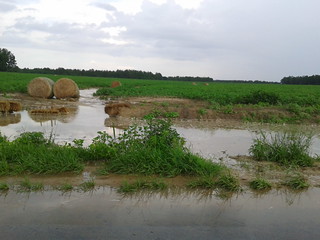
Runoff on Old Valdosta Road in Berrien County 2013-07-08 The pictured example of runoff from a cotton field was in Berrien County yesterday. While rain was pouring down, it ran half way across the road, and two cars wrecked. Once it gets across the road, either over it or through the culvert, it runs into the Withlacoochee River. As Pesticide Action Network reminds us, “Conventionally grown cotton uses more insecticides than any other single crop.”

Abbie Fentress Swanson wrote for GPB 6 July 2013, What Is Farm Runoff Doing To The Water? Scientists Wade In,

Agriculture is the nation’s leading cause of impaired water quality, according to the U.S. Environmental Protection Agency.

Continue reading

George Vellidis Dissolved Oxygen Slides

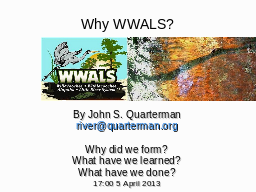
PDF of Dissolved Oxygen Dynamics in the Upper Suwannee River Basin by Prof. George Vellidis, Crop & Soil Sciences Dept., University of Georgia, Tifton, GA. He used these slides when he discussed the dynamics of dissolved oxygen concentrations in WWALS waterways at the 8 May 2013 WWALS board meeting.

More later.

-jsq

Arsenic, Outings, and Flooding: WWALS Watershed Coalition @ VLCIA 2013-04-16

Water issues strongly affect economic development, so I talked about the new WWALS Watershed Coalition at the 16 April 2013 Board Meeting of the Valdosta-Lowndes County Industrial Authority.

The VDT declined to speak, so I did. After apologizing for no okra today, I commended the Authority for talking about the missing agenda items and for mentioning due diligence and flood control.

Mostly I talked about the new WWALS Watershed Coalition, www.wwals.net, incorporated in June 2012, which is about watershed issues such as flooding, water quality, and invasive species related to the Withlacoochee, Willacoochee, Alapaha, and Little River System. I mentioned arsenic in some local well water, which the Department of Health has finally said should be tested, three years after Janet McMahan discovered it was a problem. I invited VLCIA board and staff to two upcoming WWALS events:

WWALS board meetings are every second Wednesday of the month, usually at the IHOP in Adel because it’s centrally located. WWALS is communicating with Valdosta and various organizations about flooding and other watershed-wide issues, which in my opinion have to do with things like too much clearcutting without consideration for where the water goes, too much development without consideration for what the impervious surface would do, (to my surprise, the Executive Director and several board members nodded along with that) so it was good to hear them mention flood containment.

Here’s the video:


Arsenic, Outings, and Flooding: WWALS Watershed Coalition
Regular Meeting, Valdosta-Lowndes County Industrial Authority (VLCIA),
Norman Bennett, Tom Call, Roy Copeland, Chairman, Mary Gooding, Jerry Jennett, Andrea Schruijer, Executive Director, J. Stephen Gupton, Attorney, Tom Davis, CPA, Allan Ricketts, Project Manager,S. Meghan Duke, Public Relations & Marketing Manager, Lu Williams, Operations Manager,
Video by John S. Quarterman for Lowndes Area Knowledge Exchange (LAKE), Valdosta, Lowndes County, Georgia, 16 April 2013.

-jsq

Flint River #2 on American Rivers’ Most Endangered Rivers list

American Rivers released Wednesday its list of America’s Most Endangered Rivers® 2013, and our neighbor to the west, the Flint River, is on it. Some of the Flint’s problems are the same as in our WWALS watersheds, including drought and floods. The writeup doesn’t mention it, but I think the arsenic wellwater problem extends over there, too. The Flint does have Atlanta at its headwaters, and Flint Riverkeeper and others just had to fight off a legislative attempt to frack Flint water for Atlanta. However, the overpumping problem was apparently already much worse in parts of our watersheds way back in 1980. And the Flint doesn’t have the Lowndes County Commission, which prefers to close its only public access to the Alapaha River rather than listen to 350 people wanting to keep it open for demonstrated public uses. -jsq

Flint River, Georgia Take Action
At Risk: Water supply for communities, farms, recreation, and wildlife
Threat: Outdated water management

The Flint River provides water for over one million people, 10,000 farms, unique wildlife, and 300 miles of exceptional fishing and paddling. Despite being in a historically wet area of the country, in recent years many Flint River tributaries are drying up completely and the river’s low flows have dropped dramatically.

American Rivers and Flint Riverkeeper are working in collaboration with diverse partners to restore the flows and health of the Flint. The State of Georgia also has a role to play and must act to protect the Flint in droughts and at all times to safeguard the river’s health for today and future generations.

The Threat

The Flint is a river running dry. The reasons are many, and include

Continue reading

Watershed meeting organized by Army Corps of Engineers

The U.S. Army Corps of Engineers (USACE) didn’t know there was a large water problem hereabouts, but now they do, and they want to take a watershed-wide approach, from the headwaters to the Gulf of Mexico, including both surface water and aquifer issues, perhaps starting with redrawing FEMA’s flood maps, and maybe even including once again funding the state water council.

Thursday 11 April 2013 there was a rather large governmental meeting organized by USACE in response to the City of Valdosta’s request of 11 March 2103. Yesterday, Valdosta City Council District 5 Tim Carroll sent the appended list of attendees, augmented by a conversation with him on the phone just now. We know little else, because no media or private citizens were invited.

  • USACE Savannah office: Jeff Morris, Georgia Silver Jackets Coordinator and Beth Williams, Hydraulic Engineer
  • USACE Jacksonville office: David Apple, Chief, Watershed and Restoration Planning Section
  • GADNR: Christopher Hill and Tom Shillock, GAEPD Floodplain Management Unit
  • GEMA: Dee Langley, Planning Program Manager and Terry Lunn, Director, Hazard Mitigation Division
  • GEMA: Gary Rice – Regional Field Coordinator
  • USGS: Brian McCallum, Supv. Hydrologist/ADir and Keith McFadden, Physical Scientist
  • FEMA Region 4: Susan Wilson, CFM, Floodplain Management and Insurance Branch Chief and Janice Mitchell, Insurance Specialist and Lender Compliance

Those state and national agencies were brought by:

Continue reading

Getting water tested for arsenic (and other stuff)

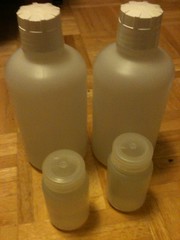
Water quality testing bottles Confused about how to test your water for arsenic? I was, too. Here’s how to do it.

Recently, there was a statement made by the Department of Health, recommending that well owners have their wells tested for arsenic.

I had heard about this previously from Janet McMahan and definitely wanted to do what she recommended (test hot water also).

I volunteer regularly at the County Extension Office and figured it would be easy to get what I needed for the testing.

I got a sheet of paper labelled “Water Submission Form” and it seemed like a standard information sheet, name, address type of well, tests requested. I figured that this is filled in at the extension once I would bring in my sample.

I got a summary sheet of paper labelled “Sampling Protocol for Testing Drinking Water” and knew that I wanted to test for Arsenic and Uranium so I followed those directions for both hot (as directed by Janet) and cold water. There is a more complete document about water quality attached.

Then, I took my samples to the extension office along with the list of tests that Janet had recommended getting. “Oh,” said the office manager, “you didn’t bring enough water for all those tests.”

She opened the book about tests and showed me that some tests I want need 4 ounces each (and one of them needs 16 oz) so the two 4 oz bottles I brought in are not near enough.

When she explained to me that tests W1 and W3 cost the same as W2 and W2 tests for more stuff, I figured I should get W2 instead of W1 and W3. But I didn’t even know what those things were, nor that the collection mechanisms are really different when I started.

It’s sort of like learning a foreign language, you can say the words, but until you actually know what they mean you don’t have a clue.

Understanding what each of the different water tests are, how to properly collect the water and how they are priced (another important factor) made it clear to me that I needed to go home (with some new bottles) and collect water on another day.

-gretchen

Water Quality and Common Treatments for Private Drinking Water Systems, Revised by Uttam Saha, Leticia Sonon, Mark Risse1 and David Kissel, Originally written by Anthony Tyson and Kerry Harrison, Extension Engineers.

Water filter to remove arsenic and lead

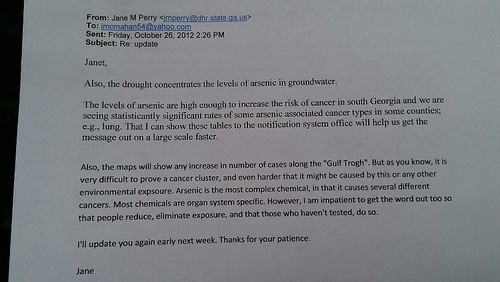
Arsenic --OSHA Wanted to make sure all of you have a Water Filter to remove Arsenic III [arsenic trioxide] and Lead!! Jane Perry, Chemical Hazards Project Director, Ga Dept of Health, has not been allowed to tell Doctors about Arsenic in our drinking water causing Cancer, especially Lung Cancer… Until she is “allowed to”, please share this email and tell others to get proper water filter! Thank You!!

-Janet McMahan

Letter from Jane M. Perry to Janet McMahan

Jane M. Perry From: Jane M Perry <jmperry@dhr.state.ga.us>
To: jmcmahan54@yahoo.com
Sent: Friday, October 26, 2012 2:26 PM
Subject: Re: update

Janet,

Also, the drought concentrates the levels of arsenic in groundwater.

The levels of arsenic are high enough to increase the risk of cancer in
Continue reading

Nonpoint Source Pollution biggest water quality problem –EPA

EPA found phosphorus and nitrogen from fertilizers, bacteria and other pollutants from urban runoff, plus mercury, in most U.S. rivers and streams. And they didn’t even mention low dissolved oxygen.

Ian Simpson wrote for Reuters, carried by NBC, EPA: More than half of U.S. rivers unsuitable for aquatic life,

Fifty-five percent of U.S. river and stream lengths were in poor condition for aquatic life, largely under threat from runoff contaminated by fertilizers, the U.S. Environmental Protection Agency said on Tuesday.

High levels of phosphorus and nitrogen, runoff from urban areas, shrinking ground cover and pollution from mercury and bacteria were putting the 1.2 million miles of streams and rivers surveyed under stress, the EPA said.

“This new science shows that America’s streams and rivers are under significant pressure,” Nancy Stone, acting administrator of the EPA’s Office of Water, said in a statement.

Twenty-one percent of the United States’ river and stream length was

Continue reading