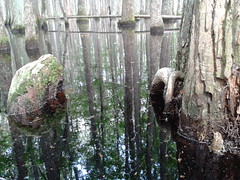
Here in central south Georgia our pocosin swamps and blackwater river
flood plains are important for fishing, hunting, wildlife and
ecological preservation as well as recreation and flood control.
In our watersheds we have serious problems of flooding at least
partly due to Continue reading →
Tomorrow the PSC decides on requiring Georgia Power to add more
solar power. The swing vote is
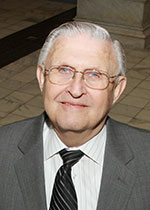
H. Doug Everett, Commissioner for
District 1, which includes all of our watersheds.
He went to high school in Sylvester, which is in the Little River
watershed, and he is on the board of the Georgia Agrirama
Development Authority.
You can contact him through the above web page, or call him at his
PSC office: (800) 282-5813.
You probably remember last month the WWALS board
sent a letter
to
the Georgia Public Service Commission asking for more solar and wind
and less water-sucking baseload power plants.
Garry Gentry
read the letter to the PSC.
More background
here.
Here’s your chance to help make more solar happen for Georgia.
The Southern Georgia Regional Commission invites you to
contact them
about agricultural
runoff. WWALS is concerned with how industrial
farming and clear cutting affects both water quality and quantity in
our watershed.
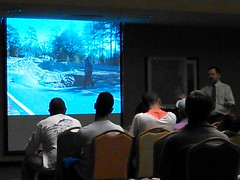
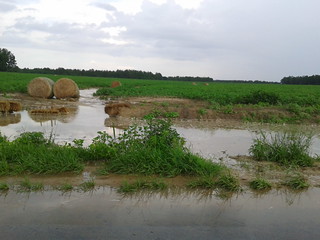
The pictured example of runoff from a cotton field was in Berrien County
yesterday.
While rain was pouring down, it ran half way across the road, and
two cars wrecked.
Once it gets across the road, either over it or through the culvert,
it runs into the Withlacoochee River.
As Pesticide Action Network reminds us,
“Conventionally grown cotton uses more insecticides than any other single crop.”
Approved 12 June 2013 by unanimous vote of the WWALS board,
Dave has mailed a signed copy to the Georgia Public Service Commission,
and I will go read it to the PSC Tuesday morning at 10 AM 18 June 2013,
at
their hearing about
Docket 36498, Georgia Power Company’s 2013 Integrated Resource Plan and Application for Decertification of Various Units
and
Docket 36499, Application for the Certification of Amended Demand Side Management Plan
The recent rains have swollen our blackwater rivers, Withlacoochee,
Willacoochee, Alapaha, and Little, under our longleaf pines and
Spanish-moss-covered oaks, and filled up the tea-colored tannin waters
in our frog-singing pocosin cypress swamps here in central South Georgia.
But that was
only a dent in our protracted drought that ranges from mild
to extreme, with projections not much better.
We do not need more traditional big baseload power plants gulping down our
river or aquifer water when solar and wind power use far less, and those
renewables are now
at grid parity with coal, natural gas, and nuclear.
PDF
of
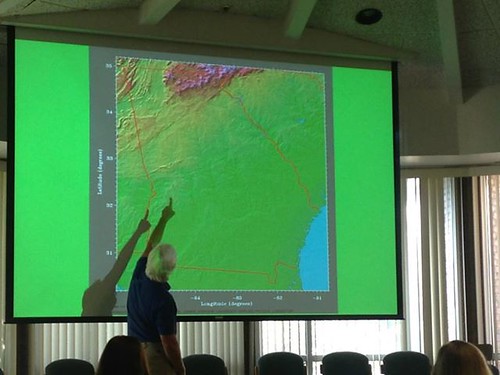
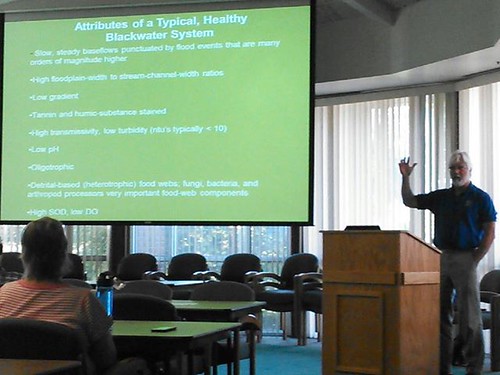
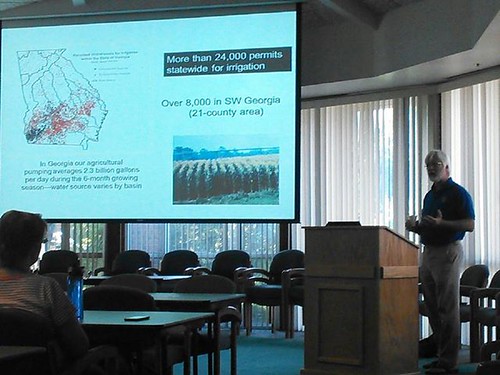
Dissolved Oxygen Dynamics in the Upper Suwannee River Basin
by
Prof. George Vellidis,
Crop & Soil Sciences Dept., University of Georgia, Tifton, GA.
He used these slides when he discussed the
dynamics of dissolved oxygen concentrations in WWALS waterways at the
8 May 2013 WWALS board meeting.
Water issues strongly affect economic development, so I talked about
the new WWALS Watershed Coalition at the
16 April 2013 Board Meeting
of the Valdosta-Lowndes County Industrial Authority.
The VDT declined to speak, so I did.
After apologizing for no okra today,
I commended the Authority for talking about the missing agenda items
and for mentioning due diligence and flood control.
WWALS board meetings are every second Wednesday of the month,
usually at the IHOP in Adel because it’s centrally located.
WWALS is communicating with Valdosta and
various organizations about
flooding and other watershed-wide issues, which in my opinion
have to do with things like too much clearcutting without
consideration for where the water goes, too much development
without consideration for what the impervious surface would do,
(to my surprise, the Executive Director and several board
members nodded along with that)
so it was good to hear them mention flood containment.
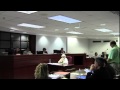
Arsenic, Outings, and Flooding: WWALS Watershed Coalition
Regular Meeting, Valdosta-Lowndes County Industrial Authority (VLCIA),
Norman Bennett, Tom Call, Roy Copeland, Chairman, Mary Gooding, Jerry Jennett,
Andrea Schruijer, Executive Director, J. Stephen Gupton, Attorney, Tom Davis, CPA, Allan Ricketts, Project Manager,S. Meghan Duke, Public Relations & Marketing Manager, Lu Williams, Operations Manager,
Video by John S. Quarterman for Lowndes Area Knowledge Exchange (LAKE), Valdosta, Lowndes County, Georgia, 16 April 2013.
At Risk: Water supply for communities, farms, recreation, and wildlife
Threat: Outdated water management
The Flint River provides water for over one million people, 10,000
farms, unique wildlife, and 300 miles of exceptional fishing and
paddling. Despite being in a historically wet area of the country,
in recent years many Flint River tributaries are drying up
completely and the river’s low flows have dropped dramatically.
American Rivers and Flint Riverkeeper are working in collaboration
with diverse partners to restore the flows and health of the Flint.
The State of Georgia also has a role to play and must act to protect
the Flint in droughts and at all times to safeguard the river’s
health for today and future generations.
The Threat
The Flint is a river running dry. The reasons are many, and include
The
U.S. Army Corps of Engineers (USACE) didn’t know there was
a large water problem hereabouts, but now they do, and they want
to take a watershed-wide approach, from the headwaters to the Gulf of
Mexico, including both surface water and aquifer issues,
perhaps starting with redrawing FEMA’s flood maps,
and maybe even including once again funding the state water council.
Thursday 11 April 2013 there was a rather large governmental meeting
organized by USACE in response to
the City of Valdosta’s request of 11 March 2103.
Yesterday,
Valdosta City Council District 5 Tim Carroll sent the appended
list of attendees, augmented by a conversation with him on the phone just now.
We know little else, because no media or private citizens were invited.
USACE Savannah office: Jeff Morris, Georgia Silver Jackets Coordinator and Beth Williams, Hydraulic Engineer
USACE Jacksonville office: David Apple, Chief, Watershed and Restoration Planning Section
GADNR: Christopher Hill and Tom Shillock, GAEPD Floodplain Management Unit
GEMA: Dee Langley, Planning Program Manager and Terry Lunn, Director, Hazard Mitigation Division
GEMA: Gary Rice – Regional Field Coordinator
USGS: Brian McCallum, Supv. Hydrologist/ADir and Keith McFadden, Physical Scientist
FEMA Region 4: Susan Wilson, CFM, Floodplain Management and Insurance Branch Chief and Janice Mitchell, Insurance Specialist and Lender Compliance
Those state and national agencies were brought by: