Tag Archives: Aquifer

Pipeline would cross Withlacoochee River twice

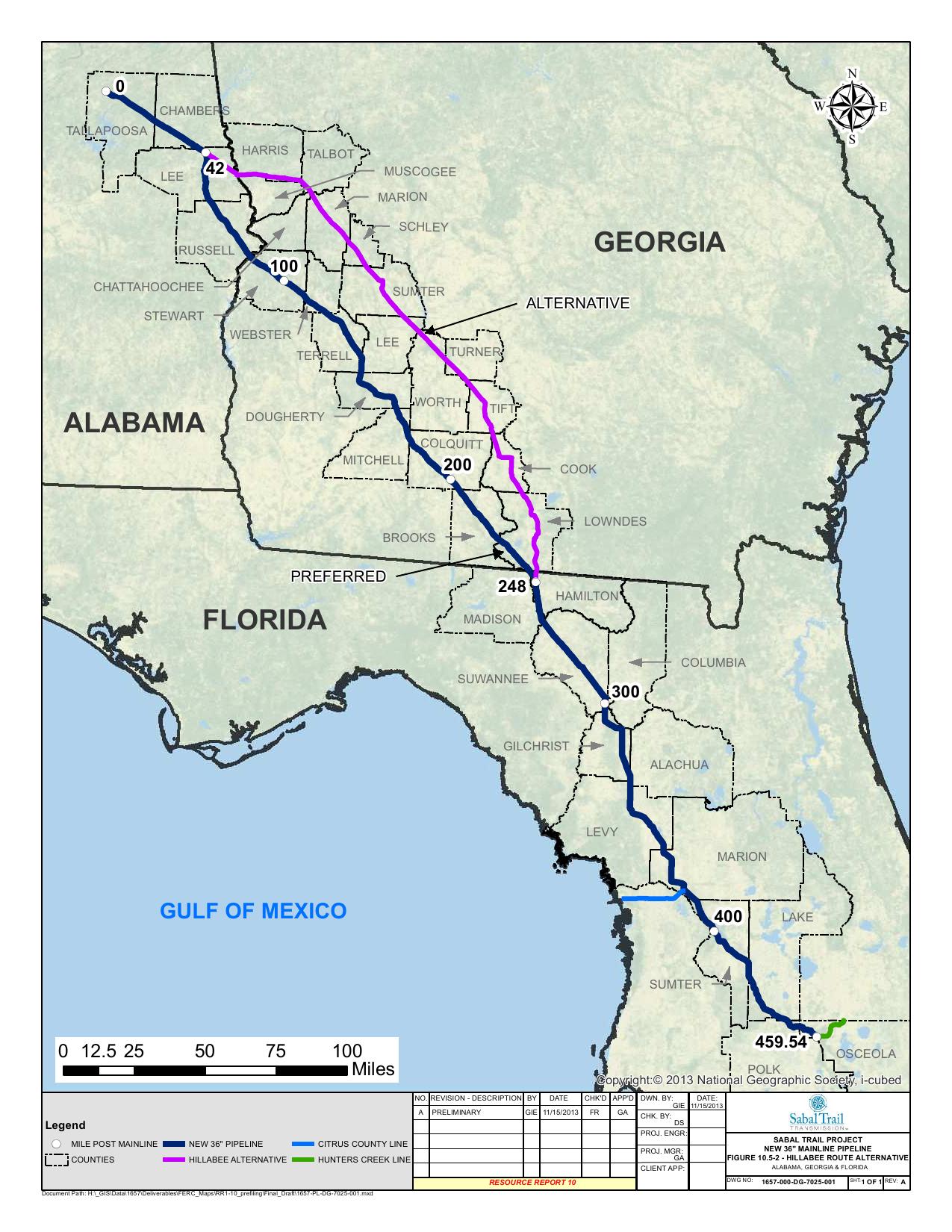
The detail maps in the General Project Description in the 15 November 2013 update to FERC by Sabal Trail Transmission reveal that the proposed path would cross the Withlacoochee River both where the river is the border of Brooks and Lowndes County and where it is the border between Hamilton and Madison County near Ellaville. In between, the pipeline would run through many wetlands near the river and through quite a few recharge zones for our drinking water source, the Floridan Aquifer. Then it crosses our downstream river, the Suwannee, into Suwannee County, Florida.

Continue reading

Pipeline alternate route still in WWALS watersheds, plus Tifton and Valdosta

The Hillabee alternative route runs right down the middle of the WWALS watersheds, through Worth County, Turner County, Tift County, Colquitt County, Cook County, and Lowndes County in Georgia, and Hamilton County, Madison County, and Suwannee County in Florida. This puts it not only still in the Withlacoochee River watershed, but also in the Little River and Alapaha River watersheds. This route by the pipeline company Sabal Trail Transmission (owned and managed by Spectra Energy) avoids Albany but apparently goes through Tifton and Valdosta and still through Lowndes County before entering Florida in Hamilton County much like Spectra’s preferred route.

Hillabee (Valdosta and Tift County) Route Alternative, Georgia

This alternate route is the rest of the Option B that was first proposed to Lowndes County residents back in June: Continue reading

WWALS files as intervenor to oppose the Sabal Trail Transmission gas pipeline

Approved by the WWALS Board 13 November 2013. PDF.

From:
WWALS Watershed Coalition
3338 Country Club Road #L336
Valdosta, GA 31605
www.wwals.net
wwalswatershed@gmail.com
18 October 2013

To:
Secretary Sarah McKinley
The Federal Energy Regulatory Commission
888 First Street N.E
Washington, DC 20426

Re: Pre-filing Docket PF14-1 Sabal Trail Transmission

Cc:
Georgia Public Service Commission
Florida Public Service Commission

WWALS Watershed Coalition, Inc. opposes the proposed Sabal Trail Transmission gas pipeline that would cut a 100 foot wide gash across our Withlacoochee River and through many wetlands in south Georgia and north Florida, including recharge zones for the Floridan Aquifer that provides our drinking water.

Sabal’s parent company, Spectra Energy, has a safety record that gives no comfort Continue reading

Aquifer storage meeting in Newton, GA 7 November 2013

It looks like SB 213 is being resurrected after falling in the Georgia House in March. This GEFA ASR meeting is in Newton, which is not far west of Tifton. When will they be coming for the waters of the Little River, too?

Jim West in the Albany Herald 29 March 2013, Flint River bill fails in the House, quoted Gordon Rogers, Flint Riverkeeper, and then referred to Georgia Water Coalition:

One aspect of the bill river advocates found objectionable was the concept of “stream flow augmentation,” including aquifer storage and recovery, or ASR, which Coalition officials define as “the injection of ground water into the aquifer, which would be extracted later and sent downstream.” According to the Coalition, the process could cause irreversible contamination of the aquifer.

GEFA News 30 October 2013, Aquifer Storage Project Public Meeting Scheduled, Continue reading

Videos: Aquifers, sinkholes, and groundscans –Prof. Don Thieme

We had to move to a larger room, so many attended this groundwater talk at VSU (about 90). Plus a guest appearance by SAVE.

Crowded small room Larger Magnolia Room

Coastal Plain Surficial Deposits, Groundwater Resources, and Recent Subsidence in south Georgia by Prof. Donald M. Thieme @ VSU for WWALS 2013-10-09 Here are Dr. Donald M. Thieme‘s slides in PDF, with his longer title:

Coastal Plain Surficial Deposits, Groundwater Resources, and Recent Subsidence in south Georgia

While we are lucky to have abundant groundwater, both from the Upper Floridan Aquifer 100 feet below us trapped in Eocene limestones and from shallow groundwater with its karst features, nonetheless overpumping has caused falls in the level of the aquifer (about 0.6 feet a year at Valdosta), resulting in rapid loss of shallow groundwater, plus surface water that enters and often contaminates the aquifer through those karst features.

Summary: abundant groundwater from Upper Floridan aquifer and shallow groundwater Summary: Fall in level of upper Floridan aquifer is primary cause for....

Sometimes those karst features subside and manifest as sinkholes like the one that ate Snake Nation Road in Lowndes County and others that can develop slow (many years) or fast (weeks or minutes).

Subsidence Problems in south Georgia and north Florida Snake Nation Road sinkhole

There were also many questions, starting with what water do personal wells reach? Also including a brief history of Valdosta well drilling from artesian to hundreds of feet down, and a sinkhole in a garage in Lowndes County, should local governments require sinkhole insurance (including mention of Moody AFB subsidence and Florida citrus growers pumping so much water it causes sinkholes). I also introduced the WWALS board members present: Gretchen Quarterman (Treasurer and videoing), Bret Wagenhorst (Outings), Heather Brasell (Secretary), Dave Hetzel (President), April Huntley (Director), me (Vice President), and Chris Graham (Member); plus a brief summary of WWALS events and outings. Here’s a video playlist:

Continue reading

WWALS supports S.A.V.E.’s fossil fuel divestment request to VSU

Approved by the WWALS Board by email 17 October 2013.

From:
WWALS Watershed Coalition
3338 Country Club Road #L336
Valdosta, GA 31605
www.wwals.net
wwalswatershed@gmail.com
18 October 2013

To:
Mr. John Crawford
Vice President for Advancement
   and Trustee
jdcrawford@valdosta.edu
VSU Foundation
   and Board of Trustees
1500 N. Patterson Street
Valdosta, GA 31698

WWALS Watershed Coalition, a nonprofit group working for conservation of the Withlacoochee, Willacoochee, Alapaha, and Little River Systems, supports the fossil fuel divestment request of Students Against Violating the Environment (S.A.V.E.).

In addition to the points made by S.A.V.E., WWALS would like to add that oil and gas leaks run downhill in our watersheds, fracking for natural gas pollutes groundwater, and fossil fuel energy plants use massive amounts of water that could go for agriculture or drinking. Divestment from fossil fuels by VSU by itself won’t stop leaks or end fracking or shut down coal plants. But it will send a clear signal that our regional state university is leading the shift from fossil fuels to renewable solar and wind power with efficiency and conservation.

Fracking may seem distant, but right now there is a proposed natural gas pipeline from Alabama to Florida that threatens Georgia’s environment and Georgians’ property rights. We don’t want an exploding pipeline like just happened in Oklahoma.

Perhaps like Harvard President Drew Faust some don’t want to get academic VSU involved in politics. But all our investments are political, and there’s nothing neutral about funding climate wreckage. As S.A.V.E. put it in their letter:

Continue reading

Now at VSU: Aquifers, sinkholes, and ground scans –Don Thieme @ WWALS

Update 2019-04-02: Videos.

Moved to VSU, University Center, Dogwood Room! Prof. Don Thieme of VSU will speak about underground water issues at the October WWALS board meeting in Wednesday October 9th at 7:30 PM in Valdosta. Join the facebook event or come as you are.

Here’s the letter Prof. Thieme and two other VSU professors wrote to the Air Force about sinkholes and subsidence on the proposed Moody Family Housing in Lowndes County, which also turns out to be in an aquifer recharge zone.

Here’s VSU’s campus map and here’s a google map: Continue reading

Aquifers, sinkholes, and ground scans –Don Thieme @ WWALS

Moved to VSU, University Center, Dogwood Room!
Prof. Don Thieme of VSU will speak about underground water issues at the October WWALS board meeting in Wednesday October 9th at 7:30 PM in Adel at the IHOP, 1200 W 4th Street. Valdosta.

Here’s the letter Prof. Thieme and two other VSU professors wrote to the Air Force about sinkholes and subsidence on the proposed Moody Family Housing in Lowndes County, which also turns out to be in an aquifer recharge zone.

It’s an open board meeting anyone can attend for the business part, as well. Here’s the agenda:

Agenda WWALS Board Meeting
7:30 pm October 9, 2013
IHOP, Adel GA
  1. Call to Order, Welcome and Introductions
  2. Speaker: Don Thieme, VSU geologist. Topic: Aquifers, sinkholes, and ground scans.
  3. Agenda Review: Additions and Changes
  4. Review and Approval of Minutes of September Board Meeting
  5. Future Meetings and Events
    1. Monthly outing (fourth Saturday): October 26, 2013 at Banks Lake near Lakeland.
    2. Monthly board meeting (second Wednesday): November 13 Continue reading

Aquifer at max pumping in central Florida

Remember, this is our aquifer, too. And watch out! They’d rather pipe somebody else’s river water than conserve in Central Florida.

Kevin Spear wrote for the Orlando Sentinel yesterday, Analysis: Floridan Aquifer can only handle 6% more pumping before serious environmental harm,

Just how much more water can Central Florida pump from the Floridan Aquifer without causing real harm to the region’s environment? After years of debate, study and anxiety, state authorities say they have finally — and officially — figured it out.

The answer: hardly any.

Using the most advanced databases and computing methodology yet developed for such a task, a consortium of state water managers and local utilities have calculated that the current amount of water pumped from the underground aquifer each day can be increased by only about 6 percent — which means the region is already exploiting the huge, life-sustaining aquifer for nearly every drop it can safely offer.

Beware! Continue reading

the single largest asset that you’ll ever own –Gordon Rogers

Albany TV covered yesterday’s WWALS Watershed Conference. First picture by Fox31, the rest by John S. Quarterman and Gretchen Quarterman. WWALS video will follow.

Franklin White wrote for Fox31online yesterday, The importance of Watershed conservation,

Gordon Rogers says, “it’s important to advocate for good management by our resource agencies within that framework of laws.”

Franklin White, Fox 31, and Gordon Rogers, Flint Riverkeeper at WWALS Water Conference

Gordon says it hits home for him because the Flint River where he works ranks second on the american rivers endangered rivers list, a reason he says water management is such an important issue to the region.

Hydrology

He says, “it belongs to all of us. it’s the single largest asset that you’ll ever own is your river and your creek and you’re aquifer.”

Environmental Lobbyist Neill Herring says the goal is to restore and preserve the habitat, water quality and flow of the Flint and other rivers.

Neill Herring

Herring says, “these natural resources particularly the water systems are their private property, they have a property interest in the water.”

And outside of the Flint, officials say there are four other major rivers to keep an eye on. those being Willacooche, Withlocooche, Alapha, and Little River systems.

Blackwater

“Cause it’s a rapidly moving political landscape. Operating wisely with this limited amount of water that you have,” says Gordon.

Permits

He says it’s important for local citizens to take ownership of the political process of their watershed. To learn more, visit the Watershed Coalitions website at WWALS.net.