Tag Archives: pipeline

Douglas again for Suwannee-Satilla Regional Water Planning Council 2015-07-1520

From Leigh Askew Elkins of UGA via GRN, same city as last month, different venue:

The Suwannee — Satilla Regional Water Council will convene on Monday, July 20, 2015 at 10:00am in the meeting room in Aniston’s Restaurant, 1404 W. Baker Highway, Douglas, GA. Registration will begin at 9:30am. Among other things, the Council will affirm its plans for enhancing inter-council planning and for engaging key implementing actors. The Council will also discuss its recommendations for plan revisions.

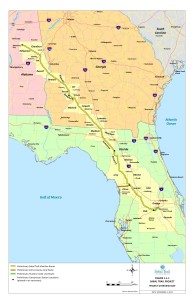
Seems like it’s time for them to say something about the Sabal Trail fracked methane pipeline, and about the shale basin under our Floridan Aquifer. Maybe WWALS will send something to them about that.

-jsq

WWALS signs on to Global Frackdown

Ban fracking before it spreads, and ban it quickly enough to stop new pipelines! WWALS signed the Global Frackdown organized by Food and Water Watch:

Fracking threatens the air we breathe, the water we drink, the communities we love and the climate on which we depend.

The specific message WWALS added when signing 29 June 2015 was:

Fracking is driving a company from Houston, Texas to try to gouge a pipeline across our fragile watersheds and drinking water aquifer. Georgia is already the fastest-growing U.S. market for solar power, and just passed a solar financing law that will make it grow even faster. Meanwhile, a shale gas basin has been discovered under south Georgia and north Florida. Ban fracking before it spreads, and ban it quickly enough to stop new pipelines!

Remember, WWALS supports a fracking ban in Floirida, and Continue reading

Local recharge through sinkholes and drainage wells moves underground

With the artesian level as much as 100 feet above sea level and the land surface is seldom more than 200 feet, a Sabal Trail pipeline drilling frac-out wouldn’t have to go far to get into the Floridan Aquifer groundwater used by wells around here. We already saw such water contamination would go underground is hard to predict. This is not news: here’s a paper from 1966 with the main points.

Artesian Water in Tertiary Limestone in the Southeastern States, By V. T. Stringfield, GEOLOGICAL SURVEY PROFESSIONAL PAPER 517, 1966. Continue reading

Pipeline corrosion: seawater and acid blackwater rivers in the fragile karst limestone Floridan Aquifer

Who could have suspected that corrosion caused the crude oil pipeline rupture still pollution California’s coastline from Santa Barbara to Los Angeles, according to PHMSA’s amended corrective order as reported by Giana Magnoli, Noozhawk, Santa Barbara, 3 June 2015?

Right after TransCanada Keystone 1 Pipeline Suffered Major Corrosion Only Two Years In Operation, 95% Worn In One Spot, as reported Julie Dermansky, Desmogblog, 30 April 2015?

Both pipeline companies claimed they used cathodic protection, which is supposed to detect and prevent such leaks.

Kinder Morgan, proposing to gouge its Palmetto petroleum products pipeline across South Carolina and the Georgia coast to Jacksonville, also claims to use cathodic protection and other measures, yet is no stranger to many incidents of corrosion and leaks.

There’s lots more evidence that such preventative measures don’t work, and often aren’t even applied, not for oil pipelines and not for fracked methane (“natural gas”) pipelines. You can sign the petition to help stop Texas pipelines from invading Georgia. Continue reading

Petition GA Gov. Deal to oppose Sabal Trail pipeline

Please sign this petition to Please Ban The Sabal Trail Fracked Gas Pipeline.

Congratulations to Push Back the Pipeline for convincing GA Gov. Deal and Lt. Gov. Cagle to oppose Kinder Morgan’s Palmetto Project and the Georgia Dept. of Transportation to deny KMI a permit.

Now it’s time for the same for the Sabal Trail Pipeline. The permitting process is different, but opposition from the state of Georgia could stop this invader, too.

While Sabal Trail has moved off our Withlacoochee River in Florida, it still wants to cross the Withlacoochee in Georgia at the Continue reading

WWALS Goals for 2015

Boating on our rivers and water trails for them, issues and education: you can help with the fun and work of WWALS! Here’s much of what can be done laid out in a list of a dozen WWALS Goals for 2015. The board has at least one opening right now, and the committees always could use more members. You can apply through the online form.

See also the monthly newsletter, the news about WWALS, and of course the website with blog, facebook the page and group, and WWALS on twitter, Youtube, and the membership google group. You can become a member or corporate sponsor of WWALS online right now.

The WWALS Executive Committee 11 March 2015 recommended Continue reading

Against Sabal Trail in Savannah 2015-05-21

Like Kinder Morgan and its Palmetto Project through southeast Georgia, Spectra Energy, also of Houston, acts entitled to gouge its Sabal Trail fracked methane pipeline through southwest Georgia, taking local lands, causing widespread environmental destruction, and risking leaks and explosions local and state taxes would have to pay for. Come hear about the fight so far against this invader and some ideas on what to do next, 7PM Thursday May 21st in Savannah. WWALS President John S. Quarterman and an affected landowner will speak.

State and local taxes will end up paying to clean up any leaks or explosions from either pipeline: both Spectra Energy from Houston, half owner of Sabal Trail, and Kinder Morgan from Houston, behind the Palmetto Project, tell the SEC every year they don’t have enough insurance to cover major incidents. Push Back the Pipeline, recently convinced Georgia Governor Nathan Deal to oppose the Palmetto pipeline, and Lt. Gov. Casey Cagle, too. Maybe they can help persuade both to oppose Sabal Trail.

Connect Savannah, today, (also on Push Back the Pipeline), Georgia’s Other Unwanted and Unneeded Pipeline,

When: Thu., May 21, 7 p.m.
Phone: 912-961-6190
Price: Free
Where: First Presbyterian Church
520 Washington Ave Savannah-Eastside
912-354-7615
www.fpc.presbychurch.net

The Palmetto Pipeline is not the only pipeline project in Georgia Continue reading

WWALS on environmental issues panel in Valdosta at LCDP 2015-06-01

WWALS will be among five organizations discussing environmental issues a the monthly Lowndes County Democratic Party (LCDP) meeting 6PM Monday June 1st 2015, at the Lowndes County Board of Elections, 2808 North Oak Street, Valdosta, GA.

Stopping Valdosta wastewater spills and restarting the Alapaha River Water Trail are among the topics WWALS President John S. Quarterman plans to mention. Solar power, the Sabal Trail pipeline, and fossil fuel divestment will also come up. Anyone can speak from the audience, so please come and join the discussion.

Other panelists, topics, and details in the LCDP post. Please join the facebook event.

-jsq

Landowner in county in WWALS watersheds sued by Sabal Trail; hearing May 28th in Moultrie

WWALS has long opposed the unnecessary, environmentally destructive, and hazardous Sabal Trail fracked methane pipeline, see for example the 3 April 2015 front page Atlanta Journal-Constitution article. Now Sabal Trail has sued a landowner in a WWALS watershed county. Everyone who can, please attend the hearing or send letters.

When: 9:30 AM 28 May 2015 Continue reading

Linkage between ground water and surface water –USGS

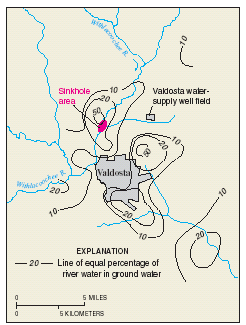
Yet more documentation on why gouging a pipeline under the Withlacoochee River, or through this Valdosta Limesink area anywhere, would be a bad idea:

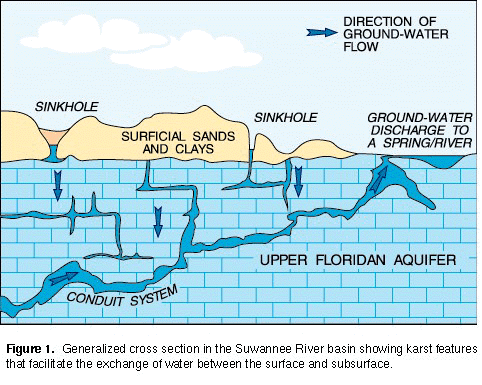
In most watersheds (river basins) in Florida the interactions between ground water and surface water typically result in a single dynamic flow system. This direct hydraulic linkage results from numerous karst features (such as sinkholes, conduit systems in the underlying limestone, and springs) that facilitate the exchange of water between the surface and subsurface (fig. 1). Unique problems can arise in protecting water quality in karst areas because of the direct and rapid transport of recharge through conduits to the subsurface and through resurgence by springs. In some areas, recharge from unknown drainage pathways to areas of discharge may contribute to chemical and biological contamination of water supplies. Such contamination in karst areas has been documented by many studies.

Yes, it says Florida, but the geology doesn’t stop at the state line, as USGS spelled out in a 1999 study of the Withlacoochee River. It works like this in Georgia, too: Continue reading