Tag Archives: Valdosta

Nestle and Madison Blue Springs

That magic word “jobs” sucked up water from one of north Florida’s most famous springs: Madison Blue Spring, very familiar to many people from south Georgia. Will it do the same about a pipeline?

Joseph Trento wrote for DC Bureau 20 July 2009, Nestlé: Draining America Bottle By Bottle: How Nestlé Got Millions and Millions of Dollars From a $230 Permit. Continue reading

Alapahoochee Watershed Area Map by SGRC

The South Georgia Regional Commission (SGRC) produced this interesting map of the Alapahoochee River Watershed 300x225 Title, in Alapahoochee Watershed Area, by John S. Quarterman, for WWALS.net, 15 July 2014 I saw on the counter while visiting the USDA FSA office in Valdosta about something unrelated. Curiously, it doesn’t show the actual river nor its tributaries Mud Creek and Grand Bay Creek. But it does show that this watershed includes much of Valdosta, half of Dasher, and all of Lake Park. Continue reading

Suwannee Bioregion Coalition?

Related to population centers in the Suwannee River watershed, someone asked, “Do we need an interstate Suwannee Bioregion Coalition to guard the waters that feed into the Suwannee River?” We’ve got pieces of it already cooperating to some extent in opposing the Sabal Trail pipeline. There are many other even larger issues that everyone in the Suwannee River basin faces.

In south Georgia and north Florida we have Continue reading

Biggest city in Suwannee River watershed?

Apparently everybody knew this but me. The biggest city in the entire 11,020 square mile Suwannee river basin, half in south Georgia and half in Florida (that half being the largest river basin in Florida), is…. Continue reading

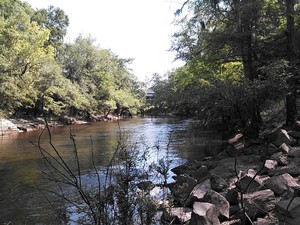
Boat upstream on the Little River @ GA 133 2014-06-28

Update 2025-01-21: Little River upstream 2014-06-28.

Paddle upstream on the Little River and float back down: the WWALS June Outing.

When: Please arrive by 8:30 AM so everyone can be ready to put in by 9AM.

Where: GA 133 bridge at the border of Brooks County and Lowndes County, Georgia. If we go far enough up, Continue reading

Regional Water Council Meeting Wednesday AM in Valdosta

Meeting notice: -jsq

NOTICE:

SUWANNEE-SATILLA
REGIONAL WATER PLANNING COUNCIL MEETING
FOR
REGIONAL ASSESSMENT OF IMPLEMENTATION STATUS

Announcement Date: May 6, 2014

TO ALL INTERESTED PERSONS AND PARTIES:
The Suwannee-Satilla Regional Water Planning Council is holding its next meeting
at the following date, time, and location:
Wednesday, May 21, 2014
Registration: 9:30 A.M. – 10:00 A.M.
Meeting: 10:00 A.M. – 1:00 P.M.


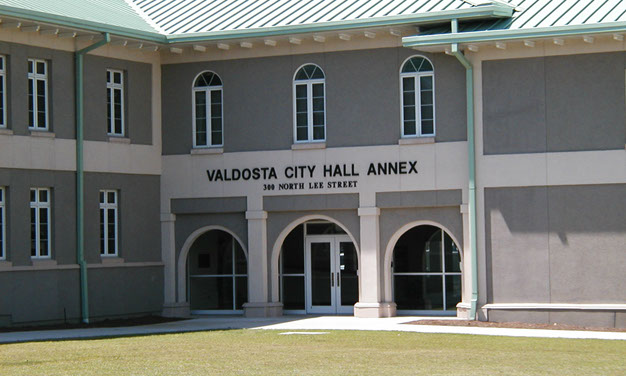
Valdosta City Hall Annex
Multipurpose Room
300 N. Lee Street
Valdosta, GA

For additional information about the Suwannee-Satilla Regional Water Planning
Council please contact:
Cliff Lewis, Assistant Branch Chief – EPD Watershed Protection Branch
229-391-2400 or Cliff.Lewis@dnr.state.ga.us

Study before Levee –Tim Carroll

Comment on facebook 10 May 2014 and he told me the same by telephone.

It is clear a full watershed wide study must be completed before any decisions can be made. As established in this first study—The City of Valdosta is the recipient-not the origin- of the flood waters. While it confirms what we already knew, my job is to try and keep the ball rolling forward. Engage congressional leaders, secure funding and find long term, sustainable solutions that benefit all communities within the watershed basin. A levee by itself is not the answer.
–Tim Carroll

This was a comment on Videos: Flooding study by Army Corps of Engineers @ VCC 2014-05-06, which was about the initial study that was confined to Valdosta, and in which the Corps proposed a levee at the mouth of Sugar Creek, above the Withlacoochee River. To their credit, the Corps were clear that they also want a long-term watershed-wide study (they want to do the entire Suwannee River drainage area), and one of the main conclusions of the initial study was:

This report established that there could be Federal interest in pursuing future flood management risk studies undre other USACE authorities.

-jsq

Flooding charts: Withlacoochee and Little Rivers

Update 2025-09-21: Graphs from water.noaa.gov.

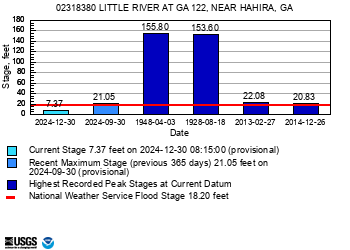
Related to the Withlacoochee and Little River Water Trail and the double USACE flooding study presentation tonight in Valdosta, here are river level charts upstream and down on the Little River, Okapilco Creek, and the Withlacoochee River related to a new USGS flood-tracking chart. In the example charts on the right, you can see the Little River peaked days ago at Tifton and yesterday at Hahira.

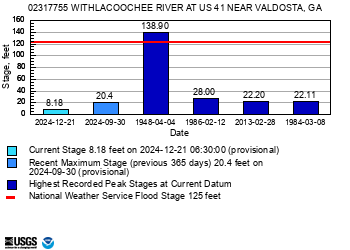
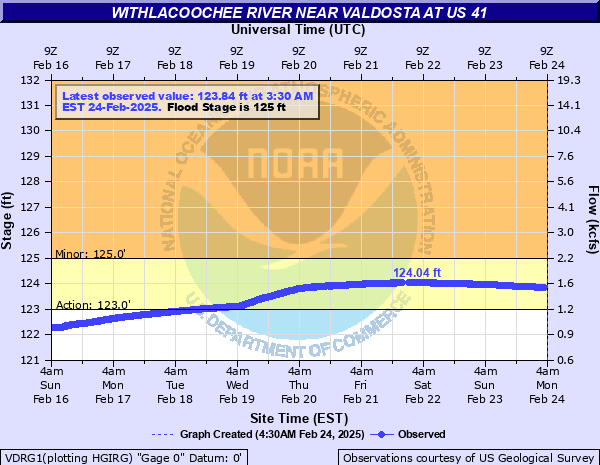
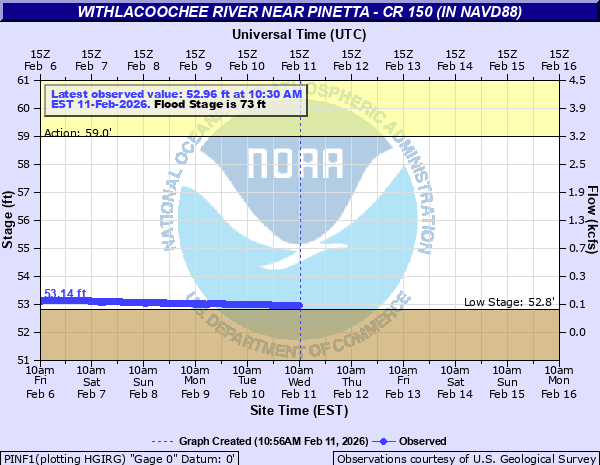
The Withlacoochee River peaked yesterday at US 41. while downstream it’s going up at US 84, and barely starting up at Pinetta (click on the above chart example for the rest). Right now you can see all that in the charts below. If this works, you’ll see something different later, because you’ll see current charts whenever you refresh this page.


Tifton Gauge, Little River at Upper Ty Ty Road, near Tifton, GA, Tift County, GA (02317797)

Highest safe 3.9 feet, 271 NAVD. Lowest boatable 0.1 feet, 267.2 NAVD.

Adel Gauge, Little River near Adel, GA, Cook County, GA (02318000)

Highest safe 7.9 feet, 181 NAVD. Lowest boatable 2.2 feet, 175.3 NAVD.

Hahira Gauge, Little River at GA 122, near Hahira, GA, Lowndes County, GA (02318380)

Highest safe 11 feet, 144 NAVD. Lowest boatable 4.25 feet, 137 NAVD.

Skipper Bridge Gauge, Withlacoochee River at Skipper Bridge Road, near Bemiss, GA, Lowndes County, GA (023177483)

Highest safe 10.7 feet, 131 NAVD. Lowest boatable 2.3 feet, 122.6 NAVD.

Valdosta Gauge, Withlacoochee River at US 41 near Valdosta, GA, Lowndes County, GA (02317755)

Highest safe 12.7 feet, 123′ NAVD. Lowest boatable 5.7 feet, 116′ NAVD.
Okapilco Creek Gauge, Okapilco Creek at GA 333, near Quitman, GA, Brooks County, GA (02318700)


Quitman Gauge, Withlacoochee River at US 84, near Quitman, GA, Brooks County, GA (02318500)

Highest safe 10.5 feet, 94 NAVD. Lowest boatable 2.0 feet, 85.5 NAVD.

Pinetta Gauge, Withlacoochee River near Pinetta, FL., Madison County, FL (02319000)

Highest safe 12.5 feet, 59 NAVD. Lowest boatable 6.0 feet, 52.5 NAVD.
Madison Gauge, Withlacoochee River near Madison, FL , Madison County, FL (02319300)

Highest safe 10.0 feet, 50 NAVD. Lowest boatable 0.1 feet, 40.1 NAVD.
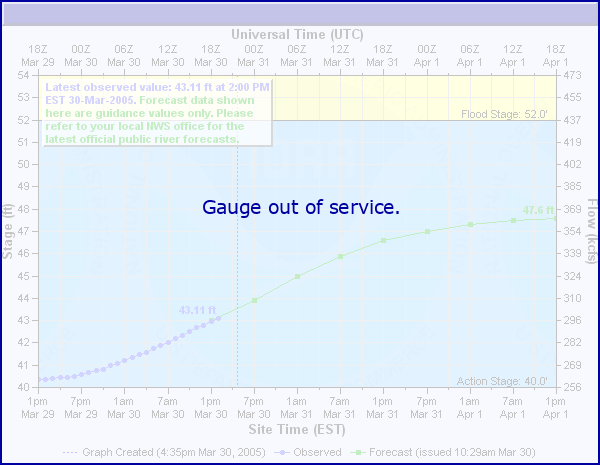
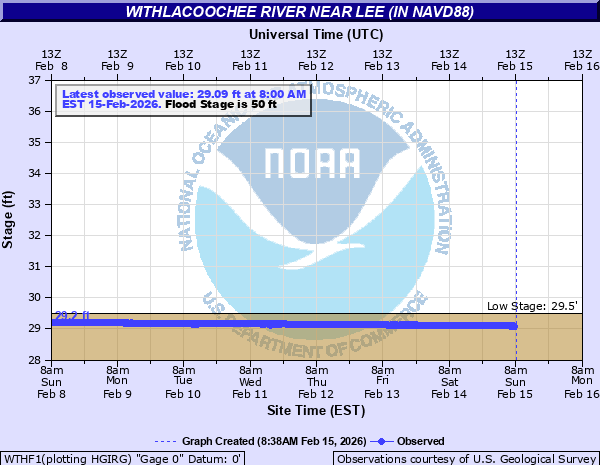
Lee Gauge, Withlacoochee River near Lee, FL, Madison County, FL (02319394)

Highest safe 44.0 feet, 44 NAVD. Lowest boatable 29.5 feet, 29.5 NAVD.
The watersheds

See also interactive map.

315x535 WRWT, in Withlacoochee River Water Trail gauges, by John S. Quarterman, for WWALS.net, 8 June 2015

See also

Old updates

Update 2016-05-31: See sea level gage reports.

Update 2016-04-27: graphs from water.weather.gov and some WRWT Safe Water Levels.

Update 2014-11-04: Simplified gage formatting.

Update 2014-11-03: That works, and see also Alapaha River water levels.

 -jsq, John S. Quarterman, Suwannee RIVERKEEPER®

You can help with clean, swimmable, fishable, drinkable, water in the 10,000-square-mile Suwannee River Basin in Florida and Georgia by becoming a WWALS member today!
https://wwals.net/donations/

Flooding study presentations by Army Corps in Valdosta 6 May 2014

Received today. -jsq

Good afternoon Mr. Quarterman,

As requested, the date for the U.S. Army Corps of Engineers (USACE) presentation will be on May 6th to Mayor/Council at the work session which begins at 5:30 pm. The City will also have a meeting with the residents and businesses in the USACE project / study area that same night at 6:30 pm at the City Hall Annex – Multipurpose Room.

Continue reading

USGS Flood-Tracking Chart for Withlacoochee and Little River Basins

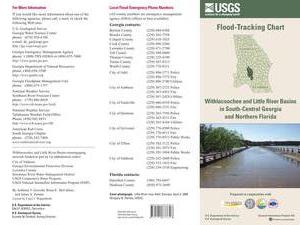
An interesting flyer pointed out by Emily Davenport, Storm Water Utilities Director, City of Valdosta. It has many useful contacts on the front, and tips on the back (don’t walk or drive through flood waters) but the most useful part is inside, where the flood-tracking chart is, in Flood-tracking chart for the Withlacoochee and Little River Basins in south-central Georgia and northern Florida, 2014, by Gotvald, Anthony J.; McCallum, Brian E.; Painter, Jaime A., USGS General Information Product: 155.

Here are the gages mentioned in the chart, with links to the live USGS FloodTracking pages, Continue reading