First time we’ve seen this: 300 gallons of raw sewage spilled from Rochelle, Georgia, in Wilcox County, at the top of the Alapaha River Basin.

Rochelle is nestled between Continue reading

First time we’ve seen this: 300 gallons of raw sewage spilled from Rochelle, Georgia, in Wilcox County, at the top of the Alapaha River Basin.
Rochelle is nestled between Continue reading
Yet again into Agrirama Lake, Tifton spilled 8,500 gallons of raw sewage yesterday (Sunday, January 6, 2019). And, finally, a number of gallons Valdosta spilled from its Withlacoochee Wastewater Treatment Plant back on December 15, 2018.

As you can see, cities in the Atlanta Metro Area spilled more. And in the table below you can see many more of them spilled.
Not that that makes Tifton’s spill Continue reading
Three weeks in a row! The Valdosta river water quality testing data WWALS obtains through a weekly open records request shows all stations tested below the Georgia state limit last Wednesday.
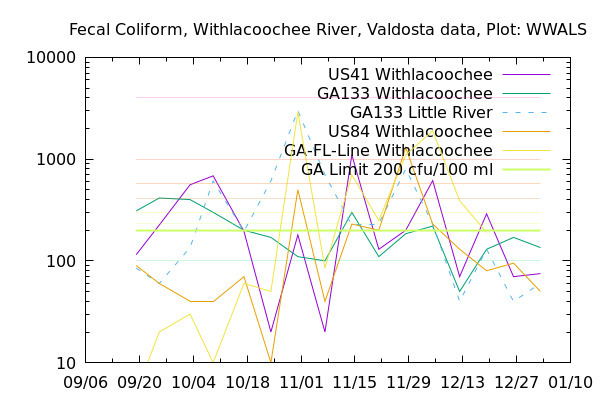
However, like the week before, there are no data for Continue reading
Quitman spilled raw sewage again yesterday, January 3, 2019, from its Land Application Site (LAS) east of town, south of US 84, next to Okapilco Creek. GA-EPD in its Sewage Spills Report of today finally got the river basin right (Suwannee), but seems to have forgotten which creek that LAS is near.
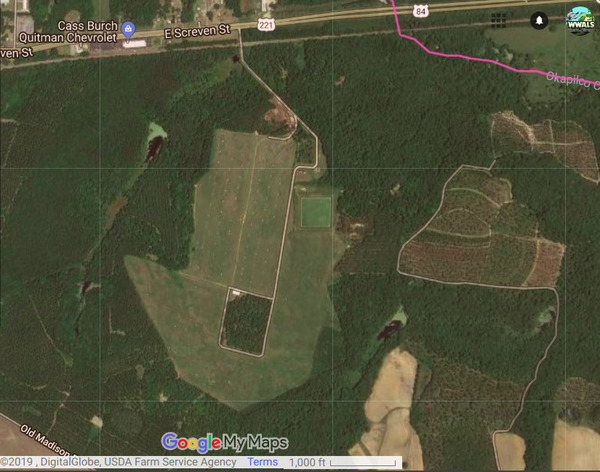
Quitman LAS on the WWALS
google map
for the
Withlacoochee and Little River Water Trail (WLRWT).
No amount is reported yet, but Quitman usually spills between 20,000 and 80,000 gallons of raw sewage. We shall see.
That Quitman spill is the only new one in the Suwannee River Basin for the past 30 days.
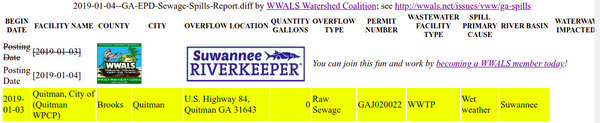
WWALS diff of 2019-01-03 and 2019-01-04 GA-EPD
Sewage Spill Reports.
A bunch of other reports are rolling off the end, as indicated by Continue reading
No new spills reported in the Suwannee River Basin in Georgia! We do have some clarifications on old spills, some even with raw sewage totals.
Since the Sewage Spills Report GA-EPD posts each day replaces the previous one, WWALS has started picking up those reports daily and parsing out differences.

This has revealed a total for a Quitman report, some Smithbriar Drive spelling corrections, a total for one Valdosta spill location, and where it goes (spoiler: into the Alapaha River Basin).
We don’t see any new spills in the past two weeks in the Suwannee River Basin in Georgia.
We also don’t see Continue reading
There’s good news in response to the weekly open records request from WWALS to Valdosta: all stations reporting are well within the Georgia state limit for bacterial levels. There’s also some puzzling news.

The puzzling news is that Continue reading
Recieved a few minutes ago via email as a PDF.
Madison, Fla. —The Florida Department of Health in Hamilton and Madison counties have lifted a health advisory issued on December 17, 2018. The city of Valdosta, Georgia reported a large spill of untreated sewage that overflowed into the Withlacoochee River. The advisory urged individuals not to come into contact with the Withlacoochee River along the Hamilton and Madison County borders.

Water samples taken by the Florida Department of Environmental Protection and the Florida Department of Health indicate Continue reading
The irony: Valdosta’s warning sign is still up at Troupville Boat Ramp after its six spills weekend before last, yet Valdosta’s own weekly water quality testing stations almost all measured below the state limits for Fecal coliform and E. coli.

The exception was at Continue reading
Not just Valdosta: Tifton spilled two places, and Quitman one, in the most recent rains. Those cities were not in the data available online from GA-EPD yesterday, but they are in the online data today.
But Valdosta spilled the most sewage and from the most locations: six places, not just the one Valdosta told the public. Plus we finally have a total for the previous WWTP spill, and all the others from the beginning of December, and those totals are not pretty.
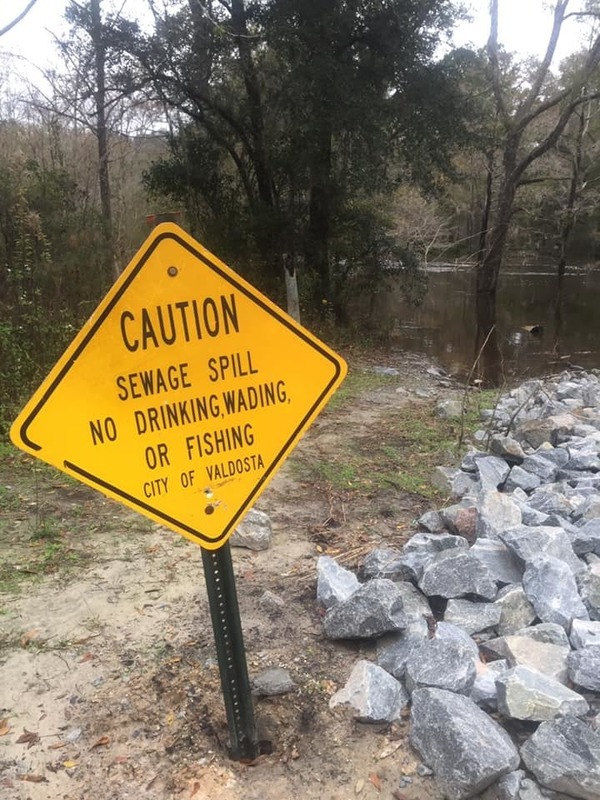
Photo: Julie Bowland, of Valdosta sewage spill sign at Troupville Boat Ramp, 21 December 2018.
That Valdosta sewage spill sign is stuck loosely into a hole WWALS dug to plant our Withlacoochee and Little River Water Trail (WLRWT) signs, which someone has yet again pulled up and thrown into the river, but I digress….
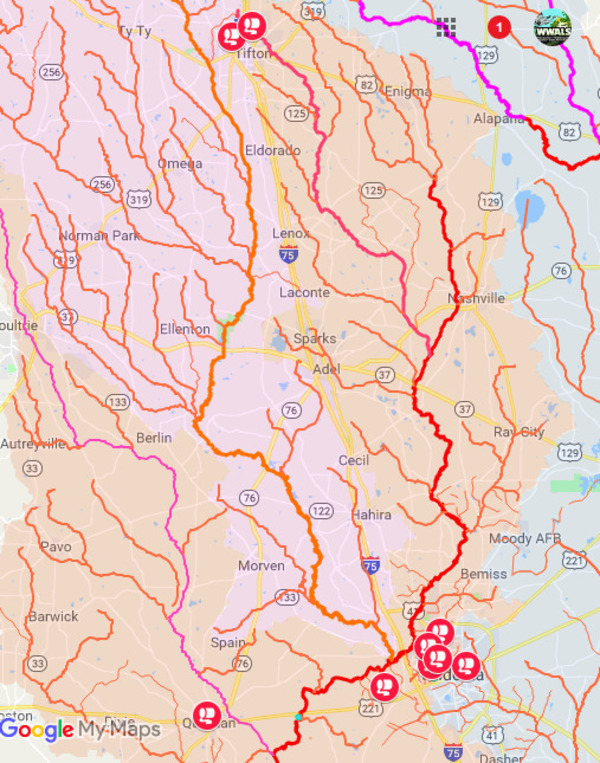
First let’s look at the city people in Florida ignore: Tifton, Georgia, the second largest city in the Suwannee River Basin (that’s right: in both Georgia and Florida). Tifton had Continue reading
Update 2021-09-11:
New URL for GA-EPD Sewage Spills Report:
https://epd.georgia.gov/watershed-protection-branch/sewage-spills-report
Well, this is a welcome Christmas present, GA-EPD!
Online posting of the statewide Georgia spreadsheet of sewage spills:
https://epd.georgia.gov/sewage-spills-report
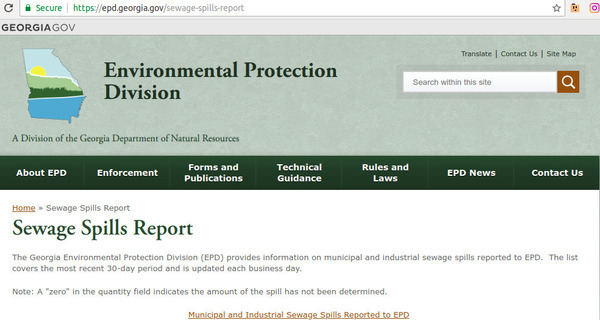
Sewage Spills Report
The Georgia Environmental Protection Division (EPD) provides information on municipal and industrial sewage spills reported to EPD. The list covers the most recent 30-day period and is updated each business day.
Note: A “zero” in the quantity field indicates Continue reading