Category Archives: GA-EPD

Raining now, sending Valdosta sewage downstream; Florida warns; Valdosta does what? 2019-12-22

Update 2019-12-23: E. coli at Little River Confluence, Spook Bridge, and Knights Ferry, Withlacoochee River 2019-12-21

The National Weather Service predicts rain coming down now will raise the Withlacoochee River from Low to Action stages above Valdosta starting today. This is after WWALS already apparently detected Valdosta sewage passing GA 133 on Tuesday, continuing Thursday, so Valdosta’s record-largest sewage spill is likely headed downstream. Florida has put out alerts, allocated funds for testing, and at least one county has declared a state of emergency. When will Valdosta even post signs downstream to the state line? When will Valdosta reimburse the downstream Florida Counties and health departments for their expenses?

[Skipper Bridge Gauge, Withlacoochee, above Valdosta, 2019-12-22, 7:30 AM]
Skipper Bridge Gauge, Withlacoochee, above Valdosta, 2019-12-22, 7:30 AM
water.weather.gov, with predicted water levels.

There’s a lot of concern downstream in Florida. Hamilton County put warning signs at all its boat ramps and Florida Parks put one at Madison Blue Spring. Those signs were still in place when I looked Monday afternoon, December 16, 2019.

[Florida Health Advisory on kiosk]
Florida Health Advisory on kiosk at Florida Campsites, upstream from Madison Blue Spring, 2019-12-16.

But Valdosta has only posted warning signs at a few places within its own city limits and at Troupville Boat Ramp, with no signs at US 84, Knights Ferry Boat Ramp, Nankin Boat Ramp, or State Line Boat Ramp. Continue reading

Suwannee Riverkeeper asks Georgia EPD to require Valdosta to do better about its record sewage spill 2019-12-17

FOR IMMEDIATE RELEASE

Hahira, Georgia, December 19, 2019 — Compelled by the severity of Valdosta’s record raw sewage spill and the expenses and stigma incurred nearby and downstream, Suwannee Riverkeeper for WWALS Watershed Coalition has sent a letter requesting ten enforcment actions to the Georgia Environmental Protection Division (GA-EPD). WWALS member Deanna Mericle of Hamilton County, Florida, summed it up: “As a person living downstream on the Withlacoochee River in Florida, I feel shat upon by Valdosta over and over. I cannot drink the water from my well. I worry about the health of the river itself and the animals that live in it and drink from it. We in Florida were patient while Valdosta was improving their wastewater plant, which apparently was not adequate since we still have spills when it rains heavily. But this time it was not a rain event. It was gross negligence. I am out of patience. I believe it is time for legal action.”

The Suwannee Riverkeeper letter notes GA-EPD already has a legal action against Valdosta, a Consent Order. WWALS asks GA-EPD to use its enforcement power to require notification, water quality testing, education, and plans and procedures not only for preventing such spills but also for tracking them as they travel down our creeks and rivers and for remediation of effects on wells and reputation.

[2019-12-17--WWALS-GA-EPD-Valdosta-sewage-0001]
2019-12-17–WWALS-GA-EPD-Valdosta-sewage-0001

“Valdosta says it does what GA-EPD tells it to do, so we’re asking GA-EPD to tell them,” said Suwannee Riverkeeper John S. Quarterman. “Today we’re forwarding the letter to Continue reading

Valdosta’s biggest spill ever: sewage into Sugar Creek, Withlacoochee River 2019-12-09

Update 2019-12-12: You can donate to the WWALS water quality testing program to help defray costs of testing, especially after this record Valdosta sewage spill.

Update 2019-12-11: Where the spill was.

While I was congratulating Valdosta Utilities Director Darryl Muse Thursday evening on no spills for months, Valdosta’s biggest-ever raw sewage spill was apparently already happening, and even he didn’t know.

Yet again Valdosta failed to adequately inform the public, or, for that matter, the Georgia Environmental Protection Division.

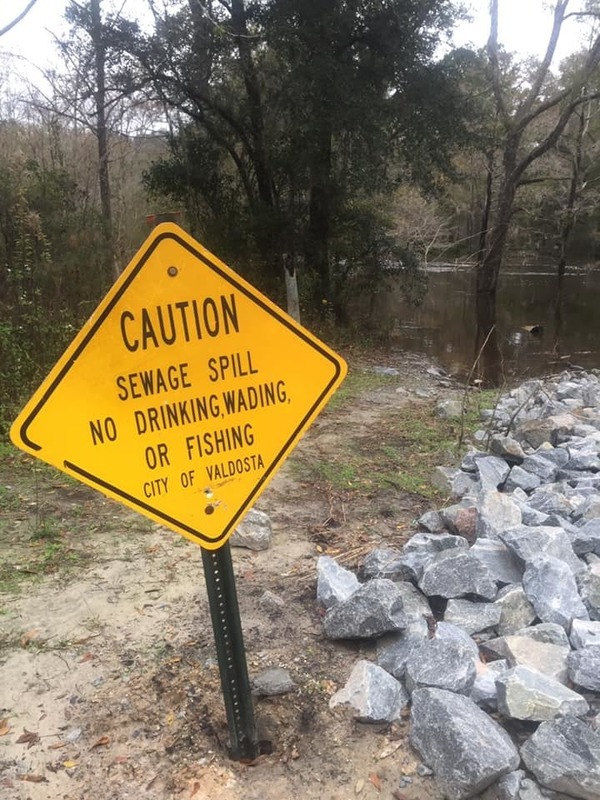
Valdosta Warning Sign, Sign
Photo: Julie Bowland, of Valdosta sewage spill sign at Troupville Boat Ramp, 21 December 2018.

How Bad Is It?

The 7,592,910 gallons of raw sewage spilled this time is more than the 6,273,595 gallons Valdosta spilled in two dozen incidents last December.

It’s 3.45 times Continue reading

Thanks to organizations for the Okefenokee Swamp, against the Titanium Mine

Thanks to the more than two dozen organizations, local, regional, statewide in Florida and Georgia, national, and international, that oppose the titanium mine that would be far too close to the Okefenokee Swamp. The Okefenokee National Wildlife Refuge (ONWR) provides boating, birding, fishing, and hunting nearby to the tune of more than $60 million a year and more than 700 jobs, making it the NWR of most economic benefit to each of Georgia and Florida. The Okefenokee Swamp is a unique ecological treasure, and is the headwaters of the Suwannee and St. Marys Rivers. The burden of proof is on the miners, and they have not met it.

[Organizations For Okefenokee Swamp, Against Titanium Mine]
Organizations For Okefenokee Swamp, Against Titanium Mine
PDF
Add your organization here: https://forms.gle/Dyqc77EBsjXBsz93A

You can still file a comment with the U.S. Army Corps of Engineers. If the Corps actually issues a permit, which they may in the next few weeks, anything filed can be used in any ensuing lawsuit.

Exactly how many organizations oppose that strip mine is hard to say, since Continue reading

Okefenokee Swamp on GWC Dirty Dozen because Titanium Mine 2019-11-14

Announced yesterday to press across Georgia and beyond, the titanium mine near Georgia and Florida’s Okefenokee Swamp proposed by Twin Pines Minerals of Alabama made the Georgia Water Coalition Dirty Dozen (see also PDF).

You can still file a comment with the Army Corps and GA-EPD asking them to reject the mine or at least require an Environmental Impact Statement. Convenience for miners is no excuse to risk the fishing, boating, and birding in the swamp and hunting and forestry nearby.

[Closeup]
Closeup of TPM equipment on mine site from GA 94 westbound.
Photo: John S. Quarterman for WWALS, November 14, 2019

2019’s
Worst Offenses Against
GEORGIA’S WATER
OKEFENOKEE SWAMP, ST. MARYS AND SUWANNEE RIVERS

Proposed 2,400-Acre Titanium Mine Threatens Signature Landscape of Georgia

INTRODUCTION:

Twenty years ago when chemical giant DuPont proposed mining titanium dioxide ore near the Okefenokee Swamp, opposition to the plan was so strong— Continue reading

Waterkeepers Florida passes resolution against titanium mine application near Okefenokee Swamp

Waterkeepers Florida asks the Army Corps to require Twin Pines Minerals to supply all the information missing from its application for a titanium mine near the Okefenokee Swamp, to prepare a full Environmental Impact Statement (EIS), to hold Public Hearings, including in Florida, and “to answer how the Corps has or will determine that the Applicant’s proposed mine would not adversely affect the Okefenokee Swamp, the St. Marys River, the Suwannee River, the Floridan Aquifer, or the State of Florida.”

You can also still comment to the Army Corps.

[TPM Equipment closeup, Wayne Morgan]
TPM Equipment closeup Photo: Wayne Morgan for Suwannee Riverkeeper on Southwings flight, pilot Allen Nodorft, 2019-10-05.

Continue reading

Floridan Aquifer withdrawals affect the Okefenokee Swamp, so how could TPM’s withdrawals not? 1995-04-11

Water withdrawals from the Floridan Aquifer affect water levels and quality in the Okefenokee Swamp, a pair of researchers concluded 24 years before Twin Pines Minerals of Alabama proposed to withdraw 2.4 4.32 million gallons per day from the Aquifer for a titanium mine within a few miles of the Swamp:

Abstract. A rapid response is observed between water level fluctuations in the Okefenokee Swamp and water levels in the underlying Floridan Aquifer. A lag of approximately one month is common, and a hydraulic diffusivity of 3.83 x 10⁻³ m2 s-1 best matches the calculated aquifer response to the swamp water level perturbations. The magnitude of leakage between the swamp and the aquifer is uncertain because of a lack of knowledge about the specific storage coefficient in the aquitard separating the swamp and the aquifer which has not been explicitly measured. An intermediate value of specific storage within the likely range of values results in a down- ward vertical flow of 1.2 meters of water per year. This induced recharge can significantly alter the natural water balance within the swamp. Such a large loss of water from the swamp may be responsible for observed pH and water level changes, and increased beavy metal accumulations in aquatic organisms in the swamp.

We cited that study[5] on page 4 of the Suwannee Riverkeeper comments to USACE about TPM, just after noting Twin Pines application to withdraw 4.32 million gallons per day (mgd) of Floridan Aquifer water much closer to the Swamp than any other permitted withdrawal. TPM’s own hydrology study in that withdrawal application shows a cone of depression in the Floridan Aquifer extending under the Swamp:

[Figure 8. Drawdown 2930 days]
Figure 8. Drawdown 2930 days

How could that not affect Swamp water levels and content?

As pointed out to the Corps by Okefenokee Swamp Park (OSP), any change to the water level in the Swamp would Continue reading

TTM groundwater withdrawal and use permit application to GA-EPD 2019-07-24

At 4.32 million gallons per day (mgd) monthly average, Twin Pines proposes to withdraw more Floridan Aquifer water than almost anything in the surrounding six southeast Georgia counties: 4.32 times the City of Folkston, and almost four times the notorious Nestlé withdrawal request for Ginnie Springs on the Santa Fe River in Florida. You can still comment to the U.S. Army Corps of Engineers about the TPM mining application. Or to GA-EPD about this water withdrawal permit.

[4.32 mgd, 1.44 mgd from each of three wells]
4.32 mgd, 1.44 mgd from each of three wells

The only things bigger nearby are the City of St. Marys (6 mgd) and the Rayonier paper mill at Jesup (74 mgd).

For comparison, Kingsland 4, Waycross-Ware County Industrial Park 3.4, Waycross 3.16, Jesup 3, Kings Bay Submarine Base 2.9 + 1 for irrigation, Satilla Regional Water and Sewer Authority 2.2, Folkston 1.0. Even Chemours in Wayne County only wants 0.605 and Southern Ionics only 0.504 in Charlton County and another 0.504 in Pierce County.

All the permitted withdrawals in Charlton County add up to less than half what TPM wants for its titanium mine near the Okefenokee Swamp: Continue reading

GA-EPD cites Suwannee Riverkeeper and US EPA against TPM titanium mine near Okefenokee Swamp 2019-09-12

GA-EPD told USACE the mining application is incomplete, asked for comments to be reopened, and cited Suwannee Riverkeeper and Georgia River Network:

“Understanding that groundwater hydrologic effects associated with the Twin Pines project have been a central concern expressed by federal resource/regulatory agencies, NGOs (e.g. the Suwannee Riverkeeper and Georgia River Network), and the public at large, we respectfully submit that the 404/401 permit application as submitted thus far is not complete since it lacks full information and findings regarding hydrogeologic factors on site and post-project effects to hydrogeology/groundwater. We feel that it is inappropriate and premature to close the project comment window when such notable elements of the environmental documentation for this project have not yet been made available. documentation which we at GaEPD judge to be important to our review of this project.”

[the 404/401 permit application as submitted thus far is not complete]
the 404/401 permit application as submitted thus far is not complete

This was revealed by USACE in a Public Notice of September 17, 2019. So far, this is the only update posted by the Corps since it closed comments on September 12, 2019.

It also includes comments by U.S. EPA, also saying the application is incomplete, and also cited by GA-EPD. EPA cites cumulative effects and notes numerous lacking documents and studies. EPA concludes:

“Due to the potential for the proposed Twin Pines Minerals mine to adversely affect the hydrology of the Okefenokee NWR, the EPA believes that there is the potential for this project as proposed to cause adverse effects to water quality and the life stages of aquatic life or other wildlife dependent on aquatic systems. The EPA finds that this project, as proposed, may result in substantial and unacceptable impacts to aquatic resources of national importance, as covered in Part IV. paragraph 3(a) of the August 1992 Memorandum of Agreement between the EPA and the Department of the Army regarding CWA Section 404(q).”

Apparently USACE is at least listening to the public and the public and NGOs such as Suwannee Riverkeeper.

You can still send in comments. The Corps won’t say they will read them, but they explicitly won’t say they won’t read them, so keep sending them in, and publish them on social media, as op-eds, etc. Continue reading

Valdosta sewer spill into Onemile Branch, Drexel Park 2019-08-03

Why do we get to find out in the newspaper Tuesday about a Saturday sewage spill that just “occurred”, and didn’t even show up in GA-EPD’s online Sewage Spill Reports until after the newspaper was printed and distributed? Rest assured it’s not Valdosta’s responsibility, according to Valdosta.

[Pipe under bridge by apartments]
Pipe under bridge by apartments

Katelyn Umholtz, Valdosta Daily Times, 5 August 2019, Sewer spill occurs near Drexel Park, Continue reading