Category Archives: Law

IRS confirmed 501(c)(3) status for WWALS

Treasurer Gretchen Quarterman reports she received a letter from the IRS yesterday (PDF, image):


PDF, Image

Dear Applicant,

We are pleased to inform you that upon review of your application for tax exempt status we have determined that you are exempt from Federal income tax under section 501(c)(3) of the Internal Revenue Code. Contributions to you are tax deductible bequests, devises, transfers or gifts under section 2055, 2106 or 2522 of the Code.

This nonprofit educational public charity status for WWALS is effective as of our date of incorporation, June 8th, 2012. So all contributions to WWALS back to that date are officially tax-deductible.

-jsq

Alapaha Greenway Trail?

A Greenway Trail is an onland version of the sort of Blueways or Water Trails WWALS is working on. WWALS board member Chris Graham got a very nice spread in one of the Lakeland newspapers today about Greenways, speaking for himself. -jsq

Lanier County Advocate, 4 June 2014, Page 12, Local nature enthusiast hoping to bring Greenway Trail to Lakeland,

Naylor native Christopher Graham has spent the majority of his life exploring the great outdoors every chance he gets.

Currently, Graham serves on the board of the Water Shed group to help ensure local rivers are clean and safe for citizens to enjoy. But what Graham has been striving for is to bring a Greenway Trail to the local area.

What are Greenway Trails? Continue reading

Two bad water bills and six good ones in the Georgia legislature today

Flint Riverkeeper has a handy legislative update about water bills in the Georgia legislature, one bad one before committee today: SB 299.

SB 299 Natural Resources; provide flexibility for establishing watershed protection standards

This bill would actually do away with the riparian buffers that currently keep mud and sewage out of rivers and streams. It’s up for a vote today in the Senate Committee on Natural Resources and the Environment. At least one Senator on that committee is in WWALS watersheds: Tyler Harper, (404) 463-5263, (404) 463-4161 fax, Ocilla, District 7, (229) 425-4840. You can contact him or your state Senator. Here are many reasons SB 299 is a bad bill.

More reasons, by Camo Coalition, of the Georgia Wildlife Federation, starting with:

Siltation kills streams. Siltation can fill lakes making boat access difficult or impossible. Silt destroys the habitat of aquatic invertebrates—caddis flies, mayflies, stone flies, and such. Pollutants can kill fish and these aquatic animals directly. Destroy the food chain; destroy the fishery.

SB 213 Flint River Drought Protection Act

This bill is not anything like its name. It’s actually a water grab that would stuff Flint River water into our fragile Floridan Aquifer and during droughts take it back out, but not for downstream use, rather for shipping to Atlanta. Even though it’s a Senate bill, it’s currently in the House Agriculture and Consumer Affairs Committee, which has not yet convened this session, so now is a good time to contact your state rep. Those in WWALS watersheds include at least:
  1. Ellis Black, Valdosta, R-174, 404.656.0287, ellis.black@house.ga.gov
  2. Amy Carter, Valdosta, R-175, 229.245.2733, 404.656.6801, amy.carter@house.ga.gov
  3. Buddy Harden, Cordele, R-148, 404.656.0188, buddy.harden@house.ga.gov

The Flint River, #2 on American Rivers’ most endangered rivers list, is the next watershed to the west of us. If this bill passes, when will they come for the waters of the Little River, too?

Good Bills

Here are some good bills that need support, with descriptions from Georgia Water Coalition’s current legislative update, which covers the same bills as Flint Riverkeeper’s update.

Extending the Ban on Aquifer Storage and Recovery

Continue reading

SB 213 Flint River water grab bill is back

As we could have guessed from the aquifer storage meeting last November, the water grab to ship to Atlanta HB 213 that failed in the Georgia House last year is back on the table this year, and it’s still a bad idea, especially with the Flint River #2 on American Rivers’ Most Endangered Rivers list.

Gordon Rogers, Flint Riverkeeper, wrote for the Atlanta Business Chronicle 10 January 2014, Bill would fundamentally change Georgia water law,

In the Dec. 13, 2013, Atlanta Business Chronicle article “Bill could aid Georgia in water case,” Georgia Environmental Protection Division Director Jud Turner was quoted saying those who object to his proposed Flint River legislation (SB 213) believe in a water swap “conspiracy theory.”

The controversial provision in SB 213 would authorize state investment in “projects to augment stream flows” and would then authorize the director to prohibit downstream property owners with permits from withdrawing “augmented” water (which is undefined). The duration of the prohibition on water withdrawals is undefined, and the bill is structured to allow private consulting companies …

-jsq

Access to rivers: legal issues

Legal access to rivers and other waterways in Georgia is unclear, and federal law may trump state law anyway.

Dan Washburn wrote some time in 2000 for The Times of Gainesville, GA, Access denied: Owners, users spar over land, which applies as much to the rest of Georgia as to north Georgia:

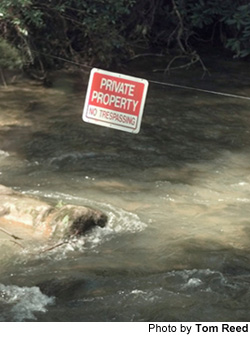
Photo by Tom Reed The conflict in North Georgia is a confusing amalgam of the old and the new, of state and federal laws, of mountains and streams. Its cast of characters includes landowners and land managers, bureaucrats and businessmen, environmentalists and adventure seekers — and lawyers, plenty of lawyers.

And much of it involves a splitting of legal and philosophical hairs that would make Mother Nature and Uncle Sam cringe.

Nowhere has this tug-of-war played out more dramatically than on Georgia’s rivers and streams, where the dispute over what is public and what is private is as murky as the Chattahoochee River after a hard rain.

There’s a lot more in the article, including this box:

Getting to the water an issue for paddlers, anglers alike

Continue reading

Delaware Riverkeeper and leaky methane pipes

Delaware Riverkeeper again has standing to oppose fracked natural gas pipelines, as part of the recent Pennsylvania Supreme Court ruling against frackers.

Andrew Maykuth wrote for philly.com 23 December 2013, What Pa. court’s ruling on gas-drilling law means,

…opponents of shale gas drilling say the court decision carries substantial symbolic and political weight. They hope it signals a reconsideration of state government’s love affair with fossil fuels.

“With this huge win, we will move ahead to further undo the industry’s grip of our state government,” said Maya van Rossum, executive director of the Delaware Riverkeeper Network, whose standing as a plaintiff in the case was restored by the Supreme Court’s decision.

The ruling may also revitalize the state’s Environmental Rights Amendment, a 42-year-old law that guarantees Pennsylvanians’ access to clean air and water.

Fracking backers of course say the ruling will harm business. Somebody remind me, why should big business get to destroy local property and watersheds to turn a buck?

Local governments in Pennsylvania made big fossil fuel think again: Continue reading

WWALS in Waycross at EPA Seven Out Superfund meeting

It’s a serious situation in Waycross, with people getting sick and dying. The contamination, whatever it is, may have crossed into WWALS watersheds, as well. Good interactions between WWALS, Satilla Riverkeeper, and silentdisaster.org, plus EPA, GA EPD, and GA Health Dept.


Matthew J. Huyser, EPA (l. standing blue shirt), Jim Brown, GA EPD (c. standing white shirt), Ashby Nix, Satilla Riverkeeper (facing Brown, paper in hand), Joan Martin McNeal, silentdisaster.org (r. in group)

For details, see these posts on Lowndes Area Knowledge Exchange (LAKE): Continue reading

Entering the Floridan Aquifer Recharge zone –Kristofer Graham

Written as a newspaper letter to the editor and posted here with permission. -jsq

Dear Residents

Did you know Lanier County doesn’t have zoning laws. Which that mean they can development on wetlands and on our Floridan Aquifer Recharge zone and build resident houses, subdivided, commercial building etc., cut timber on wetlands, on our watersheds and a Natural Gas Company want to put a pipeline through on these precious lands they can. It will destroy the land environment like our Floridan Aquifer Recharge zone (aka our drinking water) and our wetlands and our watersheds. Because it not protected like it should.

Lanier County Groundwater Recharge Areas Well it time to protect it before it all destroy and gone. It is up to our local government to protect these precious lands and preserve it in the original state. Yes it’s time for our local government to do there job to protect it. So it can be there forever.

I notices they got those lands zone as Ag and V5 zone. Which those zone doesn’t protect it and in fact it can destroy those lands Eco system because they spray pesticide for there farm crops near the Floridan Aquifer Recharge zone and wetlands, our watersheds. It will Continue reading

Aquifer storage meeting in Newton, GA 7 November 2013

It looks like SB 213 is being resurrected after falling in the Georgia House in March. This GEFA ASR meeting is in Newton, which is not far west of Tifton. When will they be coming for the waters of the Little River, too?

Jim West in the Albany Herald 29 March 2013, Flint River bill fails in the House, quoted Gordon Rogers, Flint Riverkeeper, and then referred to Georgia Water Coalition:

One aspect of the bill river advocates found objectionable was the concept of “stream flow augmentation,” including aquifer storage and recovery, or ASR, which Coalition officials define as “the injection of ground water into the aquifer, which would be extracted later and sent downstream.” According to the Coalition, the process could cause irreversible contamination of the aquifer.

GEFA News 30 October 2013, Aquifer Storage Project Public Meeting Scheduled, Continue reading

JIA replies to WWALS about marsh and land

“There currently are no plans for more development on Jekyll Island” said JIA in a response to WWALS’ assertion that marsh is not land. So why does a map under consideration by JIA show all marsh as land at mean high tide? Could “currently” mean until the law gets changed? -jsq

Continue reading