Delaware Riverkeeper and leaky methane pipes

Delaware Riverkeeper again has standing to oppose fracked natural gas pipelines, as part of the recent Pennsylvania Supreme Court ruling against frackers.

Andrew Maykuth wrote for philly.com 23 December 2013, What Pa. court’s ruling on gas-drilling law means,

…opponents of shale gas drilling say the court decision carries substantial symbolic and political weight. They hope it signals a reconsideration of state government’s love affair with fossil fuels.

“With this huge win, we will move ahead to further undo the industry’s grip of our state government,” said Maya van Rossum, executive director of the Delaware Riverkeeper Network, whose standing as a plaintiff in the case was restored by the Supreme Court’s decision.

The ruling may also revitalize the state’s Environmental Rights Amendment, a 42-year-old law that guarantees Pennsylvanians’ access to clean air and water.

Fracking backers of course say the ruling will harm business. Somebody remind me, why should big business get to destroy local property and watersheds to turn a buck?

Local governments in Pennsylvania made big fossil fuel think again: Continue reading

The Alliance opposes any new pipelines in these areas –Ichetucknee Alliance to FERC

Filed with FERC 17 December 2013 and on the Ichetucknee Alliance facebook group:

Lucinda F Merritt, Fort White, FL.

The Ichetucknee Alliance (http:// ichetucknee alliance.org) opposes placement of any new natural gas pipelines under, over or through the 5.5-mile long Ichetucknee River, including the area of Ichetucknee Springs State Park, the area of Columbia County that is included in the historic riverbed (the Ichetucknee Trace), and any part of the Ichetucknee Springshed.

The Alliance opposes any new pipelines in these areas for the following reasons.

The river and springs, including Ichetucknee Springs State Park, are Continue reading

WWALS in Waycross at EPA Seven Out Superfund meeting

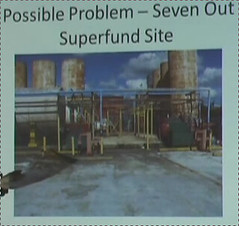
It’s a serious situation in Waycross, with people getting sick and dying. The contamination, whatever it is, may have crossed into WWALS watersheds, as well. Good interactions between WWALS, Satilla Riverkeeper, and silentdisaster.org, plus EPA, GA EPD, and GA Health Dept.


Matthew J. Huyser, EPA (l. standing blue shirt), Jim Brown, GA EPD (c. standing white shirt), Ashby Nix, Satilla Riverkeeper (facing Brown, paper in hand), Joan Martin McNeal, silentdisaster.org (r. in group)

For details, see these posts on Lowndes Area Knowledge Exchange (LAKE): Continue reading

Entering the Floridan Aquifer Recharge zone –Kristofer Graham

Written as a newspaper letter to the editor and posted here with permission. -jsq

Dear Residents

Did you know Lanier County doesn’t have zoning laws. Which that mean they can development on wetlands and on our Floridan Aquifer Recharge zone and build resident houses, subdivided, commercial building etc., cut timber on wetlands, on our watersheds and a Natural Gas Company want to put a pipeline through on these precious lands they can. It will destroy the land environment like our Floridan Aquifer Recharge zone (aka our drinking water) and our wetlands and our watersheds. Because it not protected like it should.

Lanier County Groundwater Recharge Areas Well it time to protect it before it all destroy and gone. It is up to our local government to protect these precious lands and preserve it in the original state. Yes it’s time for our local government to do there job to protect it. So it can be there forever.

I notices they got those lands zone as Ag and V5 zone. Which those zone doesn’t protect it and in fact it can destroy those lands Eco system because they spray pesticide for there farm crops near the Floridan Aquifer Recharge zone and wetlands, our watersheds. It will Continue reading

Ichetucknee Alliance thinks it got the pipeline to move

According to their facebook page today, a conservation group in Florida convinced Sabal Trail to steer clear of their springs. Or did they? The “written assurances” they they got from Spectra’s Andrea Grover say “preferred” and “currently”. In any case, some of Ichetucknee Alliance’s positions are just as valid in WWALS’ watersheds.

Here’s an excerpt from their position, Ichetucknee Alliance Pipeline Position Paper, 21 August 2013, Continue reading

Pipeline would cross Withlacoochee River twice

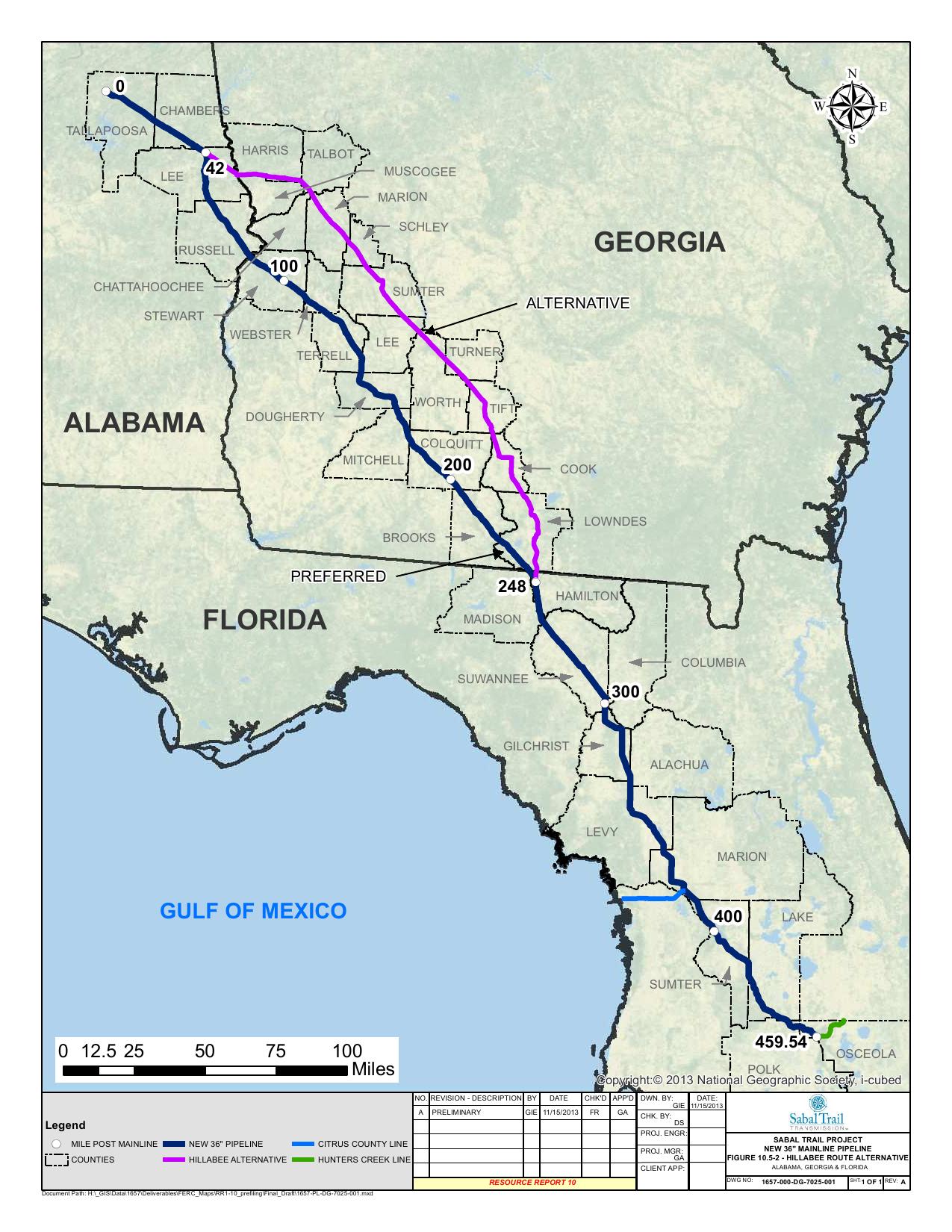
The detail maps in the General Project Description in the 15 November 2013 update to FERC by Sabal Trail Transmission reveal that the proposed path would cross the Withlacoochee River both where the river is the border of Brooks and Lowndes County and where it is the border between Hamilton and Madison County near Ellaville. In between, the pipeline would run through many wetlands near the river and through quite a few recharge zones for our drinking water source, the Floridan Aquifer. Then it crosses our downstream river, the Suwannee, into Suwannee County, Florida.

Continue reading

Pipeline alternate route still in WWALS watersheds, plus Tifton and Valdosta

The Hillabee alternative route runs right down the middle of the WWALS watersheds, through Worth County, Turner County, Tift County, Colquitt County, Cook County, and Lowndes County in Georgia, and Hamilton County, Madison County, and Suwannee County in Florida. This puts it not only still in the Withlacoochee River watershed, but also in the Little River and Alapaha River watersheds. This route by the pipeline company Sabal Trail Transmission (owned and managed by Spectra Energy) avoids Albany but apparently goes through Tifton and Valdosta and still through Lowndes County before entering Florida in Hamilton County much like Spectra’s preferred route.

Hillabee (Valdosta and Tift County) Route Alternative, Georgia

This alternate route is the rest of the Option B that was first proposed to Lowndes County residents back in June: Continue reading

WWALS files as intervenor to oppose the Sabal Trail Transmission gas pipeline

Approved by the WWALS Board 13 November 2013. PDF.

From:
WWALS Watershed Coalition
3338 Country Club Road #L336
Valdosta, GA 31605
www.wwals.net
wwalswatershed@gmail.com
18 October 2013

To:
Secretary Sarah McKinley
The Federal Energy Regulatory Commission
888 First Street N.E
Washington, DC 20426

Re: Pre-filing Docket PF14-1 Sabal Trail Transmission

Cc:
Georgia Public Service Commission
Florida Public Service Commission

WWALS Watershed Coalition, Inc. opposes the proposed Sabal Trail Transmission gas pipeline that would cut a 100 foot wide gash across our Withlacoochee River and through many wetlands in south Georgia and north Florida, including recharge zones for the Floridan Aquifer that provides our drinking water.

Sabal’s parent company, Spectra Energy, has a safety record that gives no comfort Continue reading

Waycross Superfund site in Georgia’s Dirty Dozen

EPA will be in Waycross 24 November 2013 to meet about this contamination, which has also been shipped over into WWALS watersheds. -jsq

Satilla River: Toxic Legacy in Waycross Needs Further Investigations, Cleanups, in Georgia Water Coalition’s Dirty Dozen 2013,

Satilla River

Toxic legacy in Waycross Needs Further Investigations, Cleanups

Introduction:

Lurking within Mary Street Park, a tree-lined neighborhood park in Waycross, is a silent killer—toxic pollutants from a defunct industrial wastewater treatment facility known as Seven Out Tank. Opened in 2002, the industrial waste handler operated only two years before multiple environmental violations led to the facility’s closure. Now, after Continue reading

Aquifer storage meeting in Newton, GA 7 November 2013

It looks like SB 213 is being resurrected after falling in the Georgia House in March. This GEFA ASR meeting is in Newton, which is not far west of Tifton. When will they be coming for the waters of the Little River, too?

Jim West in the Albany Herald 29 March 2013, Flint River bill fails in the House, quoted Gordon Rogers, Flint Riverkeeper, and then referred to Georgia Water Coalition:

One aspect of the bill river advocates found objectionable was the concept of “stream flow augmentation,” including aquifer storage and recovery, or ASR, which Coalition officials define as “the injection of ground water into the aquifer, which would be extracted later and sent downstream.” According to the Coalition, the process could cause irreversible contamination of the aquifer.

GEFA News 30 October 2013, Aquifer Storage Project Public Meeting Scheduled, Continue reading