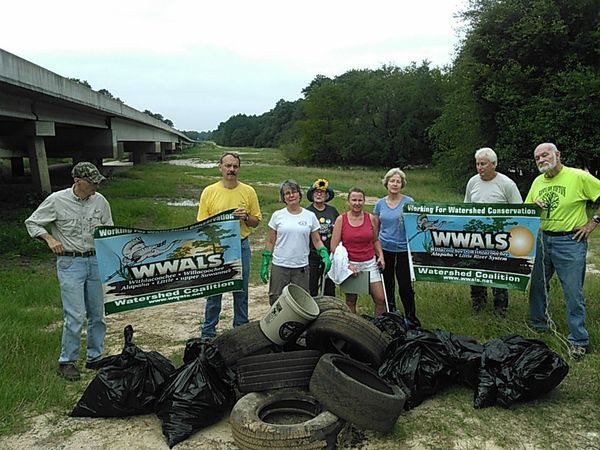
A cleanup and a new WWALS banner! Thanks to Bret Wagenhorst for both, at the Alapaha River at GA 135 on the Atkinson County side today.
-jsq

A cleanup and a new WWALS banner! Thanks to Bret Wagenhorst for both, at the Alapaha River at GA 135 on the Atkinson County side today.
-jsq
Bret Wagenhorst invites you:
For anyone who likes to paddle the pristine waters of our region’s lovely Alapaha River, I’d like to encourage you to come out for an hour this coming Saturday and help make a noticeable difference by picking up trash along the bank at one of the put in sites for the Alapaha River Water Trail. 9 a.m. at the Hwy 135 bridge south of Willacoochee.
It’s the annual WWALS Adopt-A-Stream cleanup, Continue reading
Thanks, Emily and Henry, and to the City of Valdosta for all your efforts. But could somebody please update the schedule on Valdosta’s website?
Subject: COV Sanitary Sewer System Improvement Update
Good afternoon Chris,
Thank you for reaching out to me today for an update on the sewer improvements that the City has underway. We have continued to make substantial progress since our meeting back in March that you attended. As discussed then, the city has two major projects underway. One is a $36 million dollar Force Main project and the other is a $23 million dollar Plant Relocation. As of today, the Force Main project is 5 months ahead of the July 2016 schedule and the Plant Relocation is 16 months ahead of schedule. Both projects are tracking a timeline to be complete and online around February 2016. Please note that we have not had any overflow or major permit violations at the wastewater treatment plant since making the emergency repairs in February 2014.
Below is a quick summary of an update I recently received in reference to the sewer manhole overflows: Continue reading
Rescheduled from July,
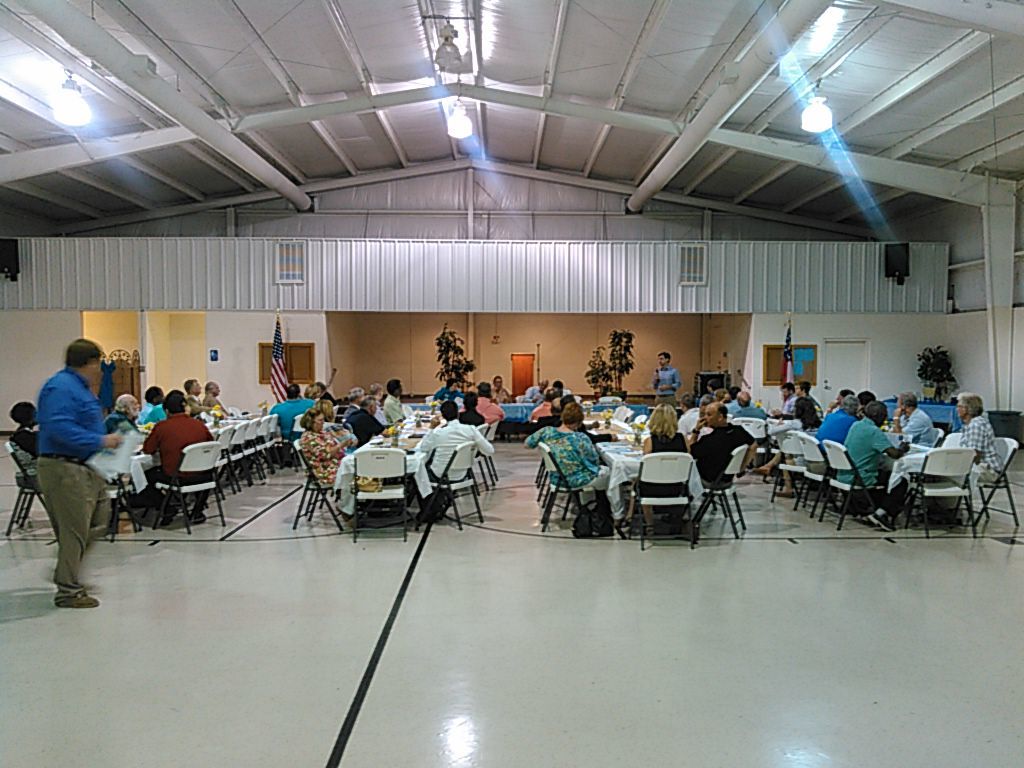 WWALS Ambassador
Dave Hetzel will speak about the
Alapaha River Water Trail (ARWT), which is
now looking to place signs and reprint brochures,
and the
Withlacoochee and Little River Water Trail (WRWT),
whose Committee is looking for more members,
at the
Southern Georgia Regional Commission Council
meeting September 24th in Pearson, Georgia.
WWALS Ambassador
Dave Hetzel will speak about the
Alapaha River Water Trail (ARWT), which is
now looking to place signs and reprint brochures,
and the
Withlacoochee and Little River Water Trail (WRWT),
whose Committee is looking for more members,
at the
Southern Georgia Regional Commission Council
meeting September 24th in Pearson, Georgia.
When: 11AM Thursday September 24th, 2015
Where: Continue reading
Also boating, deadfalls, steam engine, and rapids. Diane Shearer presented slides about the Alapaha River of her homeland, 31 March 2012 at Georgia River Network Weekend for Rivers, and said:
Right there at Alapaha, where it’s been clearcut behind it. This is one of the main problems of the river: there used to be nothing on that shore there but huge cypress trees and tupelo trees, and that’s almost gone everywhere. And that’s one of the great dangers to this river, is agricultural runoff, the fact that people can suck all the water out of it they want to, for irrigation and those sorts of things.
The video starts Continue reading
According to GA-DNR, 17 August 2015,
The Suwannee-Satilla Regional Water Council will meet on Monday, August 31, 2015 at 10:00am in the meeting room of
Aniston’s Restaurant, located at 1404 W. Baker Highway, Douglas, GA. Registration begins at 9:30am. The Council will be hearing presentations on surface water supply and agricultural water-use forecasting. The Council will also be discussing items for consideration in the revision and update of the 2011 Regional Water Plan.
Here are the LAKE videos of their June meeting and here is the announcement for their July meeting; the LAKE videos for that last one will be available soon.
-jsq
From Douglas and Tifton, Georgia through Florida to South America and South Africa,
 they ate bon-bons and floated and climbed to see springs, caves at Five Holes, and said what they thought about the
Sabal Trail pipeline proposing to gouge across the Suwannee River,
on the
WWALS Outing Saturday August 15th 2015.
they ate bon-bons and floated and climbed to see springs, caves at Five Holes, and said what they thought about the
Sabal Trail pipeline proposing to gouge across the Suwannee River,
on the
WWALS Outing Saturday August 15th 2015.
Update 2018-02-12: 5 Holes (also known as Hamilton Seven Sisters Spring) is on Suwannee River State Park (SRSP) land, and is normally closed to the public. We did have permission for this outing, thanks to Park Manager Craig Liney, as well as for the later Five Holes Cleanup and Site Exploration.
Expedition leader Chris Mericle reports he’s gotten the Suwannee River State Park vehicle entrance fees waived for this weekend’s outing, plus a permit
…to view a unique closed area of the park called “5 Holes”. 5 Holes is a series of karst windows leading to a spring. When the water level is right you can walk through a semi-cavern from the river up the spring run to the spring.
So meet us 8AM tomorrow morning, Saturday, August 15h, 2015 at Gibson Park!
James Garrett posted some Continue reading
 Lowndes County Chairman Bill Slaughter says the Naylor Boat Ramp is
on schedule for completion this fall, provided the Georgia Department
of Natural Resources returns the appropriate permits.
Lowndes County Chairman Bill Slaughter says the Naylor Boat Ramp is
on schedule for completion this fall, provided the Georgia Department
of Natural Resources returns the appropriate permits.
At last night’s Lowndes County Commission Regular Sesssion, WWALS president John S. Quarterman displayed the Alapaha River Water Trail brochures, pointing out the Naylor Boat Ramp on the map. He, ok, I, asked what was the status of that project that Lowndes County is building with SPLOST funds.
Nobody answered in the public meeting, but afterwards Continue reading
Update 2015-08-14: Now plus Five Holes caves at Suwannee River State Park!
 This flag marks where Sabal Trail plans to drill under the Suwannee River,
pictured today by Chris Mericle, who also pictured
a number spraypainted on a tree and remarked:
This flag marks where Sabal Trail plans to drill under the Suwannee River,
pictured today by Chris Mericle, who also pictured
a number spraypainted on a tree and remarked:
I know it is a small thing but, it is this lack of respect for nature that we will be forced to endure if this pipeline is permitted.
With FL DEP proposing to issue a permit for Sabal Trail, let’s go investigate, and have some fun at the same time.
 First we’ll look at the
Alapaha Rise, which is where some of the water that disappears from the Alapaha River at its
sinks comes back up out of the Floridan Aquifer.
To get to the Rise we paddle upstream on the Suwannee River,
then Continue reading
First we’ll look at the
Alapaha Rise, which is where some of the water that disappears from the Alapaha River at its
sinks comes back up out of the Floridan Aquifer.
To get to the Rise we paddle upstream on the Suwannee River,
then Continue reading