Tag Archives: Quantity

Alapaha Greenway Trail?

A Greenway Trail is an onland version of the sort of Blueways or Water Trails WWALS is working on. WWALS board member Chris Graham got a very nice spread in one of the Lakeland newspapers today about Greenways, speaking for himself. -jsq

Lanier County Advocate, 4 June 2014, Page 12, Local nature enthusiast hoping to bring Greenway Trail to Lakeland,

Naylor native Christopher Graham has spent the majority of his life exploring the great outdoors every chance he gets.

Currently, Graham serves on the board of the Water Shed group to help ensure local rivers are clean and safe for citizens to enjoy. But what Graham has been striving for is to bring a Greenway Trail to the local area.

What are Greenway Trails? Continue reading

Outing at Avera’s Mill Pond (Lewis Lake)

Lewis Lake, site of today’s outing at 4PM, is Avera’s Mill Pond. According to Wenda Gaile Bailey, “there was a partial draining of the lake late last year”, but she checked the water level yesterday. Here’s some history, and some pictures from five years ago of what you may see today.

WG Bailey wrote for WG Bailey photos, unknown date, Old Fashioned Pond Draining at Lake Lewis,

Avera’s Mill Pond, the oldest and largest pond in Berrien County, was founded by William M. Avera, son of pioneer, Daniel Avera, covers 1470 acres, and was built in the 1870’s at a cost of $3800.87

The mill dam is located Continue reading

Study before Levee –Tim Carroll

Comment on facebook 10 May 2014 and he told me the same by telephone.

It is clear a full watershed wide study must be completed before any decisions can be made. As established in this first study—The City of Valdosta is the recipient-not the origin- of the flood waters. While it confirms what we already knew, my job is to try and keep the ball rolling forward. Engage congressional leaders, secure funding and find long term, sustainable solutions that benefit all communities within the watershed basin. A levee by itself is not the answer.
–Tim Carroll

This was a comment on Videos: Flooding study by Army Corps of Engineers @ VCC 2014-05-06, which was about the initial study that was confined to Valdosta, and in which the Corps proposed a levee at the mouth of Sugar Creek, above the Withlacoochee River. To their credit, the Corps were clear that they also want a long-term watershed-wide study (they want to do the entire Suwannee River drainage area), and one of the main conclusions of the initial study was:

This report established that there could be Federal interest in pursuing future flood management risk studies undre other USACE authorities.

-jsq

Flooding charts: Withlacoochee and Little Rivers

Update 2025-09-21: Graphs from water.noaa.gov.

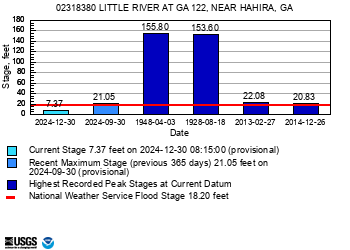
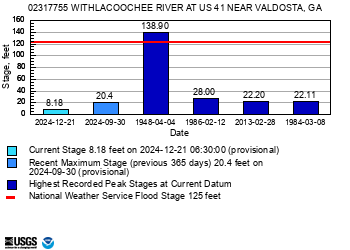
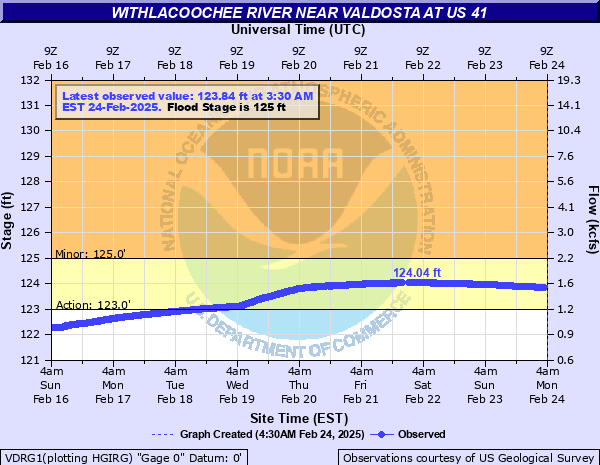
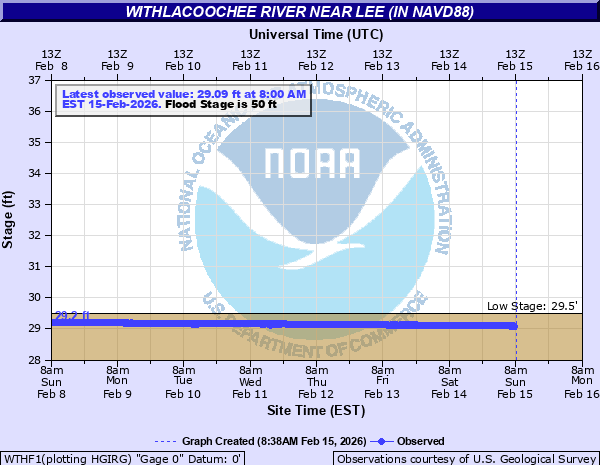
Related to the Withlacoochee and Little River Water Trail and the double USACE flooding study presentation tonight in Valdosta, here are river level charts upstream and down on the Little River, Okapilco Creek, and the Withlacoochee River related to a new USGS flood-tracking chart. In the example charts on the right, you can see the Little River peaked days ago at Tifton and yesterday at Hahira.

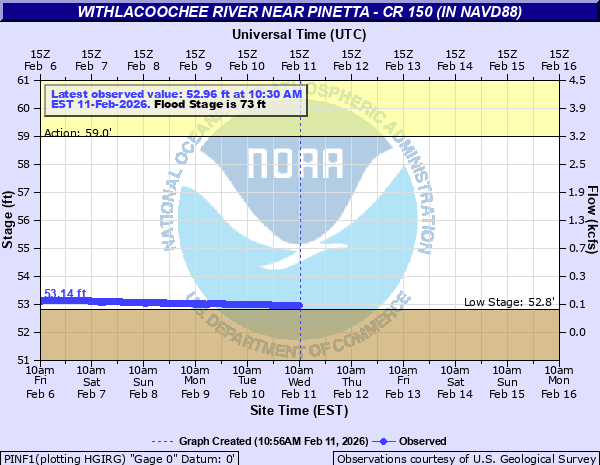
The Withlacoochee River peaked yesterday at US 41. while downstream it’s going up at US 84, and barely starting up at Pinetta (click on the above chart example for the rest). Right now you can see all that in the charts below. If this works, you’ll see something different later, because you’ll see current charts whenever you refresh this page.


Tifton Gauge, Little River at Upper Ty Ty Road, near Tifton, GA, Tift County, GA (02317797)

Highest safe 3.9 feet, 271 NAVD. Lowest boatable 0.1 feet, 267.2 NAVD.

Adel Gauge, Little River near Adel, GA, Cook County, GA (02318000)

Highest safe 7.9 feet, 181 NAVD. Lowest boatable 2.2 feet, 175.3 NAVD.

Hahira Gauge, Little River at GA 122, near Hahira, GA, Lowndes County, GA (02318380)

Highest safe 11 feet, 144 NAVD. Lowest boatable 4.25 feet, 137 NAVD.

Skipper Bridge Gauge, Withlacoochee River at Skipper Bridge Road, near Bemiss, GA, Lowndes County, GA (023177483)

Highest safe 10.7 feet, 131 NAVD. Lowest boatable 2.3 feet, 122.6 NAVD.

Valdosta Gauge, Withlacoochee River at US 41 near Valdosta, GA, Lowndes County, GA (02317755)

Highest safe 12.7 feet, 123′ NAVD. Lowest boatable 5.7 feet, 116′ NAVD.
Okapilco Creek Gauge, Okapilco Creek at GA 333, near Quitman, GA, Brooks County, GA (02318700)


Quitman Gauge, Withlacoochee River at US 84, near Quitman, GA, Brooks County, GA (02318500)

Highest safe 10.5 feet, 94 NAVD. Lowest boatable 2.0 feet, 85.5 NAVD.

Pinetta Gauge, Withlacoochee River near Pinetta, FL., Madison County, FL (02319000)

Highest safe 12.5 feet, 59 NAVD. Lowest boatable 6.0 feet, 52.5 NAVD.
Madison Gauge, Withlacoochee River near Madison, FL , Madison County, FL (02319300)

Highest safe 10.0 feet, 50 NAVD. Lowest boatable 0.1 feet, 40.1 NAVD.
Lee Gauge, Withlacoochee River near Lee, FL, Madison County, FL (02319394)

Highest safe 44.0 feet, 44 NAVD. Lowest boatable 29.5 feet, 29.5 NAVD.
The watersheds

See also interactive map.

315x535 WRWT, in Withlacoochee River Water Trail gauges, by John S. Quarterman, for WWALS.net, 8 June 2015

See also

Old updates

Update 2016-05-31: See sea level gage reports.

Update 2016-04-27: graphs from water.weather.gov and some WRWT Safe Water Levels.

Update 2014-11-04: Simplified gage formatting.

Update 2014-11-03: That works, and see also Alapaha River water levels.

 -jsq, John S. Quarterman, Suwannee RIVERKEEPER®

You can help with clean, swimmable, fishable, drinkable, water in the 10,000-square-mile Suwannee River Basin in Florida and Georgia by becoming a WWALS member today!
https://wwals.net/donations/

Flooding study presentations by Army Corps in Valdosta 6 May 2014

Received today. -jsq

Good afternoon Mr. Quarterman,

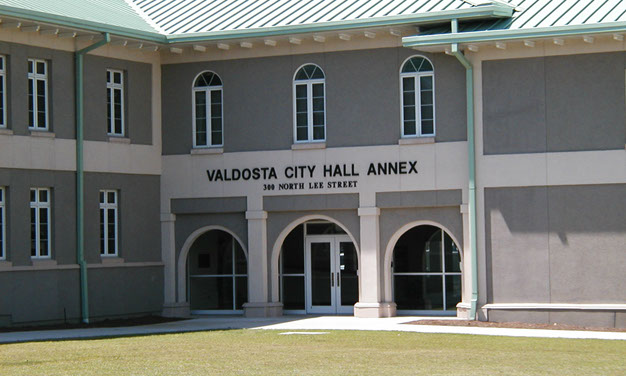
As requested, the date for the U.S. Army Corps of Engineers (USACE) presentation will be on May 6th to Mayor/Council at the work session which begins at 5:30 pm. The City will also have a meeting with the residents and businesses in the USACE project / study area that same night at 6:30 pm at the City Hall Annex – Multipurpose Room.

Continue reading

USGS Flood-Tracking Chart for Withlacoochee and Little River Basins

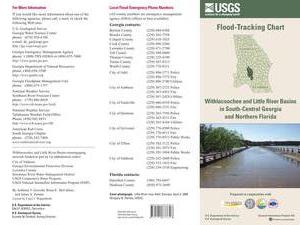
An interesting flyer pointed out by Emily Davenport, Storm Water Utilities Director, City of Valdosta. It has many useful contacts on the front, and tips on the back (don’t walk or drive through flood waters) but the most useful part is inside, where the flood-tracking chart is, in Flood-tracking chart for the Withlacoochee and Little River Basins in south-central Georgia and northern Florida, 2014, by Gotvald, Anthony J.; McCallum, Brian E.; Painter, Jaime A., USGS General Information Product: 155.

Here are the gages mentioned in the chart, with links to the live USGS FloodTracking pages, Continue reading

Avoid our area –Florida’s Suwannee River Water Management District to FERC

What they told FERC today was more subtle than just “avoid our area”, but after the Sabal Trail methane pipeline avoid karst limestone, any unconfined areas of our Floridan aquifer, caves, springs, wetlands, drilling under rivers, blasting, or using groundwater for testing pipes or disposing of it afterwards, where can that pipeline go?

The Suwannee River Water Management District (SRWMD) covers the Florida parts of WWALS’ watersheds, and our Withlacoochee River is named in the SRWMD comments. Unlike Georgia’s Suwannee-Satilla Water management District, SRWMD has state funding and staff that produced some very interesting comments.

This is the first I’ve heard of this point about source and disposal of testing water: Continue reading

Moody AFB Installation Complex Encroachment Management Action Plan (ICEMAP)

On 19 February 2014 WWALS Watershed Coalition received the appended letter from the United States Air Force about a study regarding encroachment around Moody Air Force Base, between Valdosta and Lakeland in Lowndes and Lanier Counties, in the watershed of the Alapaha River. Several documents were attached:

From: Mike Lynch <ml@marstel-day.com>
Date: Wed, Feb 19, 2014 at 10:32 AM
Subject: Moody Air Force Base Installation Complex Encroachment Management Action Plan (ICEMAP)
To:
Cc: "NICHOLS, DIONDRA R GS-11 USAF ACC 23 CES/CENPP" <diondra.nichols@us.af.mil>


On behalf of Headquarters Air Force and the 23d Wing, Marstel-Day, LLC is developing an "Installation Complex Encroachment Management Action Plan" (ICEMAP) for Moody Air Force Base (AFB), Georgia and its associated installations and facilities. Attached is a memo Continue reading

Two bad water bills and six good ones in the Georgia legislature today

Flint Riverkeeper has a handy legislative update about water bills in the Georgia legislature, one bad one before committee today: SB 299.

SB 299 Natural Resources; provide flexibility for establishing watershed protection standards

This bill would actually do away with the riparian buffers that currently keep mud and sewage out of rivers and streams. It’s up for a vote today in the Senate Committee on Natural Resources and the Environment. At least one Senator on that committee is in WWALS watersheds: Tyler Harper, (404) 463-5263, (404) 463-4161 fax, Ocilla, District 7, (229) 425-4840. You can contact him or your state Senator. Here are many reasons SB 299 is a bad bill.

More reasons, by Camo Coalition, of the Georgia Wildlife Federation, starting with:

Siltation kills streams. Siltation can fill lakes making boat access difficult or impossible. Silt destroys the habitat of aquatic invertebrates—caddis flies, mayflies, stone flies, and such. Pollutants can kill fish and these aquatic animals directly. Destroy the food chain; destroy the fishery.

SB 213 Flint River Drought Protection Act

This bill is not anything like its name. It’s actually a water grab that would stuff Flint River water into our fragile Floridan Aquifer and during droughts take it back out, but not for downstream use, rather for shipping to Atlanta. Even though it’s a Senate bill, it’s currently in the House Agriculture and Consumer Affairs Committee, which has not yet convened this session, so now is a good time to contact your state rep. Those in WWALS watersheds include at least:
  1. Ellis Black, Valdosta, R-174, 404.656.0287, ellis.black@house.ga.gov
  2. Amy Carter, Valdosta, R-175, 229.245.2733, 404.656.6801, amy.carter@house.ga.gov
  3. Buddy Harden, Cordele, R-148, 404.656.0188, buddy.harden@house.ga.gov

The Flint River, #2 on American Rivers’ most endangered rivers list, is the next watershed to the west of us. If this bill passes, when will they come for the waters of the Little River, too?

Good Bills

Here are some good bills that need support, with descriptions from Georgia Water Coalition’s current legislative update, which covers the same bills as Flint Riverkeeper’s update.

Extending the Ban on Aquifer Storage and Recovery

Continue reading

Delaware Riverkeeper and leaky methane pipes

Delaware Riverkeeper again has standing to oppose fracked natural gas pipelines, as part of the recent Pennsylvania Supreme Court ruling against frackers.

Andrew Maykuth wrote for philly.com 23 December 2013, What Pa. court’s ruling on gas-drilling law means,

…opponents of shale gas drilling say the court decision carries substantial symbolic and political weight. They hope it signals a reconsideration of state government’s love affair with fossil fuels.

“With this huge win, we will move ahead to further undo the industry’s grip of our state government,” said Maya van Rossum, executive director of the Delaware Riverkeeper Network, whose standing as a plaintiff in the case was restored by the Supreme Court’s decision.

The ruling may also revitalize the state’s Environmental Rights Amendment, a 42-year-old law that guarantees Pennsylvanians’ access to clean air and water.

Fracking backers of course say the ruling will harm business. Somebody remind me, why should big business get to destroy local property and watersheds to turn a buck?

Local governments in Pennsylvania made big fossil fuel think again: Continue reading