First time we’ve seen this: 300 gallons of raw sewage spilled from Rochelle, Georgia, in Wilcox County, at the top of the Alapaha River Basin.

Rochelle is nestled between Continue reading

First time we’ve seen this: 300 gallons of raw sewage spilled from Rochelle, Georgia, in Wilcox County, at the top of the Alapaha River Basin.
Rochelle is nestled between Continue reading
A month ago at Beatty Branch:
“Everything in this area depends on groundwater,” said John Quarterman, the Suwannee Riverkeeper in Lowndes County, where Moody is located. “I’m not saying that Moody necessarily did make enough contamination to be a problem, but I can’t tell from this report, and I don’t think it’s our responsibility to determine that they didn’t.”
![[Photographer Hyosub Shin and Reporter Meris Lutz]](https://www.wwals.net/pictures/2018-12-07--ajc-moody-afb/20181207_125050.jpg)
Photographer Hyosub Shin and Reporter Meris Lutz,
The Atlanta Journal-Constitution,
online today and in Sunday’s Atlanta paper newspaper,
Contaminated groundwater, a toxic legacy of Georgia’s air bases,
3 January 2019.
Moody Air Force Base tested their own wells, and found them clean. Which is good, but
![[Figure 2 AFFF Area Locations]](https://www.wwals.net/pictures/2018-12-07--ajc-moody-afb/Moody-site-inspect-PFOA-PFAS-0081.jpg)
Figure 2 AFFF Area Locations
PDF
their wells are much deeper than the wells the rest of us use in the country around here. Moody did not test any of those wells; Continue reading
No new spills reported in the Suwannee River Basin in Georgia! We do have some clarifications on old spills, some even with raw sewage totals.
Since the Sewage Spills Report GA-EPD posts each day replaces the previous one, WWALS has started picking up those reports daily and parsing out differences.

This has revealed a total for a Quitman report, some Smithbriar Drive spelling corrections, a total for one Valdosta spill location, and where it goes (spoiler: into the Alapaha River Basin).
We don’t see any new spills in the past two weeks in the Suwannee River Basin in Georgia.
We also don’t see Continue reading
Not just Valdosta: Tifton spilled two places, and Quitman one, in the most recent rains. Those cities were not in the data available online from GA-EPD yesterday, but they are in the online data today.
But Valdosta spilled the most sewage and from the most locations: six places, not just the one Valdosta told the public. Plus we finally have a total for the previous WWTP spill, and all the others from the beginning of December, and those totals are not pretty.
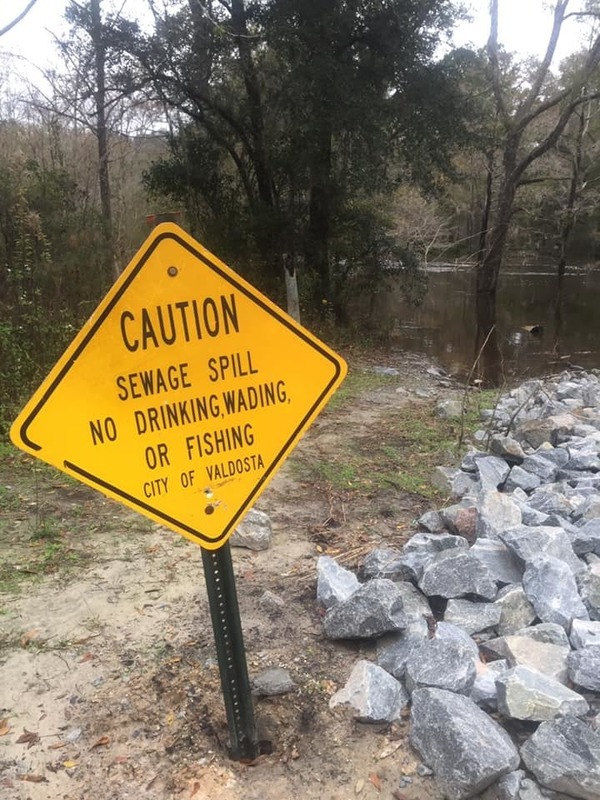
Photo: Julie Bowland, of Valdosta sewage spill sign at Troupville Boat Ramp, 21 December 2018.
That Valdosta sewage spill sign is stuck loosely into a hole WWALS dug to plant our Withlacoochee and Little River Water Trail (WLRWT) signs, which someone has yet again pulled up and thrown into the river, but I digress….
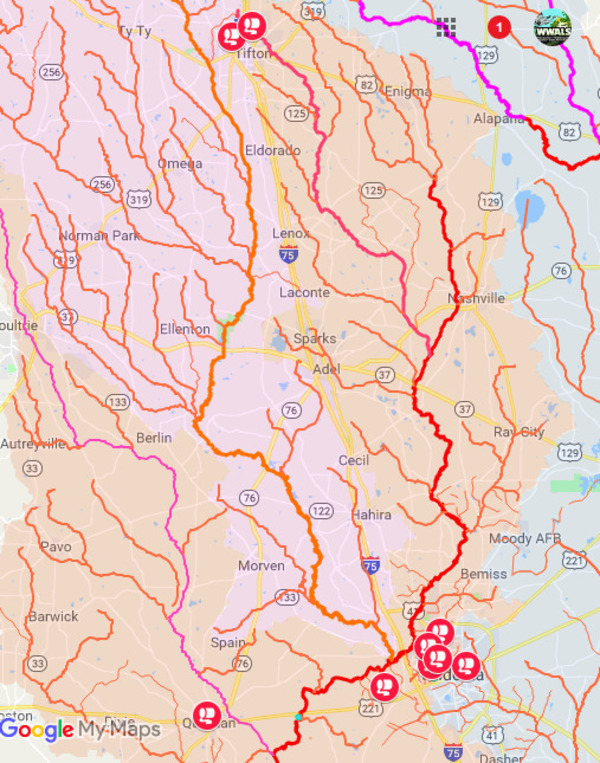
First let’s look at the city people in Florida ignore: Tifton, Georgia, the second largest city in the Suwannee River Basin (that’s right: in both Georgia and Florida). Tifton had Continue reading
The local TV station is keeping Lowndes County and Valdosta on their toes about sewage, while WWALS starts testing and continues urging GA-EPD to tell everybody when anybody spills.
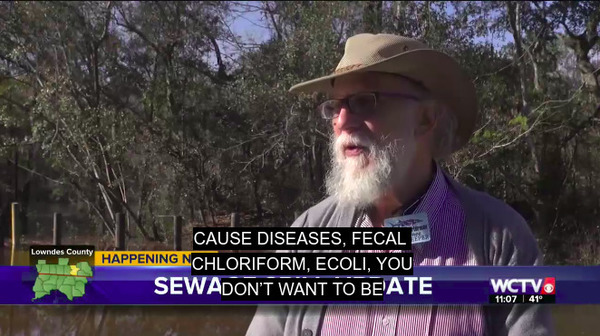
Emma Wheeler, WCTV, 6 December 2018, Heavy rain causes sewage spill in Lowndes County, Continue reading
Yesterday I left a message for Lowndes County Utilities asking if they had any spills. They never called back. But they did report to GA-EPD 35,000 gallons of raw sewage spilled from Madison Highway near exit 11. I hear they sent out a press release which said it was into Bevel Creek, which flows into the Withlacoochee River near the Georgia-Florida state line.
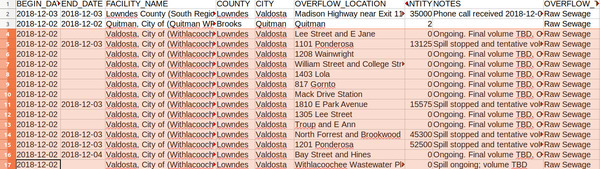
Quitman, Lowndes County, and Valdosta spills, December 2-3, 2018, as reported to GA-EPD Atlanta.
See also the raw data.
Just now I received this from Lowndes County:
Public Notice
December 4, 2017The Lowndes County Utility Department experienced a sanitary sewage spill on December 3, 2018 on Madison Highway at exit 11 near I-75. Untreated sewage entered into a drainage ditch that flows to Bevel Creek. It has been estimated that approximately 35,000 gallons of untreated sewage entered into the ditch during the event and the duration of the spill lasted approximately six hours. The spill was caused due to excessive rainfall. The County is monitoring this situation and is performing all reporting requirements as required by the Georgia Environmental Protection Division and the County’s NPDES Permit. Anyone having questions or comments may contact The Lowndes County Utilities Department at 229-671-2500.
Also, in addition to the WWTP spill Valdosta told the public about, they had 13 other spills, most, like that WWTP spill, still ongoing. Merely the total raw sewage spilled from the ones they have stopped totals 126,500 gallons.
These Suwannee River Basin spills from Quitman, Lowndes County, and Valdosta were not the only spills in this time period: Continue reading
When I shared their press release on facebook last night, the best thing I could think of to say was: at least Valdosta told us as it is happening.
But why, Valdosta, why? Seriously, you’re not prepared for rain?
After Hurricane Michael barely missed Valdosta?
After only two months ago Valdosta Utilities assured us all they were prepared?
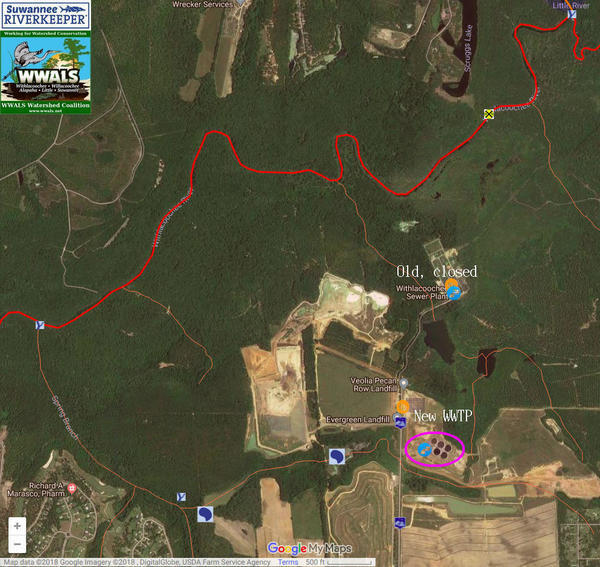
Map: WWALS, Withlacoochee and Little River Water Trail.
And in a rain that submerged US 84 near the Withlacoochee River Bridge and washed out Old Lake Park Road you’re telling us nothing washed from the WWTP down the creek that goes directly to the Withlacoochee River? Continue reading
Water quality is worse upstream of Valdosta’s Withlacoochee WTP and far downstream of its Mud Creek WTP, according to Valdosta’s most recent data, received last week in response to a Georgia Open Records Act (GORA) request from WWALS. This is the recent data I mentioned in the tour of Valdosta WTPs.
Does this data mean Valdosta is perfect and will never spill again? Nope. But it does mean there’s more than one source of fecal coliform and E. coli. We need to find those other sources, which is one reason WWALS is starting a water quality testing program.
Valdosta’s smaller WTP is in the Alapaha River Basin.
The WTP is the image left of top center, St. Augustine Road is the green diamond top left, Johnson Road is the grey diamond below and left of top center, and GA 135 Alapahoochee is the grey diamond bottom right.

100 and 10 are good readings for Fecal Coliform and E. coli, upstream of the Mud Creek WTP. Continue reading
Thanks to Valdosta Utilities Director Darryl Muse and staff for the Tour of Valdosta wastewater treatment plants Wednesday. Afterwards, I got them to sit down in a conference room and say again the most important points. They said what they had done to prevent future spills like the big ones this year.
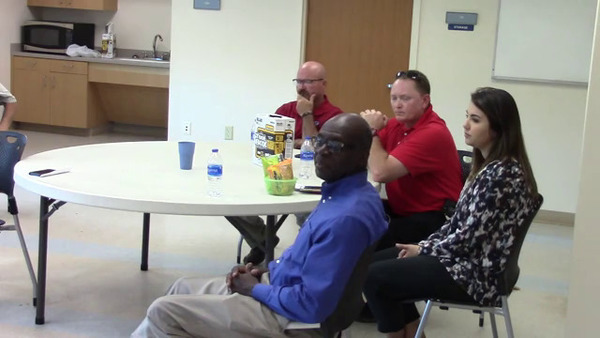
Counterclockwise from front: Utilities Director Darryl Muse, Public Information Officer Ashlyn Becton, Environmental Manager Scott Fowler, Mud Creek WTP Superintendent Mud Creek
Stanley K. Martin.
We also elicited Valdosta Utilities’ view on the letter establishing the Middle and Lower Suwannee River and Withlacoochee River Task Force, which was mainly Continue reading
Here is most of a year’s river water quality testing data from the city of Valdosta, on a Water Reporter map:
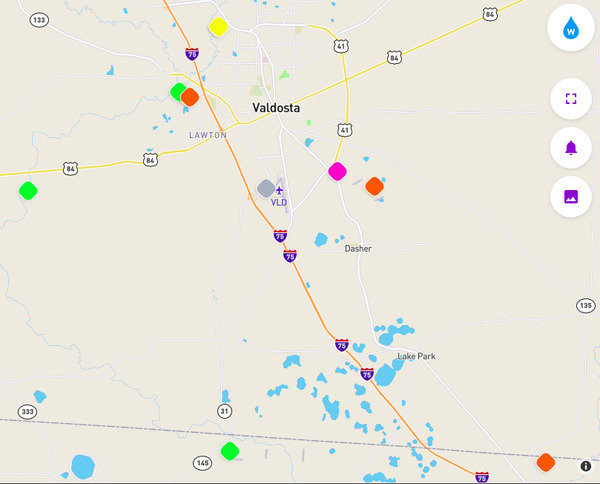
Click on any of the colored diamonds for graphs. Scroll right to see more graphs. Click on any graph to see every datapoint. Clearly fecal coliform (FCOLI) and E. coli (ECOLI) have significant spikes way beyond the Georgia state limit of 200 cfu/100 ml.
However, as we already saw on the spill followup data map, often, even usually, FCOLI and ECOLI are just as bad or worse upstream Continue reading