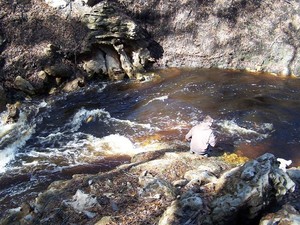
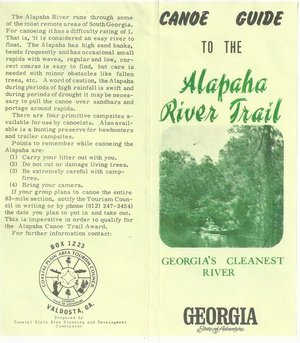
WWALS February outing scheduled for tomorrow the 22nd has been cancelled. It was planned to be on the Alapaha River. The launching point would have been from the HWY 84 bridge near Naylor to the landing point at Mayday bridge on Howell Rd. near Howell. It is an 11.1 mile section of the Alapaha with rapids and a small waterfall. We hope to enjoy this trip sometime in the future.
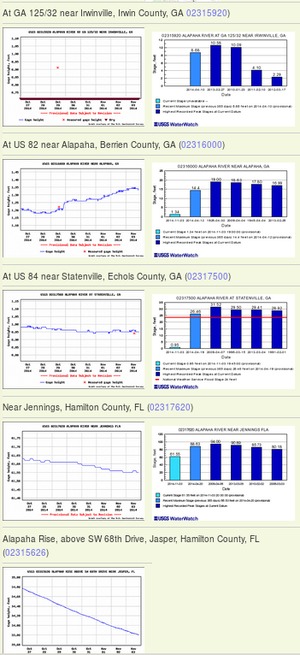
At this time, the water levels on the Alapaha River are rising. The level at the HWY 84 bridge is currently over 11′ with a fast moving current. Unfortunately, high water and fast currents are not safe for recreational canoeing and kayaking.
It would be great to see all WWALS members at our scheduled outing for next month! The Second Annual Big Little River Paddle Event scheduled for March 22nd at 9:30AM.
-CLG
Proposed for the WWALS January 2014 outing:
the river most people know nothing about,
from the convergence of Mud Swamp Creek where Grand Bay Creek forms the border
between Lowndes County and Echols County in Georgia east of Valdosta,
about 14 miles through Echols County between Lake Park and Statenville,
to the Alapaha River in Hamilton County, Florida east of Jennings:
the Alapahoochee River.
Echols / Hamilton county, GA SR 135 to FL SR 150 on Alapaha section
whitewater kayaking, rafting, and paddling information.
This stretch of Alapahoochee River Grand Bay Canal) in Echols /
Hamilton County is 4.5 miles long and is according to American
Whitewater a class II section of whitewater.
Written as a newspaper letter to the editor and posted here with permission. -jsq
Dear Residents
Did you know Lanier County doesn’t have zoning laws. Which that mean
they can development on wetlands and on our Floridan Aquifer
Recharge zone and build resident houses, subdivided, commercial
building etc., cut timber on wetlands, on our watersheds and a
Natural Gas Company want to put a pipeline through on these precious
lands they can. It will destroy the land environment like our
Floridan Aquifer Recharge zone (aka our drinking water) and our
wetlands and our watersheds. Because it not protected like it
should.
Well it time to protect it before it all destroy and gone.
It is up to our local government to protect these precious lands and
preserve it in the original state. Yes it’s time for our local
government to do there job to protect it. So it can be there
forever.
I notices they got those lands zone as Ag and V5 zone.
Which those zone doesn’t protect it and in fact it can destroy those
lands Eco system because they spray pesticide for there farm crops
near the Floridan Aquifer Recharge zone and wetlands, our
watersheds. It will Continue reading →
According to
their facebook page today,
a conservation group in Florida convinced Sabal Trail to steer clear
of their springs.
Or did they?
The “written assurances” they they got from Spectra’s Andrea Grover
say “preferred” and “currently”.
In any case, some of Ichetucknee Alliance’s positions are just as valid
in WWALS’ watersheds.
Maybe we need signs like that around here to remind
people that what goes into the ground comes out in our
drinking water.
For example,
San Antonio has its
Edwards Aquifer Protection Program.
Maybe our local governments need to have
Floridan Aquifer Protection Programs.
Georgia state law seems to indicate they should.
(1) Background. Variable levels of recharge area protection can be
based upon the State’s hydrogeology (e.g., areas such as the
Dougherty Plain where a major aquifer crops out would receive a
relatively high degree of protection whereas other areas, such as
the shale hills of northwest Georgia, would receive a lower degree
of protection). Recharge area protection within the significant
recharge areas would be further refined, based upon the local
susceptibility or vulnerability to human induced pollution (e.g.,
high, medium, or low). The significant recharge areas have already
been identified and mapped (about 22-23% of the State). Pollution
susceptibility mapping is ongoing. Existing statutes are adequate
for protecting the remaining recharge areas (about 77-78% of the
State).
[…]
(2)(f)3. In the Coastal Plain, the significant recharge areas are Continue reading →
Update 3 March 2016: Suwannee River, ten rivers, and current location of USGS streamer.
The USGS Streamer interactive map
shows all (well, most) tributaries
of our two biggest WWALS rivers.
Visitors sometimes refer to our “four rivers”
since we only originally named four in our
WWALS mission:
Withlacoochee, Willacoochee, Alapaha, and Little.
Yet we added the upper Suwannee, and there always were more than that:
from one to ten rivers, depending on how you count them.
The Withlacoochee River tributary map here shows
the New River south of Tifton joining the Withlacoochee between
Nashville and Adel.
The New River is rather important, since it forms half of the boundary between Cook
and Berrien Counties (the Withlacoochee River forms the other half): Continue reading →
Water issues strongly affect economic development, so I talked about
the new WWALS Watershed Coalition at the
16 April 2013 Board Meeting
of the Valdosta-Lowndes County Industrial Authority.
The VDT declined to speak, so I did.
After apologizing for no okra today,
I commended the Authority for talking about the missing agenda items
and for mentioning due diligence and flood control.
WWALS board meetings are every second Wednesday of the month,
usually at the IHOP in Adel because it’s centrally located.
WWALS is communicating with Valdosta and
various organizations about
flooding and other watershed-wide issues, which in my opinion
have to do with things like too much clearcutting without
consideration for where the water goes, too much development
without consideration for what the impervious surface would do,
(to my surprise, the Executive Director and several board
members nodded along with that)
so it was good to hear them mention flood containment.
Arsenic, Outings, and Flooding: WWALS Watershed Coalition
Regular Meeting, Valdosta-Lowndes County Industrial Authority (VLCIA),
Norman Bennett, Tom Call, Roy Copeland, Chairman, Mary Gooding, Jerry Jennett,
Andrea Schruijer, Executive Director, J. Stephen Gupton, Attorney, Tom Davis, CPA, Allan Ricketts, Project Manager,S. Meghan Duke, Public Relations & Marketing Manager, Lu Williams, Operations Manager,
Video by John S. Quarterman for Lowndes Area Knowledge Exchange (LAKE), Valdosta, Lowndes County, Georgia, 16 April 2013.