Tag Archives: Alapaha River

Small Valdosta sewer spills after big rains 2017-01-23

Update 2017-01-25: And also a spill at the WWTP.

Nobody likes sewer spills, but no, these are not the same as before Valdosta’s recent wastewater system improvements: Document-0001 nothing this time came from the Withlacoochee Wastewater Treatment Plant, and the amounts were small compared to previous years (10-62%) and in far fewer locations.

That didn’t stop WTXL from using this title: Amber Lewis, WTXL, 24 January 2017, Major Sewage Spill Reported in Valdosta,

The City of Valdosta has reported that a large amount of untreated sewage has spilled in the area.

The Florida Department of Health reports that Continue reading

WWALS becomes Suwannee RIVERKEEPER

Update 2023-03-31: Suwannee River Basin is bigger than several states, less populous than any: Suwannee Riverkeeper and WWALS work for fishable, swimmable, drinkable water in all 10,000 square miles of the Suwannee River Basin and Estuary.

FOR IMMEDIATE RELEASE

WWALS becomes Suwannee RIVERKEEPER®

Hahira, Georgia; December 30, 2016 — The Waterkeeper Alliance Board of Directors has approved its Affiliate WWALS Watershed Coalition, Inc. to become a Member. The newly appointed Suwannee RIVERKEEPER®, John S. Quarterman, will work to protect and preserve the Suwannee River Basin by combining his firsthand knowledge of the waterways with an unwavering commitment to the rights of the community and to the rule of law.

[Detail with creeks]
Suwannee River Basin and Estuary including Santa Fe River HUC, added 2019-09-26.

“Waterkeeper Alliance is thrilled to have Suwannee RIVERKEEPER® to be the eyes, ears, and voice for this vital watershed and community,” said Robert F. Kennedy, Jr., President of Waterkeeper Alliance. “Every community deserves to have swimmable, drinkable and fishable water, and John S. Quarterman is the right leader to fight for clean water in the region.”

The Suwannee RIVERKEEPER® will be a full-time advocate for the Suwannee River and its tributaries, including the Withlacoochee, Willacoochee, Alapaha, Little, and Suwannee Rivers in Georgia and Florida, protecting and restoring water quality through community action and enforcement. Quarterman stated, “Suwannee RIVERKEEPER®’s aim is to provide strong advocacy that will result in an improved quality of life for all citizens, whether they rely on it for drinking water or recreation or whether they simply value the Suwannee River Basin’s continued well-being.” Continue reading

WWALS receives grant for water conservation outreach to farmers and community

FOR IMMEDIATE RELEASE

WWALS receives grant for water conservation outreach to farmers and community (PDF)

Hahira, Georgia; December 27, 2016 — Local water conservation group WWALS Watershed Coalition (WWALS) has received a grant of Just enough water here, 31.0016918, -83.4573364 $6,000 from the Georgia Water Coalition (GWC) to help groups in towns, counties, and countryside to draw the big picture of watershed conservation, as well as to help organize at least one grant from a different source to assist at least one farmer in erosion control.

The award contract of November 11, 2016, says Continue reading

Less withdrawals, more water retention for North Florida Regional Water Supply Plan: WWALS PR 2016-12-06

FOR IMMEDIATE RELEASE

Jasper, Florida, November 6th 2016 — Better modeling and measurement of more water reuse and retention with fewer water withdrawals in both north Florida and south Georgia, WWALS Watershed Coalition (WWALS) recommended yesterday in comments (PDF) on the North Florida Regional Water Supply Plan (NFRWSP). WWALS also opposed the Falling Creek Aquifer Storage project and suggested a replacement, and recommended including threats to the FLoridan Aquifer and the Suwannee, Withlacoochee, and Alapaha Rivers such as pipelines and fracking.

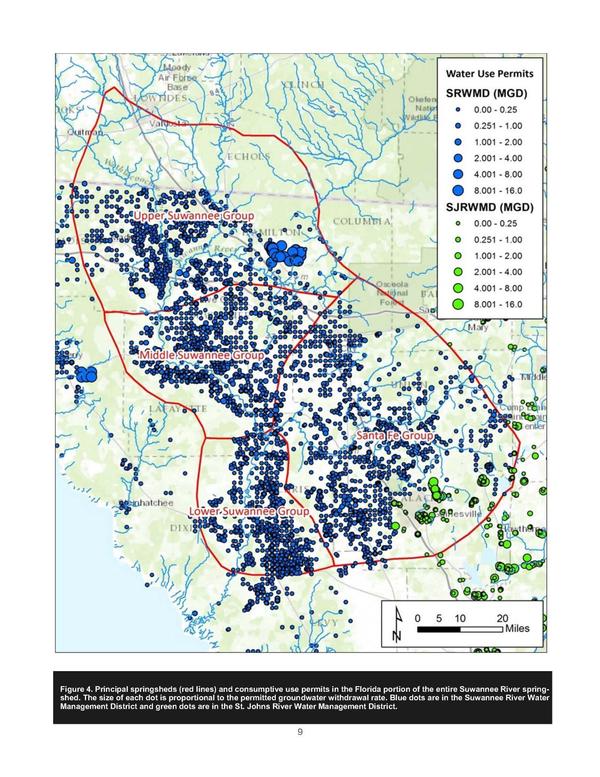
Figure C3: Aquifer surface change due to withdrawals in north Florida and south Georgia WWALS applauded water supply projects involving reuse or stormwater, especially those in Jacksonvile and Gainesville, two of the sources of the general problem of falling water levels in the Floridan Aquifer. WWALS also applauded the plan to set minimum flow levels on the upper Suwannee River and WWALS expects to be involved with that.

WWALS recommended expanding the original study area, which stopped at the Suwannee River on the west and the Georgia-Florida state line on the north. WWALS president John S. Quarterman explained,

“Our rivers don’t stop because there’s a state line on a map, and there are three second-magnitude springs on the Withlacoochee River in Georgia south of Valdosta, one of them with a more than 4,000-foot cave system, that aren’t taken into account in this draft plan.”

Quarterman elaborated on a much larger concern: Continue reading

Aerials: Dry Alapaha River and the Alapaha Rise 2016-11-23

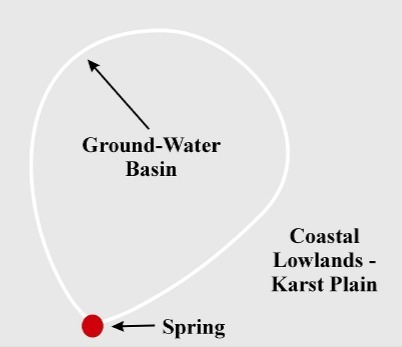
The Alapaha River is dry much of the year in most of its Florida run, because it goes underground upstream and comes back up in the Alapaha Rise, which is actually upstream on the Suwannee River from the Alapaha Confluence. The Cody Scarp causes this underground river phenomenon. See also the WWALS Alapaha River Water Trail.

CR 751 bridge, dry Alapaha River, 30.4485760, -83.0968860

CR 751 bridge, dry Alapaha River,

Alapaha River Confluence with Suwannee River, 30.4368660, -83.0982100

Continue reading

Videos, Valdosta Wastewater and Flood Prevention 2016-10-27

The crowd was very attentive to every word about wastewater and flood prevention, with officials from the City of Valdosta presenting in the first of a new quarterly WWALS speaker series. If you didn’t come, you can see and hear in these videos Henry Hicks about wastewater, Emily Davenport about flood prevention, Tim Carroll about solar power, and Sementha Mathews about how to get more information from Valdosta. WWALS Treasurer and acting Executive Director Gretchen Quarterman opened and closed the meeting.

Each talk had many small but important stories, so we will probably blog more posts about those. Meanwhile, here are the videos: see for yourself! Continue reading

Pictures: Alapaha and Dead River Sinks 2016-11-06

the Alapaha River sink, 30.5855189, -83.0528064 A very scenic hike to some of the most unusual geological features in all of Florida: the Alapaha River Sink and the Dead River Sink. We walked over beds of 50-million-year-old fossilized oysters, above all our drinking water in the Floridan Aquifer. See many pictures and a few videos of the sights, and a google map of the sites.

Practicing Geologist Dennis Price led us by the scenic route on this hike, explaining the karst geology on display, which underlies all of north Florida and south Georgia, containing our drinking water in the Floridan Aquifer. Dennis and hike organizer Chris Mericle recommend making this very unusual area a state park.

The Alapaha River goes underground here unless it has a lot of water, which usually this time of year and right now it does not.

[Don't fall into the Devil's Den, 30.5855189, -83.0528064]
Don’t fall into the Devil’s Den, 30.5855189, -83.0528064

Update 2022-11-17: The Jennings Gauge read 61.70′ NAVD88.

Until recently nobody knew for sure Continue reading

WWALS at Alapaha Station Celebration 2016-11-12

WWALS be talking about how Alapaha RIver Water Trail, which starts at Sheboggy Landing on US 82 just east of Alapaha, GA, at the Alapaha Station Celebration. This the third year for WWALS at this festival located in the upper middle section of our watershed near the Willacoochee and Alapaha Rivers.

When: 9AM-5PM Saturday November 12th 2016

Where: 245 NE Railroad St, Alapaha, GA 31622

Events: facebook, meetup.

Some people wonder: what’s the station? It’s Continue reading

Deserter Lake in Alapaha Wildlife Management Area

Update 2016-10-20: WMA check-in hunt does not count towards Georgia bag limit.

WWALS member Patrick Kunes took this video of Deserter Lake in Irwin County on the Alapaha River in the new Alapaha River Wildlife Management Area (WMA) on the Alapaha River betweeen Tifton and Ocilla. You can hear him talking about turkeys he saw, and you can see the lake on the river. He mentions deadfalls, which are a common feature on the upper Alapaha River. The river itself is not really boatable up that far much of the year, but lakes like this one often still have water. Many such lakes do not have public access, but Deserter Lake does now. This lake is upstream from the formal start of the Alapaha River Water Trail (ARWT), but we’ve included it in the online material about the ARWT because Deserter Lake is in the new Alapaha WMA.

Patrick wrote about this video: Continue reading