Tag Archives: Suwannee River

The NFRWSP’s job is to figure out how to increase water levels in the aquifer. –Dennis J. Price 2016-12-12

This is a letter Practicing Geologist Dennis J. Price wrote for publication.

December 12, 2016

RE: North Florida Regional Water Supply Partnership

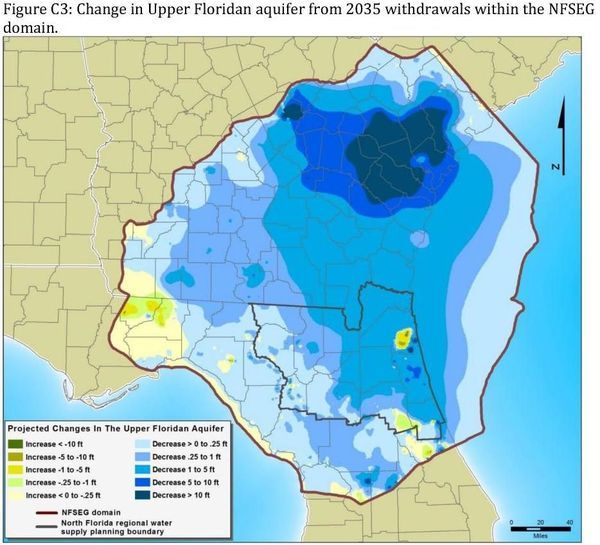
About 5 years ago, a report prepared for the Suwannee River Water Management District (SRWMD) indicated that under North Columbia County, East Hamilton County and Baker County, ground water levels in the Floridan aquifer (the aquifer the majority of us citizens get our water from) had dropped about 20 feet, more or less. The effects of the loss of that 20 feet was first felt and is very obvious in White Springs, 13 miles north of Lake City. The spring quit flowing for all intents and purposes. Tourism and the Towns economy plummeted.

[2019-04-03 White Sulfur Spring Flowing]
2019-04-03 White Sulfur Spring Flowing, so unusual an event it was reported for SRWMD by their Senior Hydrologist Fay Baird.

The report placed the greatest blame for the drawdown on water use by the coastal communities of South Georgia and North Florida. Scientists from the St. John’s River Water Management District (SJRWMD) at first concurred with this assessment. After objections from the Jacksonville Electric Authority (JEA) and the removal of several key employees at the SJRWMD, the SJRWMD said they weren’t sure anymore and a study needed to be done.

So, you guessed it, a committee was formed, The North Florida Regional Water Supply Partnership (NFRWSP). Don’t get me wrong regarding this committee, it is probably the single most important committee ever formed in our area. Their plans will affect the continued growth of North Florida communities along with the economy and recreational opportunities in our lakes and rivers.

Figure C3: Aquifer surface change due to withdrawals in north Florida and south Georgia

The NFRWSP’s job Continue reading

Letter: WWALS to FDEP and SRWMD: acquisitions, invitations, withdrawals, water quality testing 2020-11-10

Sent yesterday afternoon after the morning SRWMD board meeting.


November 10, 2020

To: Noah Valenstein
Secretary, FDEP
Noah.Valenstein@floridadep.gov

Hugh Thomas
Executive Director, SRWMD
Hugh.Thomas@srwmd.org

Sen. Keith Perry
Perry.Keith@flsenate.gov

Cc: Scott R. Koons
E.D., Rivers Task Force
koons@ncfrpc.org

Re: land acquisitions, event invitations, water withdrawals, and water quality testing

Dear Secretary Valenstein, Director Thomas, and Sen. Perry,

This morning I spoke via gotowebinar in the SRWMD Board Meeting. This letter expands on what I said.

[WWALS letter to FDEP and SRWMD]
WWALS letter to FDEP and SRWMD
PDF

I offered compliments, a suggestion, and a recommendation on the FDEP press release of yesterday: Continue reading

Trailmarker Tree Trails 2020-11-04

Second of a series of posts from Dr. Ken Sulak, USGS, retired. He is aware that Indian Trailmarker Trees are still speculative. Maybe with enough examples we can all determine whether they are what they seem to be. Please send pictures and locations of any trailmarker trees you may have seen, especially along old trails that crossed the Alapaha, Withlacoochee, Little, Suwannee, or Santa Fe Rivers, such as Old Coffee Road or various versions of El Camino Real.

[Old Trails]
Old Trails

Thanks for your reply. The trailmarker tree thing is an offshoot of my research on historic settler fords, ferries and bridges. Certainly early settlers traded with Seminoles and followed their trails. This Motte map is one of the few I have encountered that shows trails from GA coming into FL. There has also been more published on the ‘Alachua Trail’ figured in the next map. But that is of less interest to me because folks using that trail were primarily headed to the St. Johns River area—a distinct migration thing from the GA and SC folks headed for ‘Middle Florida’ where the best farm land and ample water was available.

I have been trying to confine my studies and field explorations to that area—but have inevitably gotten involved with what was happening in S GA. I have made several foot and solo kayak trips to the GA/FL border, and up into GA a bit now.

Many coming south from GA crossed into Spanish FL at Warners (Beauforts, Hornes) Ferry over the Withlacoochee, then headed south to Deadman’s Bay (Steinhatchee) to boil down salt water to make several barrels full of salt to take back to GA in wagons. This is one of the several ‘Old Salt Trails’ that later immigrant settlers used. All six of the so-far discovered trailmarker trees fall right on one of the dotted trails in this map

[1838 Motte Seminole War trail map]
Motte’s 1838 Seminole War map showing trails with dotted lines.

Warners Ferry or Horn’s Ferry was near where the current Horn Bridge is over the Withlacoochee River just upstream of State Line Boat Ramp and the GA-FL line.

I asked Ken a few questions, including: Continue reading

Horrid quality at GA 133 Friday, but good downstream and Saturday 2020-11-07

2020-11-13: Horrendous water quality at GA 133 & US 84 Wednesday, clean downstream 2020-11-12

Something bad got in the Withlacoochee River between US 41 and GA 133 on Friday: very bad, eleven times the Georgia Adopt-A-Stream alert limit for E. coli. But downstream water quality results by Valdosta Friday at US 84 and by WWALS down to the State Line show nothing unusual. Whatever it was maybe hadn’t gotten that far. Valdosta downstream results for Monday (today) and FDOH results for Tuesday may be interesting.

Once again, nothing at US 41 or GA 133 can be due to last Tuesday’s Tifton spill, because Tifton is on the Little River, and those places are on the Withlacoochee River upstream of the Little River Confluence.

So what caused those very bad GA 133 Valdosta results? It’s hard to avoid thinking somebody dumped into the river. When this phenomenon just started, rumor had it that GA-EPD had found the culprit, which was a private company. If so, there must be more than one, or whoever it was is back at it.

[Many locations]
Many locations

We also have Friday WWALS datapoints for Naylor Beach on the Alapaha River and for Royal Spring on the Suwannee River, both good. Continue reading

Twin Pines Minerals permit applications to GA-EPD

Here are four of the five active permit applications to GA-EPD from Twin Pines Minerals related to the proposed titanium mine far too close to the Okefenokee Swamp, which is the headwaters of the Suwannee and St. Marys Rivers, and interchanges water with the Floridan Aquifer, from which we all drink. Apparently there is also an air quality permit application. Since the Army Corps has abdicated oversight of this mine, you can ask the Georgia government to reject these permits.

[Page 2]
Page 2
Figure 75: Proposed Project Aquatic Feature Impact Areas Map –Twin Pines Minerals

Here is the relevant passage from GA-EPD’s responses to my open records request. I have interleaved links to where the files for each application are on the WWALS google drive.

Here is a summary of the permit applications in the GA EPD Watershed Protection Branch: Continue reading

Searching for Trailmarker Trees 2020-11-02

Here’s the first of a series of posts from Dr. Ken Sulak, USGS, retired, whom you may remember we’ve quoted before about sturgeon jumping in the Suwannee River. He’s got several new pursuits that entwine with Suwannee River Basin rivers, and he’s asking for your assistance. He is aware that Indian Trailmarker Trees are still speculative. Maybe with enough examples we can all determine whether they are what they seem to be.

WWALS riverrats –

While exploring old bridge and ferry sites along the Suwannee River and its tributaries, I have encountered five unmistakable Indian Trailmarker Trees (and Brack Barker has shown me a sixth). I won’t say I discovered these, because some human first shaped each, and thousands of Indians and early settlers used these manmade landmarks to navigate through South Georgia and Florida’s 27 million acres of seemingly endless and trackless primordial Longleaf Pine Forest. Sure, there were Indian trails that the settlers also followed, like the Alachua Trail and the Old Salt Road (plural). But that was not necessarily easy. No welcome to Florida signs back then, no road signs, no road maps, no GPS — although the sun and stars provided compass directions.

[Trailmarker Trees, How To, and old map]
Trailmarker Trees, How To, and old map

The noted naturalist Herbert Stoddard came to Florida with his family as a small boy in 1893. Florida became a US Territory in 1822, with settlers arriving in droves thereafter. But even as late as 1893, there were few real roads to follow. Stoddard recalls: “Came a long ride in a horse-drawn wagon over bumpy, one-track roads through the longleaf woods … They were crooked as snakes, for every time a pine tree fell across the road, Continue reading

Tifton spilled 2,000 gallons raw sewage 2020-11-03

Update 2020-11-06: Odd water quality upstream, Withlacoochee River 2020-11-04

Any amount is too much, but that 2,000 gallons Tuesday was probably not enough to affect Reed Bingham State Park Lake much, nor anything downstream from it. However, we don’t know, because nobody was testing on Willow Creek or the Little River above RBSP. Any spill is too much raw sewage into waterways.

[Golden Road Lift Station, Spill, RBSP, Little, Withlacoochee, Suwannee Rivers]
Golden Road Lift Station, Spill, RBSP, Little, Withlacoochee, Suwannee Rivers

Unlike some other cities recently, Tifton did timely report this spill, which appeared in GA-EPD’s Sewage Spills Report the day after it happened.

And this time was less than the 250,000 gallons on September 11, 2017 from the same Golden Road Lift Station. Continue reading

SRWMD Board immune to conflicts of interest; Lands Committee buying many parcels 2020-11-10

SRWMD Board members are immune to conflicts of interest if companies they have contracts with or are employed by companies that have cost-share agreements with the District. Such agreements include at least one dairy; I don’t know whether any SRWMD Board members are involved in that.

The Lands Committee is buying up many parcels, which is probably a good thing.

Also, apparently Charles Keith is Treasurer now, not Richard Schwab. While they still only have six of nine board members. Wasn’t a seventh one appointed by the governor?

[Conflict, Cost-Share, Land Purchases]
Conflict, Cost-Share, Land Purchases

There is nothing on the agenda about Nestlé or M-CORES, but that won’t stop anyone from talking about those things in Public Comments.

They meet 9AM Tuesday, 10 November, 2020. You can attend tomorrow morning’s meeting from anywhere. If you want to speak, you must sign up on the public comment form as well as for the webinar and the voice call-in number.

The Meeting will be conducted via GoTo Webinar for Presentations Only

GoTo Webinar Link: https://attendee.gotowebinar.com/register/2119912704840872974

Separate Call-In Number for Audio

Toll Free 1-888-585-9008 – Conference Room Number: 704-019-452 #

Public Comment Form Link: www.MySuwanneeRiver.com/Comments

The SRWMD Board and Lands Committee packets are on the WWALS website, along with images of each page. Continue reading

Waterkeepers Florida Against FDEP Assumption of Army Corps CWA 404 permitting 2020-11-02

Waterkeepers Florida, representing all fourteen Waterkeepers of Florida, wrote to U.S. EPA and FDEP yesterday objecting to FDEP’s plan to take over water permitting from the Army Corps of Engineers. FDEP hasn’t even kept up with the responsibilities it has, and is in no way prepared to take on a much heavier load. Suwannee Riverkeeper voted for this letter, which was also signed by many other organizations, including OSFR and Paddle Florida.

Please vote today for people who will support clean water.

[Opposition and Addendum Letters]
Opposition and Addendum Letters

The Florida Department of Environmental Protection (FDEP)’s list of waterways it plans to assume (see FDEP’s Appendix A) omits numerous navigable waterways previously listed by the U.S. Army Corps of Engineers. Checking all the Florida rivers that empty into the Gulf of Mexico, I found that most of them were included by FDEP, except not the Suwannee River or its tributaries (many creeks, Lake Santa Fe, and the Santa Fe, New, Ichetucknee, Alapaha, Alapahoochee, and Withlacoochee (north) Rivers), not the Withlacoochee (south) River nor its tributaries such as the Rainbow River, and not the Ochlockonee River nor its tributaries, such as Lake Talquin. I added 30 Suwannee River Basin waterways and 24 others to the Waterkeepers Florida list of missing waterways, which is the main subject of the Addendum letter (see PDF). The Addendum also contains copies of several letters previously sent to FDEP: an opposition letter similar to the one to EPA, a request for Public Hearings, and a request that online rulemaking hearings be discontinued until the pandemic allows holding them in person.

Opposition Letter

Here is a transcription of the letter to EPA. See also the PDF.

Don’t forget to vote for clean water. Continue reading

FDOT says it will look for toll road financial need after reports: you can vote! 2020-10-21

FDOT actually answered my complaint that there is no demonstrated need for the M-CORES toll roads, saying FDOT would be sure to do financial due diligence. After the “Final” Task Force reports go to the legislature.

Meanwhile, FDOT has spent how many millions of taxpayer dollars on the un-needed boondoggle? Despite NRTR demonstrating that 93% of comments FDOT received opposed the toll roads?

Nevermind their “deadlines,” you can still send comments to FDOT, and they will go into the public record, retrievable through open records requests.

And don’t forget to vote for people who will stop this toll roads boondoggle and instead do good things for natural Florida and its people. Votes are comments the state of Florida cannot ignore.

[Graph 93-percent-AGAINST 10 14 20-0001]
Graph 93-percent-AGAINST 10 14 20-0001
PDF

I didn’t get to comment on the Suncoast Corridor Task Force meeting, because they didn’t see my sign-up to comment using their procedures. I asked them about that, and got them to acknowledge I had signed up to comment in the Northern Turnpike Connector Task Force meeting the next day.

Here is what I sent FDOT immediately after speaking on October 21, 2020: Continue reading